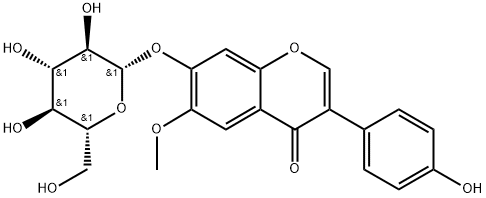
Physicochemical Properties
| Molecular Formula | C22H22O10 |
| Molecular Weight | 446.4 |
| Exact Mass | 446.121 |
| Elemental Analysis | C, 59.19; H, 4.97; O, 35.84 |
| CAS # | 40246-10-4 |
| PubChem CID | 187808 |
| Appearance | White to off-white solid powder |
| Density | 1.5±0.1 g/cm3 |
| Boiling Point | 751.1±60.0 °C at 760 mmHg |
| Melting Point | 210ºC |
| Flash Point | 264.1±26.4 °C |
| Vapour Pressure | 0.0±2.6 mmHg at 25°C |
| Index of Refraction | 1.675 |
| LogP | 0.16 |
| Hydrogen Bond Donor Count | 5 |
| Hydrogen Bond Acceptor Count | 10 |
| Rotatable Bond Count | 5 |
| Heavy Atom Count | 32 |
| Complexity | 690 |
| Defined Atom Stereocenter Count | 5 |
| SMILES | O1[C@]([H])([C@@]([H])([C@]([H])([C@@]([H])([C@@]1([H])C([H])([H])O[H])O[H])O[H])O[H])OC1C([H])=C2C(C(C(C3C([H])=C([H])C(=C([H])C=3[H])O[H])=C([H])O2)=O)=C([H])C=1OC([H])([H])[H] |
| InChi Key | OZBAVEKZGSOMOJ-MIUGBVLSSA-N |
| InChi Code | InChI=1S/C22H22O10/c1-29-15-6-12-14(30-9-13(18(12)25)10-2-4-11(24)5-3-10)7-16(15)31-22-21(28)20(27)19(26)17(8-23)32-22/h2-7,9,17,19-24,26-28H,8H2,1H3/t17-,19-,20+,21-,22-/m1/s1 |
| Chemical Name | 3-(4-hydroxyphenyl)-6-methoxy-7-(((2S,3R,4S,5S,6R)-3,4,5-trihydroxy-6-(hydroxymethyl)tetrahydro-2H-pyran-2-yl)oxy)-4H-chromen-4-one |
| Synonyms | Glycitein-7-beta-O-glucoside; Glycitin; ZX-AFC000687; ZXAFC000687; ZX AFC000687; HY-N0012; HYN0012; HY N0012 |
| HS Tariff Code | 2934.99.9001 |
| Storage |
Powder-20°C 3 years 4°C 2 years In solvent -80°C 6 months -20°C 1 month |
| Shipping Condition | Room temperature (This product is stable at ambient temperature for a few days during ordinary shipping and time spent in Customs) |
Biological Activity
| Targets | Natural isoflavone; flavonoids |
| ln Vitro | Daidzin (0.01-10 µM; 7 days) has the ability to stimulate cell division and BMSC osteoblast formation [1]. In BMSCs, daizenein (0, 0.5, 1 and 5 µM) stimulates the expression of the Col I and ALP genes. |
| ln Vivo | Daidzin (5–20 mg/kg; intraperitoneal injection; three times; once every eight hours)) inhibits TLR4-mediated NF-κB and MAPK activation, which helps safeguard the LPS-sensing pathway at the base of lung tissue [2]. |
| Enzyme Assay | The aim of the present study was to examine the effect of glycitin on the regulation of osteoblasts from bone marrow stem cells (BMSCs) through transforming growth factor (TGF)-β or protein kinase B (AKT) signaling pathways. BMSCs were extracted from New Zealand white rabbits and used to analyze the effect of glycitin on BMSCs. BMSCs were cleared using xylene and observed via light microscopy. BMSCs were subsequently induced with glycitin (0.01, 0.5, 1, 5 and 10 µM) for 7 days, and stained with Oil Red O. The mechanism of action of glycitin on BMSCs was investigated, in which contact with collagen type I (Col I), alkaline phosphatase (ALP), TGF-β and AKT was studied. Firstly, BMSCs appeared homogeneously mazarine blue, and which showed that BMSCs were successful extracted. Administration of glycitin increased cell proliferation and promoted osteoblast formation from BMSCs. Furthermore, glycitin activated the gene expression of Col I and ALP in BMSCs. Notably, glycitin suppressed protein expression of TGF-β and AKT in BMSCs. These results indicated that glycitin may regulate osteoblasts through TGF-β or AKT signaling pathways in BMSCs[1]. |
| Cell Assay |
Cell viability assay [1] Cell Types: bone marrow stem cells (BMSC) Tested Concentrations: 0.01, 0.5, 1, 5 and 10 µM Incubation Duration: 7 days The results can inhibit the protein expression of TGF-β and AKT in BMSC [1]. Experimental Results: Increase cell proliferation and promote BMSC osteoblast formation. |
| Animal Protocol |
Animal/Disease Models: BALB/c male mice (6-8 weeks old, weight 18-22 grams) treated with LPS [2] Doses: 5 mg/kg, 10 mg/kg and 20 mg/kg Route of Administration: intraperitoneal (ip) injection ; 3 times (once every 8 hrs (hrs (hours))) Experimental Results:Dramatically diminished lung damage caused by LPS. |
| References |
[1]. Glycitin regulates osteoblasts through TGF-β or AKT signaling pathways in bone marrow stem cells. Exp Ther Med. 2016 Nov;12(5):3063-3067. [2]. Glycitin alleviates lipopolysaccharide-induced acute lung injury via inhibiting NF-κB and MAPKs pathway activation in mice. Int Immunopharmacol. 2019 Oct:75:105749. |
| Additional Infomation |
Glycitin is a glycosyloxyisoflavone that is isoflavone substituted by a methoxy group at position 6, a hydroxy group at position 4' and a beta-D-glucopyranosyloxy group at position 7. It has a role as a plant metabolite. It is a methoxyisoflavone, a hydroxyisoflavone, a monosaccharide derivative and a 7-hydroxyisoflavones 7-O-beta-D-glucoside. Glycitin has been reported in Salvia hispanica, Glycine max, and other organisms with data available. |
Solubility Data
| Solubility (In Vitro) | DMSO : 89 ~100 mg/mL (199.37 ~224.01 mM) |
| Solubility (In Vivo) |
Solubility in Formulation 1: ≥ 2.5 mg/mL (5.60 mM) (saturation unknown) in 10% DMSO + 40% PEG300 + 5% Tween80 + 45% Saline (add these co-solvents sequentially from left to right, and one by one), clear solution. For example, if 1 mL of working solution is to be prepared, you can add 100 μL of 25.0 mg/mL clear DMSO stock solution to 400 μL PEG300 and mix evenly; then add 50 μL Tween-80 to the above solution and mix evenly; then add 450 μL normal saline to adjust the volume to 1 mL. Preparation of saline: Dissolve 0.9 g of sodium chloride in 100 mL ddH₂ O to obtain a clear solution. Solubility in Formulation 2: ≥ 2.5 mg/mL (5.60 mM) (saturation unknown) in 10% DMSO + 90% (20% SBE-β-CD in Saline) (add these co-solvents sequentially from left to right, and one by one), clear solution. For example, if 1 mL of working solution is to be prepared, you can add 100 μL of 25.0 mg/mL clear DMSO stock solution to 900 μL of 20% SBE-β-CD physiological saline solution and mix evenly. Preparation of 20% SBE-β-CD in Saline (4°C,1 week): Dissolve 2 g SBE-β-CD in 10 mL saline to obtain a clear solution. Solubility in Formulation 3: ≥ 2.5 mg/mL (5.60 mM) (saturation unknown) in 10% DMSO + 90% Corn Oil (add these co-solvents sequentially from left to right, and one by one), clear solution. For example, if 1 mL of working solution is to be prepared, you can add 100 μL of 25.0 mg/mL clear DMSO stock solution to 900 μL of corn oil and mix evenly. Solubility in Formulation 4: 10% DMSO+40% PEG300+5% Tween-80+45% Saline: ≥ 2.5 mg/mL (5.60 mM) (Please use freshly prepared in vivo formulations for optimal results.) |
| Preparing Stock Solutions | 1 mg | 5 mg | 10 mg | |
| 1 mM | 2.2401 mL | 11.2007 mL | 22.4014 mL | |
| 5 mM | 0.4480 mL | 2.2401 mL | 4.4803 mL | |
| 10 mM | 0.2240 mL | 1.1201 mL | 2.2401 mL |