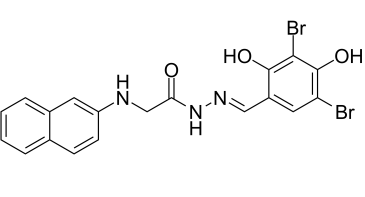
GlyH-101 is a novel and potent CFTR inhibitor (cystic fibrosis transmembrane conductance regulator) with Ki of 1.4 uM. GlyH-101 is a glycine hydrazide that has been shown to block CFTR channels. GlyH-101 blocked I(Cl.PKA) in a concentration- and voltage-dependent fashion (IC(50) at +100 mV=0.3 ± 1.5 μM and at -100 mV=5.1 ± 1.3 μM). GlyH-101 blocks the open pore of cardiac CFTR channels at an electrical distance of 0.15 ± 0.03 from the external membrane surface.
Physicochemical Properties
| Molecular Formula | C19H15BR2N3O3 |
| Molecular Weight | 493.1487 |
| Exact Mass | 490.947 |
| CAS # | 328541-79-3 |
| PubChem CID | 135476586 |
| Appearance | Light yellow to yellow solid powder |
| Density | 1.7±0.1 g/cm3 |
| Index of Refraction | 1.696 |
| LogP | 6.92 |
| Hydrogen Bond Donor Count | 4 |
| Hydrogen Bond Acceptor Count | 5 |
| Rotatable Bond Count | 5 |
| Heavy Atom Count | 27 |
| Complexity | 536 |
| Defined Atom Stereocenter Count | 0 |
| InChi Key | RMBDLOATEPYBSI-NUGSKGIGSA-N |
| InChi Code | InChI=1S/C19H15Br2N3O3/c20-15-8-13(18(26)17(21)19(15)27)9-23-24-16(25)10-22-14-6-5-11-3-1-2-4-12(11)7-14/h1-9,22,26-27H,10H2,(H,24,25)/b23-9+ |
| Synonyms | GlyH101 GlyH 101 GlyH-101. |
| HS Tariff Code | 2934.99.9001 |
| Storage |
Powder-20°C 3 years 4°C 2 years In solvent -80°C 6 months -20°C 1 month |
| Shipping Condition | Room temperature (This product is stable at ambient temperature for a few days during ordinary shipping and time spent in Customs) |
Biological Activity
| ln Vitro | In PCT and PS120 cells, GlyH-101 (0-50 µM) demonstrates anti-proliferative action [1]. PCT cells' CFTR-like currents are inhibited by GlyH-101 (0.5, 1, 5, 10 µM) in a concentration-dependent manner [1]. VSORC current is inhibited by GlyH-101 (0.5, 1, 5, 10 µM), having IC50 values of 5.38 and 6.26 µM for PS120 and PCT cells, respectively [1]. |
| ln Vivo | GlyH-101 (2.5 µg) decreases intestinal fluid secretion in mice caused by cholera toxin by about 80%[2]. |
| Cell Assay |
Cell Viability Assay[1] Cell Types: PCT, PS120 Cell Tested Concentrations: 0, 1, 5, 10, 20, 50 µM Incubation Duration: 24 hrs (hours) Experimental Results: Inhibition of cell growth in a dose-dependent manner. |
| References |
[1]. Discovery of glycine hydrazide pore-occluding CFTR inhibitors: mechanism, structure-activity analysis, and in vivo efficacy. J Gen Physiol. 2004 Aug;124(2):125-37. [2]. Cystic fibrosis transmembrane regulator inhibitors CFTR(inh)-172 and GlyH-101 target mitochondrial functions, independently of chloride channel inhibition. J Pharmacol Exp Ther. 2010 Apr;333(1):60-9. [3]. Cardiac ion channel current modulation by the CFTR inhibitor GlyH-101. Biochem Biophys Res Commun. 2011 Apr 29;408(1):12-7. [4]. Revisiting CFTR inhibition: a comparative study of CFTRinh -172 and GlyH-101 inhibitors. Br J Pharmacol. 2014 Aug;171(15):3716-27. [5]. Discovery of glycine hydrazide pore-occluding CFTR inhibitors: mechanism, structure-activity analysis, and in vivo efficacy. J Gen Physiol. 2004 Aug;124(2):125-37. |
| Additional Infomation | Glycine, n-2-naphthalenyl-, 2-[(3,5-dibromo-2,4-dihydroxyphenyl)methylene]hydrazide is a member of naphthalenes. |
Solubility Data
| Solubility (In Vitro) | DMSO : ≥ 58 mg/mL (~117.61 mM) |
| Solubility (In Vivo) |
Solubility in Formulation 1: ≥ 2.5 mg/mL (5.07 mM) (saturation unknown) in 10% DMSO + 40% PEG300 +5% Tween-80 + 45% Saline (add these co-solvents sequentially from left to right, and one by one), clear solution. For example, if 1 mL of working solution is to be prepared, you can add 100 μL of 25.0 mg/mL clear DMSO stock solution to 400 μL PEG300 and mix evenly; then add 50 μL Tween-80 + to the above solution and mix evenly; then add 450 μL normal saline to adjust the volume to 1 mL. Preparation of saline: Dissolve 0.9 g of sodium chloride in 100 mL ddH₂ O to obtain a clear solution. (Please use freshly prepared in vivo formulations for optimal results.) |
| Preparing Stock Solutions | 1 mg | 5 mg | 10 mg | |
| 1 mM | 2.0278 mL | 10.1389 mL | 20.2778 mL | |
| 5 mM | 0.4056 mL | 2.0278 mL | 4.0556 mL | |
| 10 mM | 0.2028 mL | 1.0139 mL | 2.0278 mL |