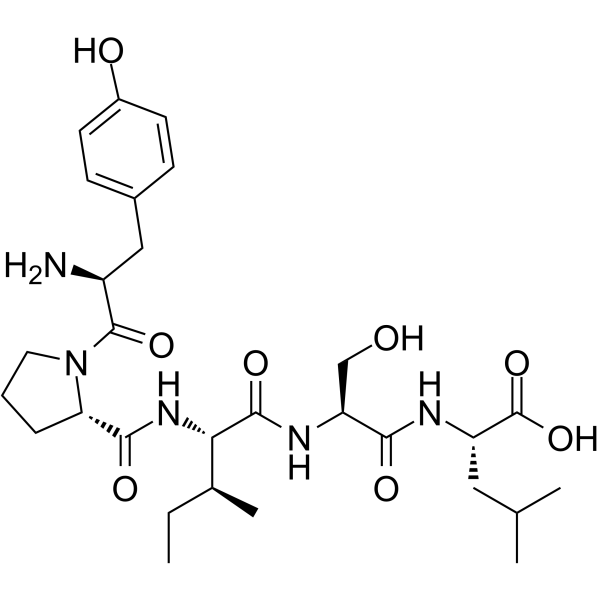
Physicochemical Properties
| Molecular Formula | C29H45N5O8 |
| Molecular Weight | 591.6963 |
| Exact Mass | 591.327 |
| CAS # | 142479-62-7 |
| PubChem CID | 25221466 |
| Appearance | White to off-white solid powder |
| LogP | 1.687 |
| Hydrogen Bond Donor Count | 7 |
| Hydrogen Bond Acceptor Count | 9 |
| Rotatable Bond Count | 15 |
| Heavy Atom Count | 42 |
| Complexity | 939 |
| Defined Atom Stereocenter Count | 6 |
| SMILES | CC[C@H](C)[C@@H](C(=O)N[C@@H](CO)C(=O)N[C@@H](CC(C)C)C(=O)O)NC(=O)[C@@H]1CCCN1C(=O)[C@H](CC2=CC=C(C=C2)O)N |
| InChi Key | QFRLEUJNZXTNTR-YYOLRRQBSA-N |
| InChi Code | InChI=1S/C29H45N5O8/c1-5-17(4)24(27(39)32-22(15-35)25(37)31-21(29(41)42)13-16(2)3)33-26(38)23-7-6-12-34(23)28(40)20(30)14-18-8-10-19(36)11-9-18/h8-11,16-17,20-24,35-36H,5-7,12-15,30H2,1-4H3,(H,31,37)(H,32,39)(H,33,38)(H,41,42)/t17-,20-,21-,22-,23-,24-/m0/s1 |
| Chemical Name | (2S)-2-[[(2S)-2-[[(2S,3S)-2-[[(2S)-1-[(2S)-2-amino-3-(4-hydroxyphenyl)propanoyl]pyrrolidine-2-carbonyl]amino]-3-methylpentanoyl]amino]-3-hydroxypropanoyl]amino]-4-methylpentanoic acid |
| HS Tariff Code | 2934.99.9001 |
| Storage |
Powder-20°C 3 years 4°C 2 years In solvent -80°C 6 months -20°C 1 month Note: Please store this product in a sealed and protected environment, avoid exposure to moisture. |
| Shipping Condition | Room temperature (This product is stable at ambient temperature for a few days during ordinary shipping and time spent in Customs) |
Biological Activity
| Targets | Gluten exorphin C exhibited opioid activity and acted as a ligand for opioid receptors. It showed rather δ-selectivity. The half-maximal inhibitory concentration (IC50) values in the guinea pig ileum (GPI, primarily μ-receptor mediated) and mouse vas deferens (MVD, primarily δ-receptor mediated) assays were 40 μM and 13.5 μM, respectively. In radioreceptor assays using [3H]DAGO (μ-receptor ligand) and [3H]DADLE (δ-receptor ligand), the IC50 values were 110 μM and 30 μM, respectively, yielding a μ/δ selectivity ratio of 3.7 [1]. |
| ln Vitro |
Gluten exorphin C is a new opioid peptide isolated from wheat gluten digested with pepsin, trypsin, and chymotrypsin. GPI and MVD assays were used to evaluate gluten exorphin C's opioid action, whereas radioreceptor assays were used to determine its receptor affinity. The IC50 for GPI and MVD tests was 40 μM and 13.5 μM, respectively. Gluten exorphin C differs significantly from any previously known endogenous or exogenous opioid peptides in that the N-terminal Tyr is the only aromatic amino acid. Analogues of Tyr-Pro-X-Ser-Leu were synthesized and their structure-activity connections investigated. Peptides containing an aromatic amino acid or an aliphatic hydrophobic amino acid exhibit opioid action [1]. The opioid activity of gluten exorphin C was evaluated using isolated tissue preparations. In the guinea pig ileum (GPI) assay, the peptide inhibited electrically induced contractions with an IC50 of 40 μM. In the mouse vas deferens (MVD) assay, it inhibited contractions with an IC50 of 13.5 μM, indicating higher potency at δ-receptors. The inhibitory effects were reversible by naloxone, confirming opioid receptor-mediated activity [1]. Radioreceptor binding assays were performed using rat brain membranes. Gluten exorphin C displaced the binding of the μ-selective ligand [3H]DAGO with an IC50 of 110 μM and the δ-selective ligand [3H]DADLE with an IC50 of 30 μM, confirming its affinity for opioid receptors and a preference for the δ-subtype [1]. |
| Enzyme Assay |
The enzymatic digestion protocol for generating gluten exorphin C from wheat gluten is described. Wheat gluten was first digested with pepsin in 0.02 N HCl (pH 2.0) at 36°C for 17 hours. The pH was then adjusted to 7.0, the solution was boiled and centrifuged, and the supernatant was lyophilized. This peptic digest was further hydrolyzed with a combination of trypsin and chymotrypsin in distilled water at 36°C for 5 hours, followed by boiling and centrifugation to obtain the final digest containing the opioid peptides [1]. Opioid activity assays were conducted using isolated tissue preparations. For the guinea pig ileum (GPI) assay, a segment of ileum was suspended in an organ bath containing physiological solution aerated with a gas mixture. Electrical field stimulation was applied, and the inhibitory effect of test samples on the twitch response was measured. For the mouse vas deferens (MVD) assay, a similar setup was used with the vas deferens tissue. The concentration causing 50% inhibition (IC50) of the twitch response was determined for each sample [1]. Radioreceptor assays were performed to evaluate receptor affinity. Rat brain membranes were incubated with a radiolabeled opioid ligand (either [3H]DAGO for μ-receptors or [3H]DADLE for δ-receptors) in the presence or absence of the test peptide. After incubation, bound and free radioactivity were separated by filtration, and the amount of bound radioligand was measured. The concentration of peptide inhibiting 50% of specific radioligand binding (IC50) was calculated [1]. |
| References |
[1]. Gluten exorphin C. A novel opioid peptide derived from wheat gluten. FEBS Lett. 1993 Jan 18;316(1):17-9. |
| Additional Infomation |
Gluten exorphin C is an oligopeptide. Gluten exorphin C (Tyr-Pro-Ile-Ser-Leu) is a novel opioid peptide isolated from a pepsin-trypsin-chymotrypsin digest of wheat gluten. It is structurally unique among known opioid peptides because its N-terminal tyrosine is the only aromatic amino acid in the sequence, whereas other endogenous and exogenous opioid peptides typically contain a second aromatic residue (Phe or Trp) at position 3 or 4. This peptide is released by the action of gastrointestinal proteases, suggesting it could be formed in the digestive tract after wheat gluten ingestion [1]. Structure-activity relationship studies with analogs (Tyr-Pro-X-Ser-Leu) showed that opioid activity is retained when position X is occupied by an aliphatic hydrophobic amino acid (e.g., norvaline, norleucine) or an aromatic amino acid (Phe, Trp). Substitution with basic (Lys) or hydrophilic (Ala, Thr) amino acids abolished activity. This indicates that hydrophobicity at the third residue is crucial for activity, and a second aromatic amino acid is not essential for opioid peptides containing the Tyr-Pro sequence [1]. It is suggested that gluten exorphin C, formed during digestion, might be involved in the physiological effects (e.g., modulation of gastrointestinal motility and hormone release) previously observed upon oral administration of wheat gluten peptic digest, as some of those effects were naloxone-reversible [1]. |
Solubility Data
| Solubility (In Vitro) | H2O : ~100 mg/mL (~169.00 mM) |
| Solubility (In Vivo) |
Solubility in Formulation 1: 50 mg/mL (84.50 mM) in PBS (add these co-solvents sequentially from left to right, and one by one), clear solution; with sonication. (Please use freshly prepared in vivo formulations for optimal results.) |
| Preparing Stock Solutions | 1 mg | 5 mg | 10 mg | |
| 1 mM | 1.6900 mL | 8.4502 mL | 16.9005 mL | |
| 5 mM | 0.3380 mL | 1.6900 mL | 3.3801 mL | |
| 10 mM | 0.1690 mL | 0.8450 mL | 1.6900 mL |