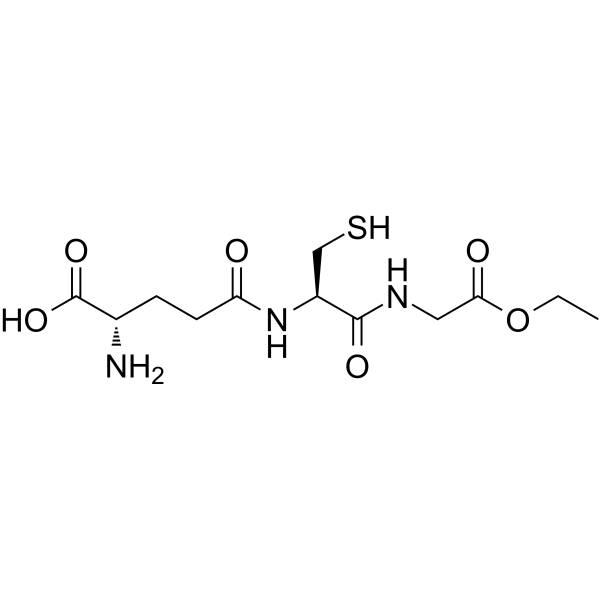
Physicochemical Properties
| Molecular Formula | C12H21N3O6S |
| Molecular Weight | 335.38 |
| Exact Mass | 335.115 |
| Elemental Analysis | C, 42.98; H, 6.31; N, 12.53; O, 28.62; S, 9.56 |
| CAS # | 92614-59-0 |
| PubChem CID | 147253 |
| Appearance | Typically exists as white to off-white solids at room temperature |
| Density | 1.3±0.1 g/cm3 |
| Boiling Point | 644.3±55.0 °C at 760 mmHg |
| Flash Point | 343.5±31.5 °C |
| Vapour Pressure | 0.0±4.1 mmHg at 25°C |
| Index of Refraction | 1.536 |
| LogP | -3.8 |
| Hydrogen Bond Donor Count | 5 |
| Hydrogen Bond Acceptor Count | 8 |
| Rotatable Bond Count | 11 |
| Heavy Atom Count | 22 |
| Complexity | 418 |
| Defined Atom Stereocenter Count | 2 |
| SMILES | [C@@H](CS)(NC(=O)CC[C@H](N)C(=O)O)C(=O)NCC(=O)OCC |
| InChi Key | JKRODHBGNBKZLE-YUMQZZPRSA-N |
| InChi Code | InChI=1S/C12H21N3O6S/c1-2-21-10(17)5-14-11(18)8(6-22)15-9(16)4-3-7(13)12(19)20/h7-8,22H,2-6,13H2,1H3,(H,14,18)(H,15,16)(H,19,20)/t7-,8-/m0/s1 |
| Chemical Name | N5-((R)-1-((2-ethoxy-2-oxoethyl)amino)-3-mercapto-1-oxopropan-2-yl)-L-glutamine |
| HS Tariff Code | 2934.99.9001 |
| Storage |
Powder-20°C 3 years 4°C 2 years In solvent -80°C 6 months -20°C 1 month Note: This product requires protection from light (avoid light exposure) during transportation and storage. |
| Shipping Condition | Room temperature (This product is stable at ambient temperature for a few days during ordinary shipping and time spent in Customs) |
Biological Activity
| Targets | GSH |
| ln Vitro | The aberrant redox regulation and anti-oxidative defense is one of the main causes of age-induced decline in oocytes quality and embryo development in mammals. The present study aimed to elucidate the effect of glutathione ethyl ester (GSH-OEt), a cell-permeable glutathione (GSH) donor, on the developmental competence of oocytes in cows with advanced reproductive age. Oocytes were collected from cows aged 30-50 months or >120 months, which were defined as young or aged, respectively, and subjected to in vitro maturation (IVM) in the presence of 5 mM of GSH-OEt. In aged cows, the GSH level in follicular fluid was lower, and the intracellular levels of reactive oxygen species (ROS) in post-IVM oocytes was higher than those in young cows. GSH-OEt supplementation during IVM reduced the ROS contents of oocyte in aged cows but not in young cows. GSH-OEt treatment promoted the meiotic progression and increased the proportion of oocytes with mature cytoplasm containing evenly dispersed cortical granules in aged cows. After in vitro fertilization, the normal fertilization and development to the blastocyst stage were enhanced by GSH-OEt in aged cows to levels comparable to those in young cows. Further, oocyte maturation in the presence of GSH-OEt increased the proportion of diploid blastocyst in aged cows. In contrast, GSH-OEt failed to enhance the oocyte maturation, fertilization, and embryo development in young cows. Taken together, the exogenous supplementation of GSH-OEt during IVM modulated the age-related oxidative damage of bovine oocytes and improved the developmental competence of oocytes in aged cows. Oocytes presented a distinct response to GSH-OEt treatment depending on the donor age. GSH-OEt supplementation during IVM could be of practical value through the efficiency improvement of chromosomally normal embryo production in aged cows. |
| References |
[1]. Glutathione ethyl ester improved the age-induced decline in the developmental competence of bovine oocytes. Theriogenology. 2021 Jun:167:37-43. |
| Additional Infomation | Radiation-Protective Agents Drugs used to protect against ionizing radiation. They are usually of interest for use in radiation therapy but have been considered for other purposes, e.g. military. |
Solubility Data
| Solubility (In Vitro) | DMSO: 125 mg/mL (372.71 mM) |
| Solubility (In Vivo) |
Note: Listed below are some common formulations that may be used to formulate products with low water solubility (e.g. < 1 mg/mL), you may test these formulations using a minute amount of products to avoid loss of samples. Injection Formulations (e.g. IP/IV/IM/SC) Injection Formulation 1: DMSO : Tween 80: Saline = 10 : 5 : 85 (i.e. 100 μL DMSO stock solution → 50 μL Tween 80 → 850 μL Saline) *Preparation of saline: Dissolve 0.9 g of sodium chloride in 100 mL ddH ₂ O to obtain a clear solution. Injection Formulation 2: DMSO : PEG300 :Tween 80 : Saline = 10 : 40 : 5 : 45 (i.e. 100 μL DMSO → 400 μLPEG300 → 50 μL Tween 80 → 450 μL Saline) Injection Formulation 3: DMSO : Corn oil = 10 : 90 (i.e. 100 μL DMSO → 900 μL Corn oil) Example: Take the Injection Formulation 3 (DMSO : Corn oil = 10 : 90) as an example, if 1 mL of 2.5 mg/mL working solution is to be prepared, you can take 100 μL 25 mg/mL DMSO stock solution and add to 900 μL corn oil, mix well to obtain a clear or suspension solution (2.5 mg/mL, ready for use in animals). Injection Formulation 4: DMSO : 20% SBE-β-CD in saline = 10 : 90 [i.e. 100 μL DMSO → 900 μL (20% SBE-β-CD in saline)] *Preparation of 20% SBE-β-CD in Saline (4°C,1 week): Dissolve 2 g SBE-β-CD in 10 mL saline to obtain a clear solution. Injection Formulation 5: 2-Hydroxypropyl-β-cyclodextrin : Saline = 50 : 50 (i.e. 500 μL 2-Hydroxypropyl-β-cyclodextrin → 500 μL Saline) Injection Formulation 6: DMSO : PEG300 : castor oil : Saline = 5 : 10 : 20 : 65 (i.e. 50 μL DMSO → 100 μLPEG300 → 200 μL castor oil → 650 μL Saline) Injection Formulation 7: Ethanol : Cremophor : Saline = 10: 10 : 80 (i.e. 100 μL Ethanol → 100 μL Cremophor → 800 μL Saline) Injection Formulation 8: Dissolve in Cremophor/Ethanol (50 : 50), then diluted by Saline Injection Formulation 9: EtOH : Corn oil = 10 : 90 (i.e. 100 μL EtOH → 900 μL Corn oil) Injection Formulation 10: EtOH : PEG300:Tween 80 : Saline = 10 : 40 : 5 : 45 (i.e. 100 μL EtOH → 400 μLPEG300 → 50 μL Tween 80 → 450 μL Saline) Oral Formulations Oral Formulation 1: Suspend in 0.5% CMC Na (carboxymethylcellulose sodium) Oral Formulation 2: Suspend in 0.5% Carboxymethyl cellulose Example: Take the Oral Formulation 1 (Suspend in 0.5% CMC Na) as an example, if 100 mL of 2.5 mg/mL working solution is to be prepared, you can first prepare 0.5% CMC Na solution by measuring 0.5 g CMC Na and dissolve it in 100 mL ddH2O to obtain a clear solution; then add 250 mg of the product to 100 mL 0.5% CMC Na solution, to make the suspension solution (2.5 mg/mL, ready for use in animals). Oral Formulation 3: Dissolved in PEG400 Oral Formulation 4: Suspend in 0.2% Carboxymethyl cellulose Oral Formulation 5: Dissolve in 0.25% Tween 80 and 0.5% Carboxymethyl cellulose Oral Formulation 6: Mixing with food powders Note: Please be aware that the above formulations are for reference only. InvivoChem strongly recommends customers to read literature methods/protocols carefully before determining which formulation you should use for in vivo studies, as different compounds have different solubility properties and have to be formulated differently. (Please use freshly prepared in vivo formulations for optimal results.) |
| Preparing Stock Solutions | 1 mg | 5 mg | 10 mg | |
| 1 mM | 2.9817 mL | 14.9085 mL | 29.8169 mL | |
| 5 mM | 0.5963 mL | 2.9817 mL | 5.9634 mL | |
| 10 mM | 0.2982 mL | 1.4908 mL | 2.9817 mL |