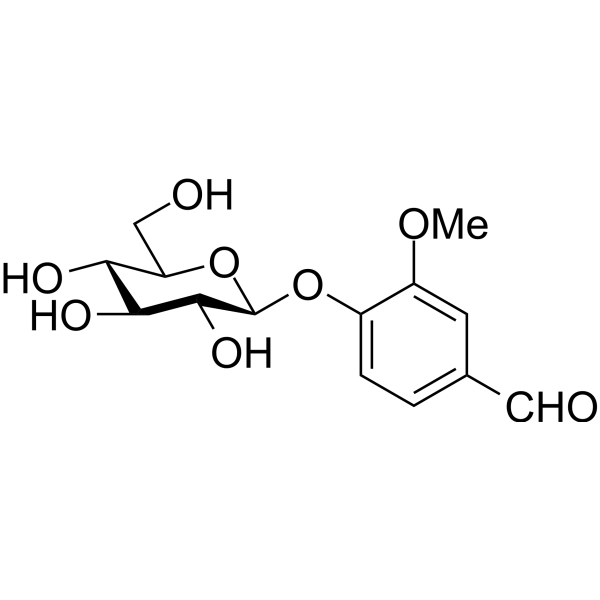
Physicochemical Properties
| Molecular Formula | C14H18O8 |
| Molecular Weight | 314.2879 |
| Exact Mass | 314.1 |
| CAS # | 494-08-6 |
| PubChem CID | 6452133 |
| Appearance | White to light yellow solid powder |
| Density | 1.481g/cm3 |
| Boiling Point | 574.7ºC at 760 mmHg |
| Flash Point | 216.6ºC |
| Vapour Pressure | 4.75E-14mmHg at 25°C |
| Index of Refraction | 1.628 |
| LogP | -1.6 |
| Hydrogen Bond Donor Count | 4 |
| Hydrogen Bond Acceptor Count | 8 |
| Rotatable Bond Count | 5 |
| Heavy Atom Count | 22 |
| Complexity | 365 |
| Defined Atom Stereocenter Count | 5 |
| SMILES | COC1=C(C=CC(=C1)C=O)O[C@H]2[C@@H]([C@H]([C@@H]([C@H](O2)CO)O)O)O |
| InChi Key | LPRNQMUKVDHCFX-RKQHYHRCSA-N |
| InChi Code | InChI=1S/C14H18O8/c1-20-9-4-7(5-15)2-3-8(9)21-14-13(19)12(18)11(17)10(6-16)22-14/h2-5,10-14,16-19H,6H2,1H3/t10-,11-,12+,13-,14-/m1/s1 |
| Chemical Name | 3-methoxy-4-[(2S,3R,4S,5S,6R)-3,4,5-trihydroxy-6-(hydroxymethyl)oxan-2-yl]oxybenzaldehyde |
| HS Tariff Code | 2934.99.9001 |
| Storage |
Powder-20°C 3 years 4°C 2 years In solvent -80°C 6 months -20°C 1 month Note: This product requires protection from light (avoid light exposure) during transportation and storage. |
| Shipping Condition | Room temperature (This product is stable at ambient temperature for a few days during ordinary shipping and time spent in Customs) |
Biological Activity
| ln Vitro |
- Glucovanillin was hydrolyzed by β-glucosidases produced by colonizing Bacillus isolates (Bacillus subtilis, Bacillus amyloliquefaciens, Bacillus licheniformis) from Vanilla planifolia pods during curing. In vitro culture experiments showed that B. subtilis exhibited the highest hydrolysis efficiency: when incubated with 10 mM Glucovanillin at 30°C for 48 h, the hydrolysis rate reached ~85%, producing 8.5 mM vanillin (the main flavor compound of vanilla). B. amyloliquefaciens and B. licheniformis showed hydrolysis rates of ~65% and ~55%, respectively, under the same conditions [1] - The hydrolysis of Glucovanillin was dependent on bacterial β-glucosidase activity. When the culture supernatant of B. subtilis was treated with a β-glucosidase inhibitor (1 mM glucose), the hydrolysis rate of Glucovanillin decreased by ~70%, confirming that β-glucosidase is the key enzyme mediating the reaction [1] |
| Enzyme Assay |
- For β-glucosidase activity assay using Glucovanillin as substrate: β-glucosidase was purified from the culture supernatant of B. subtilis. The reaction mixture contained 50 mM sodium acetate buffer (pH 5.5), 5 mM Glucovanillin, and 0.1 mg/mL purified β-glucosidase, with a total volume of 0.5 mL. The mixture was incubated at 35°C for 1 h, and the reaction was terminated by boiling for 5 minutes. The amount of vanillin produced (product of Glucovanillin hydrolysis) was measured by high-performance liquid chromatography (HPLC) using a C18 column. The mobile phase was methanol-water (30:70, v/v) at a flow rate of 1.0 mL/min, and detection was performed at 280 nm. β-glucosidase activity was calculated as micromoles of vanillin produced per minute per milligram of enzyme (μmol/min/mg) [1] - For Glucovanillin hydrolysis by Bacillus isolates: Single Bacillus colonies were inoculated into LB medium supplemented with 10 mM Glucovanillin, and cultured at 30°C with shaking (180 rpm). Samples were taken at 12 h, 24 h, 36 h, and 48 h. After centrifugation (12,000 × g for 10 minutes), the supernatant was filtered through a 0.22 μm membrane and analyzed by HPLC to determine the residual Glucovanillin concentration and vanillin production. The hydrolysis rate was calculated as [(initial Glucovanillin concentration - residual Glucovanillin concentration) / initial Glucovanillin concentration] × 100% [1] |
| References |
[1]. Involvement of Colonizing Bacillus Isolates in Glucovanillin Hydrolysis during the Curing of Vanilla planifolia Andrews. Appl Environ Microbiol. 2015 Aug;81(15):4947-54. |
| Additional Infomation |
Glucovanillin is a glycoside. Glucovanillin has been reported in Ruellia patula, Scutellaria albida, and other organisms with data available. See also: Elymus repens root (part of). - Glucovanillin (vanillin β-D-glucoside) is a major glycosidic precursor of vanillin (the characteristic flavor compound of Vanilla planifolia) and is naturally present in the green pods of V. planifolia. It is inert in terms of flavor and needs to be hydrolyzed to release free vanillin during the curing process [1] - The hydrolysis of Glucovanillin by colonizing Bacillus isolates is a key step in vanilla curing: these bacteria colonize the pod surface during curing, secrete β-glucosidases, and convert Glucovanillin to vanillin, which determines the flavor quality and vanillin yield of cured vanilla pods [1] - Glucovanillin is stable under acidic conditions (pH 3.0–5.0) but is easily hydrolyzed by microbial β-glucosidases at neutral to slightly acidic pH (pH 5.0–7.0), which is consistent with the pH range of vanilla pods during curing (pH 5.5–6.5) [1] |
Solubility Data
| Solubility (In Vitro) | DMSO : ~100 mg/mL (~318.18 mM) |
| Solubility (In Vivo) |
Solubility in Formulation 1: ≥ 2.5 mg/mL (7.95 mM) (saturation unknown) in 10% DMSO + 40% PEG300 + 5% Tween80 + 45% Saline (add these co-solvents sequentially from left to right, and one by one), clear solution. For example, if 1 mL of working solution is to be prepared, you can add 100 μL of 25.0 mg/mL clear DMSO stock solution to 400 μL PEG300 and mix evenly; then add 50 μL Tween-80 to the above solution and mix evenly; then add 450 μL normal saline to adjust the volume to 1 mL. Preparation of saline: Dissolve 0.9 g of sodium chloride in 100 mL ddH₂ O to obtain a clear solution. Solubility in Formulation 2: ≥ 2.5 mg/mL (7.95 mM) (saturation unknown) in 10% DMSO + 90% (20% SBE-β-CD in Saline) (add these co-solvents sequentially from left to right, and one by one), clear solution. For example, if 1 mL of working solution is to be prepared, you can add 100 μL of 25.0 mg/mL clear DMSO stock solution to 900 μL of 20% SBE-β-CD physiological saline solution and mix evenly. Preparation of 20% SBE-β-CD in Saline (4°C,1 week): Dissolve 2 g SBE-β-CD in 10 mL saline to obtain a clear solution. Solubility in Formulation 3: ≥ 2.5 mg/mL (7.95 mM) (saturation unknown) in 10% DMSO + 90% Corn Oil (add these co-solvents sequentially from left to right, and one by one), clear solution. For example, if 1 mL of working solution is to be prepared, you can add 100 μL of 25.0 mg/mL clear DMSO stock solution to 900 μL of corn oil and mix evenly. (Please use freshly prepared in vivo formulations for optimal results.) |
| Preparing Stock Solutions | 1 mg | 5 mg | 10 mg | |
| 1 mM | 3.1818 mL | 15.9089 mL | 31.8177 mL | |
| 5 mM | 0.6364 mL | 3.1818 mL | 6.3635 mL | |
| 10 mM | 0.3182 mL | 1.5909 mL | 3.1818 mL |