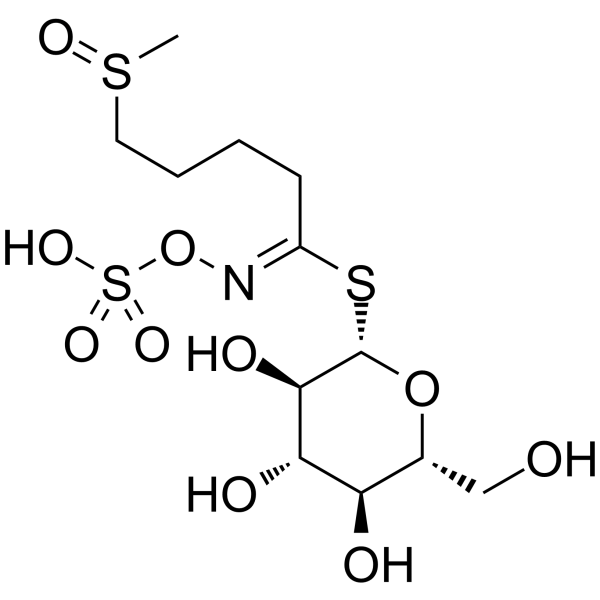
Physicochemical Properties
| Molecular Formula | C12H23NO10S3 |
| Molecular Weight | 437.5067 |
| Exact Mass | 436.041 |
| CAS # | 21414-41-5 |
| PubChem CID | 9548634 |
| Appearance | White to light yellow solid powder |
| LogP | -0.53 |
| Hydrogen Bond Donor Count | 5 |
| Hydrogen Bond Acceptor Count | 13 |
| Rotatable Bond Count | 10 |
| Heavy Atom Count | 26 |
| Complexity | 593 |
| Defined Atom Stereocenter Count | 5 |
| SMILES | CS(=O)CCCC/C(=N\OS(=O)(=O)O)/S[C@H]1[C@@H]([C@H]([C@@H]([C@H](O1)CO)O)O)O |
| InChi Key | GMMLNKINDDUDCF-RFOBZYEESA-N |
| InChi Code | InChI=1S/C12H23NO10S3/c1-25(18)5-3-2-4-8(13-23-26(19,20)21)24-12-11(17)10(16)9(15)7(6-14)22-12/h7,9-12,14-17H,2-6H2,1H3,(H,19,20,21)/b13-8+/t7-,9-,10+,11-,12+,25?/m1/s1 |
| Chemical Name | [(2S,3R,4S,5S,6R)-3,4,5-trihydroxy-6-(hydroxymethyl)oxan-2-yl] (1E)-5-methylsulfinyl-N-sulfooxypentanimidothioate |
| HS Tariff Code | 2934.99.9001 |
| Storage |
Powder-20°C 3 years 4°C 2 years In solvent -80°C 6 months -20°C 1 month |
| Shipping Condition | Room temperature (This product is stable at ambient temperature for a few days during ordinary shipping and time spent in Customs) |
Biological Activity
| Targets |
- Keap1-Nrf2 signaling pathway: Glucoraphanin acts as a stable precursor of sulforaphane (SFN), an inducer of nuclear factor (erythroid-derived 2)-like 2 (Nrf2) [1] - Keap1-Nrf2 signaling pathway: Glucoraphanin mediates biological effects through activating the Keap1-Nrf2 signaling pathway, which is involved in regulating inflammation and neurotrophic factor signaling [2] |
| ln Vitro |
1. Neurite outgrowth assay in PC12 cells: Sulforaphane (SFN), the active metabolite of Glucoraphanin, potentiated nerve growth factor (NGF)-induced neurite outgrowth in PC12 cells in a concentration-dependent manner. At concentrations of 0.01 μM, 0.1 μM, and 1.0 μM, SFN significantly enhanced neurite growth compared to the NGF-alone control. This potentiating effect was completely antagonized by Nrf2 siRNA but not by negative control siRNA. Additionally, SFN (1.0 μM) increased Nrf2 protein levels in PC12 cells, and this effect was also blocked by Nrf2 siRNA [2] |
| ln Vivo |
In mice fed a high-fat diet, sulforaphane decreases body weight growth and improves energy expenditure. In mice given a high-fat diet, sulforaphane enhances insulin sensitivity and glucose tolerance. Nevertheless, in Nrf2−/− mice, sulforaphane has neither anti-obesity or insulin-sensitizing effects. In wild-type mice's white adipose depots, sulforaphane can prevent the HFD-induced decline in Ucp1 protein levels, but not in Nrf2−/− mice. Sulforaphane can lessen oxidative stress and hepatic steatosis brought on by an HFD. In the liver and adipose tissue, glucoseraphanin prevents HFD-induced pro-inflammatory macrophage activation. Moreover, sulforaphane lowers the proportion of Proteobacteria and LPS in the gut microbiome of mice given a high-fat diet [1]. The shortening of the social avoidance period in stressed mice was dramatically decreased when mice were fed pellets containing 0.1% glucoraphanin (GF). Treatment with pellets containing 0.1% GF significantly reduced the reduction in sucrose preference in stressed mice in the 1% sucrose preference test (SPT) [2]. 1. Anti-obesity and metabolic regulation in HFD-fed mice: Glucoraphanin supplementation attenuated weight gain, improved glucose tolerance and insulin sensitivity, and reduced hepatic steatosis in high-fat diet (HFD)-fed wild-type mice, but not in Nrf2 knockout mice. It decreased plasma lipopolysaccharide levels and reduced the relative abundance of the gram-negative bacteria family Desulfovibrionaceae in the gut microbiome. Glucoraphanin also increased energy expenditure and upregulated uncoupling protein 1 (Ucp1) protein expression in inguinal and epididymal adipose depots. Furthermore, it attenuated hepatic lipogenic gene expression, lipid peroxidation, M1-like macrophage accumulation, and inflammatory signaling pathways [1] 2. Antidepressant and stress resilience effects in mice: Dietary intake of 0.1% Glucoraphanin during the juvenile and adolescent stages prevented depression-like phenotypes (assessed by social interaction test, sucrose preference test) in adult mice after repeated social defeat stress. The Keap1-Nrf2 signaling pathway was involved in this effect, as Nrf2 knockout mice showed enhanced inflammation (increased serum pro-inflammatory cytokines TNF-α, IL-6, IL-1β) and decreased brain-derived neurotrophic factor (BDNF) and TrkB signaling in the prefrontal cortex, CA3, and dentate gyrus of the hippocampus [2] |
| Cell Assay |
1. PC12 cell neurite outgrowth assay: PC12 cells were cultured and treated with NGF (2.5 ng/ml) alone or in combination with SFN (0.01 μM, 0.1 μM, 1.0 μM) for a specified period. For siRNA experiments, cells were transfected with Nrf2 siRNA or negative control siRNA prior to treatment with NGF and SFN. After incubation, immunocytochemistry was performed using microtubule-associated protein 2 (MAP-2) antibody to visualize neurites. Neurite outgrowth was quantified by measuring neurite length, and Nrf2 protein levels were detected by Western blot analysis [2] |
| Animal Protocol |
1. HFD-induced obesity and metabolic disorder model: Wild-type and Nrf2 knockout mice were fed a high-fat diet to induce obesity and insulin resistance. Glucoraphanin was supplemented in the diet or via appropriate administration route for a continuous period. During the experiment, body weight was monitored regularly. At the end of the intervention, glucose tolerance tests and insulin sensitivity tests were performed. Mice were sacrificed, and plasma, liver, adipose tissue (inguinal and epididymal), and gut microbiome samples were collected for analysis of lipopolysaccharide levels, bacterial composition, Ucp1 protein expression, hepatic lipogenic genes, lipid peroxidation, and inflammatory markers [1] 2. Repeated social defeat stress-induced depression model: Juvenile and adolescent mice were fed a diet containing 0.1% Glucoraphanin for a predetermined period. After reaching adulthood, the mice were subjected to repeated social defeat stress to induce depression-like phenotypes. Behavioral tests including social interaction test, tail-suspension test, forced swimming test, and sucrose preference test were conducted to evaluate depressive-like behaviors. After behavioral testing, mice were sacrificed, and brain tissues (prefrontal cortex, hippocampus CA3 and dentate gyrus) were collected for Western blot analysis of Keap1, Nrf2, BDNF, TrkB, GluA-1, and PSD-95 protein levels. Serum samples were also collected to measure pro-inflammatory cytokine concentrations [2] |
| References |
[1]. Glucoraphanin Ameliorates Obesity and Insulin Resistance Through Adipose Tissue Browning and Reduction of Metabolic Endotoxemia in Mice. Diabetes. 2017 May;66(5):1222-1236. [2]. Role of Keap1-Nrf2 signaling in depression and dietary intake of glucoraphanin confers stress resilience in mice. Sci Rep. 2016 Jul 29;6:30659. |
| Additional Infomation |
Glucoraphanin is under investigation in clinical trial NCT01879878 (Pilot Study Evaluating Broccoli Sprouts in Advanced Pancreatic Cancer [POUDER Trial]). 1. Glucoraphanin is a glucosinolate and a stable precursor of sulforaphane (SFN), which activates the Nrf2 signaling pathway [1] 2. The biological effects of Glucoraphanin are Nrf2-dependent, as its beneficial effects on obesity, insulin resistance, and depression were abolished in Nrf2 knockout mice [1] 3. Glucoraphanin exerts anti-obesity effects by promoting adipose tissue browning, reducing metabolic endotoxemia, modulating gut microbiota, and attenuating chronic inflammation and redox stress [1] 4. Glucoraphanin confers stress resilience and anti-depressive effects by regulating the Keap1-Nrf2 signaling pathway and downstream BDNF-TrkB neurotrophic signaling [2] |
Solubility Data
| Solubility (In Vitro) | H2O : ≥ 76.5 mg/mL (~174.85 mM) |
| Solubility (In Vivo) |
Solubility in Formulation 1: 100 mg/mL (228.57 mM) in PBS (add these co-solvents sequentially from left to right, and one by one), clear solution; with sonication. (Please use freshly prepared in vivo formulations for optimal results.) |
| Preparing Stock Solutions | 1 mg | 5 mg | 10 mg | |
| 1 mM | 2.2857 mL | 11.4283 mL | 22.8566 mL | |
| 5 mM | 0.4571 mL | 2.2857 mL | 4.5713 mL | |
| 10 mM | 0.2286 mL | 1.1428 mL | 2.2857 mL |