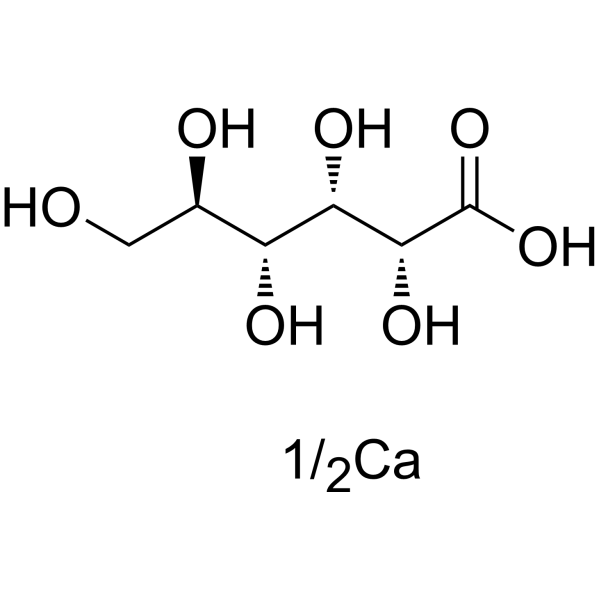
Physicochemical Properties
| Molecular Formula | C12H22CAO14 |
| Molecular Weight | 430.3727 |
| Exact Mass | 430.063 |
| CAS # | 299-28-5 |
| PubChem CID | 9290 |
| Appearance | White to off-white solid powder |
| Boiling Point | 673.6ºC at 760 mmHg |
| Melting Point | 195°C |
| Flash Point | 375.2ºC |
| Hydrogen Bond Donor Count | 10 |
| Hydrogen Bond Acceptor Count | 14 |
| Rotatable Bond Count | 8 |
| Heavy Atom Count | 27 |
| Complexity | 165 |
| Defined Atom Stereocenter Count | 8 |
| SMILES | C([C@H]([C@H]([C@@H]([C@H](C(=O)[O-])O)O)O)O)O.C([C@H]([C@H]([C@@H]([C@H](C(=O)[O-])O)O)O)O)O.[Ca+2] |
| InChi Key | NEEHYRZPVYRGPP-IYEMJOQQSA-L |
| InChi Code | InChI=1S/2C6H12O7.Ca/c2*7-1-2(8)3(9)4(10)5(11)6(12)13;/h2*2-5,7-11H,1H2,(H,12,13);/q;;+2/p-2/t2*2-,3-,4+,5-;/m11./s1 |
| Chemical Name | calcium;(2R,3S,4R,5R)-2,3,4,5,6-pentahydroxyhexanoate |
| HS Tariff Code | 2934.99.9001 |
| Storage |
Powder-20°C 3 years 4°C 2 years In solvent -80°C 6 months -20°C 1 month Note: Please store this product in a sealed and protected environment, avoid exposure to moisture. |
| Shipping Condition | Room temperature (This product is stable at ambient temperature for a few days during ordinary shipping and time spent in Customs) |
Biological Activity
| ADME/Pharmacokinetics |
Absorption, Distribution and Excretion Approximately one-fifth to one-third of orally administered calcium is absorbed in the small intestine, depending on presence of vitamin D metabolites, pH in lumen, and on dietary factors, such as calcium binding to fiber or phytates. Calcium absorption is increased when a calcium deficiency is present or when a patient is on a low-calcium diet. In patients with achlorhydria or hypochlorhydria, calcium absorption, especially with the carbonate salt, may be reduced. Renal (20%) - The amount excreted in the urine varies with degree of calcium absorption and whether there is excessive bone loss or failure of renal conservation. Fecal (80%) - Consists mainly of nonabsorbed calcium, with only a small amount of endogenous fecal calcium excreted. Not available Approximately one-fifth to one-third of orally administered calcium is absorbed in the small intestine, depending on presence of vitamin D metabolites, pH in lumen, and on dietary factors, such as calcium binding to fiber or phytates. Calcium absorption is increased when a calcium deficiency is present or when a patient is on a low-calcium diet. In patients with achlorhydria or hypochlorhydria, calcium absorption, especially with the carbonate salt, may be reduced. /Calcium supplements/ Elimination: Renal (20%) - The amount excreted in the urine varies with degree of calcium absorption and whether there is excessive bone loss or failure of renal conservation. Fecal (80%) - Consists mainly of nonabsorbed calcium, with only a small amount of endogenous fecal calcium excreted. /Calcium supplements/ Metabolism / Metabolites Calcium gluconate does not require hepatic metabolism for the release of Ca++ and is as effective as calcium chloride in treating ionic hypocalcemia in the absence of hepatic function. |
| Toxicity/Toxicokinetics |
Protein Binding Moderate, approximately 45% in plasma. Interactions Concurrent use of excessive amounts of /alcohol, caffeine (usually more than 8 cups of coffee a day), or tobacco/ has been reported to decrease calcium absorption. Concurrent use /of estrogens/ with calcium supplements may increase calcium absorption, which is used to therapeutic advantage when estrogens are prescribed for the treatment of postmenopausal osteoporosis. /Calcium supplements/ Concurrent use with calcium supplements may decrease effectiveness of cellulose sodium phosphate in preventing hypercalciuria. /Calcium supplements/ Concurrent use /of other calcium-containing medications or oral magnesium-containing medications/ with calcium supplements may increase serum calcium or magnesium concentration in susceptible patients, mainly patients with impaired renal function, leading to hypercalcemia or hypermagnesemia, respectively. /Calcium supplements/ For more Interactions (Complete) data for CALCIUM GLUCONATE (21 total), please visit the HSDB record page. Non-Human Toxicity Values LD50 Rat oral >5,000 mg/kg bw |
| Additional Infomation |
Calcium gluconate is the calcium salt of D-gluconic acid. It has a role as a nutraceutical. It contains a D-gluconate. Calcium gluconate is used as mineral supplement and medication when there is insufficient calcium in the diet. Supplementation may be done to treat or prevent osteoporosis or rickets, consequences of hypocalcemia. It can also be taken by mouth but is not recommended by injection into a muscle. Calcium Gluconate Injection, USP is a sterile, nonpyrogenic supersaturated solution of calcium gluconate for intravenous use only. Each mL contains: Calcium gluconate 94 mg; calcium saccharate (tetrahydrate) 4.5 mg; water for injection q.s. Hydrochloric acid and/or sodium hydroxide may have been added for pH adjustment (6.0 to 8.2). Calcium saccharate provides 6% of the total calcium and stabilizes the supersaturated solution of calcium gluconate. Each 10 mL of the injection provides 93 mg elemental calcium (Ca++) equivalent to 1 g of calcium gluconate. Calcium Gluconate is the gluconate salt of calcium. An element or mineral necessary for normal nerve, muscle, and cardiac function, calcium as the gluconate salt helps to maintain calcium balance and prevent bone loss when taken orally. This agent may also be chemopreventive for colon and other cancers. (NCI04) The calcium salt of gluconic acid. The compound has a variety of uses, including its use as a calcium replenisher in hypocalcemic states. See also: Calcium Cation (has active moiety) ... View More ... Drug Indication Oral calcium salts are used as dietary supplemental therapy for person who may not get enough calcium in their regular diet. Calcium gluconate is used as a cardioprotective agent in high blood potassium. Calcium gluconate is the antidote for magnesium sulfate toxicity. Mechanism of Action Calcium is essential for the functional integrity of the nervous, muscular, and skeletal systems. It plays a role in normal cardiac function, renal function, respiration, blood coagulation, and cell membrane and capillary permeability. Also, calcium helps to regulate the release and storage of neurotransmitters and hormones, the uptake and binding of amino acids, absorption of vitamin B 12, and gastrin secretion. The major fraction (99%) of calcium is in the skeletal structure primarily as hydroxyapatite, Ca 10(PO 4) 6(OH) 2; small amounts of calcium carbonate and amorphous calcium phosphates are also present. The calcium of bone is in a constant exchange with the calcium of plasma. Since the metabolic functions of calcium are essential for life, when there is a disturbance in the calcium balance because of dietary deficiency or other causes, the stores of calcium in bone may be depleted to fill the body's more acute needs. Therefore, on a chronic basis, normal mineralization of bone depends on adequate amounts of total body calcium. Therapeutic Uses Some studies have shown that calcium supplementation begun in the second trimester may be effective in lowering blood pressure in pregnancy women with pregnancy-induced hypertension or pre-eclampsia, both of which may possibly be associated with increased calcium demand of the fetus during the last trimester. /Calcium supplements/ Oral calcium salts are used as dietary supplemental therapy for person who may not get enough calcium in their regular diet. Due to increased needs, children and pregnancy women are at greatest risk. Pre- and postmenopausal women; adolescents, especially girls and the elderly may not receive adequate calcium in their diets. ... Calcium supplements are used as part of the prevention and treatment of osteoporosis in patients with an inadequate calcium intake. The use of calcium citrate may reduce the risk of kidney stones in susceptible patients. The use of water-soluble salts of calcium (ie, citrate, gluconate, and lactate) may be preferable to acid-soluble salts (ie, carbonate and phosphate) for patients with reduced stomach acid or patients taking acid-inhibiting medication, such as the histamine H2-receptor antagonists. /Calcium supplements; Included in US product labeling/ Oral calcium supplements provide a source of calcium ion for treating calcium depletion occurring in conditions such as chronic hypoparathyroidism, pseudohypoparathyroidism, osteomalacia, rickets, chronic renal failure, and hypocalcemia secondary to the administration of anticonvulsant medications. When chronic hypocalcemia is due to vitamin D deficiency oral calcium salts may be administered concomitantly with vitamin D analogs. /Calcium supplements; Included in US product labeling/ Calcium chloride and parenteral calcium gluconate are used to decrease or reverse the cardiac depressant effects of hyperkalemia on electrocardiographic (ECG) function. /Calcium supplements; Included in US product labeling/ For more Therapeutic Uses (Complete) data for CALCIUM GLUCONATE (27 total), please visit the HSDB record page. Drug Warnings VET: ... Calcium gluconate ... if given by iv injection, should be admin slowly ... given rapidly ... may have toxic effect on heart. Calcium gluconate ... not recommended for im use because dose must be large and danger of sterile abscess formation is too great. Many physicians recommend that pregnant women receive multivitamin and mineral supplements, especially those pregnant women who do not consume an adequate diet and those in high-risk categories )ie, women carrying more than one fetus, heavy cigarette smokers, and alcohol and drug abusers). Taking excessive amounts of a multivitamin and mineral supplement may be harmful to the mother and/or fetus and should be avoided. /Calcium supplements/ Side/adverse effects may be more likely to occur if oral calcium supplements are taken in much larger doses than recommended (greater than 2000 to 2500 mg a day), if they are taken for a longer period of time, or if they are taken by patients with renal function impairment or milk-alkali syndrome. /Calcium supplements/ For more Drug Warnings (Complete) data for CALCIUM GLUCONATE (15 total), please visit the HSDB record page. Pharmacodynamics Calcium Gluconate is the gluconate salt of calcium. An element or mineral necessary for normal nerve, muscle, and cardiac function, calcium as the gluconate salt helps to maintain calcium balance and prevent bone loss when taken orally. This agent may also be chemopreventive for colon and other cancers. |
Solubility Data
| Solubility (In Vitro) |
H2O : ~20 mg/mL (~92.51 mM) DMSO : ~1 mg/mL (~4.63 mM) |
| Solubility (In Vivo) |
Note: Listed below are some common formulations that may be used to formulate products with low water solubility (e.g. < 1 mg/mL), you may test these formulations using a minute amount of products to avoid loss of samples. Injection Formulations (e.g. IP/IV/IM/SC) Injection Formulation 1: DMSO : Tween 80: Saline = 10 : 5 : 85 (i.e. 100 μL DMSO stock solution → 50 μL Tween 80 → 850 μL Saline) *Preparation of saline: Dissolve 0.9 g of sodium chloride in 100 mL ddH ₂ O to obtain a clear solution. Injection Formulation 2: DMSO : PEG300 :Tween 80 : Saline = 10 : 40 : 5 : 45 (i.e. 100 μL DMSO → 400 μLPEG300 → 50 μL Tween 80 → 450 μL Saline) Injection Formulation 3: DMSO : Corn oil = 10 : 90 (i.e. 100 μL DMSO → 900 μL Corn oil) Example: Take the Injection Formulation 3 (DMSO : Corn oil = 10 : 90) as an example, if 1 mL of 2.5 mg/mL working solution is to be prepared, you can take 100 μL 25 mg/mL DMSO stock solution and add to 900 μL corn oil, mix well to obtain a clear or suspension solution (2.5 mg/mL, ready for use in animals). Injection Formulation 4: DMSO : 20% SBE-β-CD in saline = 10 : 90 [i.e. 100 μL DMSO → 900 μL (20% SBE-β-CD in saline)] *Preparation of 20% SBE-β-CD in Saline (4°C,1 week): Dissolve 2 g SBE-β-CD in 10 mL saline to obtain a clear solution. Injection Formulation 5: 2-Hydroxypropyl-β-cyclodextrin : Saline = 50 : 50 (i.e. 500 μL 2-Hydroxypropyl-β-cyclodextrin → 500 μL Saline) Injection Formulation 6: DMSO : PEG300 : castor oil : Saline = 5 : 10 : 20 : 65 (i.e. 50 μL DMSO → 100 μLPEG300 → 200 μL castor oil → 650 μL Saline) Injection Formulation 7: Ethanol : Cremophor : Saline = 10: 10 : 80 (i.e. 100 μL Ethanol → 100 μL Cremophor → 800 μL Saline) Injection Formulation 8: Dissolve in Cremophor/Ethanol (50 : 50), then diluted by Saline Injection Formulation 9: EtOH : Corn oil = 10 : 90 (i.e. 100 μL EtOH → 900 μL Corn oil) Injection Formulation 10: EtOH : PEG300:Tween 80 : Saline = 10 : 40 : 5 : 45 (i.e. 100 μL EtOH → 400 μLPEG300 → 50 μL Tween 80 → 450 μL Saline) Oral Formulations Oral Formulation 1: Suspend in 0.5% CMC Na (carboxymethylcellulose sodium) Oral Formulation 2: Suspend in 0.5% Carboxymethyl cellulose Example: Take the Oral Formulation 1 (Suspend in 0.5% CMC Na) as an example, if 100 mL of 2.5 mg/mL working solution is to be prepared, you can first prepare 0.5% CMC Na solution by measuring 0.5 g CMC Na and dissolve it in 100 mL ddH2O to obtain a clear solution; then add 250 mg of the product to 100 mL 0.5% CMC Na solution, to make the suspension solution (2.5 mg/mL, ready for use in animals). Oral Formulation 3: Dissolved in PEG400 Oral Formulation 4: Suspend in 0.2% Carboxymethyl cellulose Oral Formulation 5: Dissolve in 0.25% Tween 80 and 0.5% Carboxymethyl cellulose Oral Formulation 6: Mixing with food powders Note: Please be aware that the above formulations are for reference only. InvivoChem strongly recommends customers to read literature methods/protocols carefully before determining which formulation you should use for in vivo studies, as different compounds have different solubility properties and have to be formulated differently. (Please use freshly prepared in vivo formulations for optimal results.) |
| Preparing Stock Solutions | 1 mg | 5 mg | 10 mg | |
| 1 mM | 2.3236 mL | 11.6179 mL | 23.2358 mL | |
| 5 mM | 0.4647 mL | 2.3236 mL | 4.6472 mL | |
| 10 mM | 0.2324 mL | 1.1618 mL | 2.3236 mL |