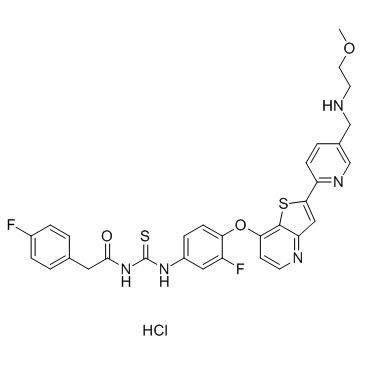
Physicochemical Properties
| Molecular Formula | C31H28CLF2N5O3S2 |
| Molecular Weight | 656.1655 |
| Exact Mass | 655.129 |
| Elemental Analysis | C, 56.75; H, 4.30; Cl, 5.40; F, 5.79; N, 10.67; O, 7.31; S, 9.77 |
| CAS # | 1123838-51-6 |
| Related CAS # | Glesatinib;936694-12-1 |
| PubChem CID | 127255607 |
| Appearance | Off-white to pink solid powder |
| Hydrogen Bond Donor Count | 4 |
| Hydrogen Bond Acceptor Count | 10 |
| Rotatable Bond Count | 11 |
| Heavy Atom Count | 44 |
| Complexity | 902 |
| Defined Atom Stereocenter Count | 0 |
| SMILES | Cl[H].S1C2=C(C([H])=C([H])N=C2C([H])=C1C1C([H])=C([H])C(=C([H])N=1)C([H])([H])N([H])C([H])([H])C([H])([H])OC([H])([H])[H])OC1C([H])=C([H])C(=C([H])C=1F)N([H])C(N([H])C(C([H])([H])C1C([H])=C([H])C(=C([H])C=1[H])F)=O)=S |
| InChi Key | TUVXGVPWXBWWEP-UHFFFAOYSA-N |
| InChi Code | InChI=1S/C31H27F2N5O3S2.ClH/c1-40-13-12-34-17-20-4-8-24(36-18-20)28-16-25-30(43-28)27(10-11-35-25)41-26-9-7-22(15-23(26)33)37-31(42)38-29(39)14-19-2-5-21(32)6-3-19;/h2-11,15-16,18,34H,12-14,17H2,1H3,(H2,37,38,39,42);1H |
| Chemical Name | N-[[3-fluoro-4-[2-[5-[(2-methoxyethylamino)methyl]pyridin-2-yl]thieno[3,2-b]pyridin-7-yl]oxyphenyl]carbamothioyl]-2-(4-fluorophenyl)acetamide;hydrochloride |
| Synonyms | Glesatinib HCl; MGCD265 hydrochloride; Glesatinib hydrochloride; MGCD265 hydrochloride; MGCD 265 HCl; MGCD265 hydrochloride; MGCD-265 HCl; MGCD265 HCl |
| HS Tariff Code | 2934.99.9001 |
| Storage |
Powder-20°C 3 years 4°C 2 years In solvent -80°C 6 months -20°C 1 month Note: Please store this product in a sealed and protected environment, avoid exposure to moisture. |
| Shipping Condition | Room temperature (This product is stable at ambient temperature for a few days during ordinary shipping and time spent in Customs) |
Biological Activity
| ln Vitro |
Glesatinib hydrochloride (MGCD265 hydrochloride; 0.01-5 μM; for 72 hours) inhibits the growth of cancer cells in a dose-dependent manner and exhibits a low IC50 value of 0.08 μM on NSCLC H1299 cells[1]. Glesatinib hydrochloride (0.01, 0.1, 0.5, 1 μM) dramatically increases the percentage of apoptotic cells by several times in NSCLC H1299 cells[1]. Glesatinib hydrochloride exhibits cytotoxicity against P-gp overexpressing cancer cells KB-C2, SW620/Ad300, HEK293/ABCB1, as well as their parent cells KB-3-1, SW620, and HEK293 cells, with IC50 values ranging from 5 to 10 μM[1]. Glesatinib hydrochloride (1, 3 μM; 120 mins) enhances intracellular [3H]-Inhibits and accumulates papalitaxel [3H]In cancer cell lines overexpressing P-gp, parietaxel efflux is observed[2]. Glesatinib hydrochloride (0-40 μM) increases P-gp transporters' ATPase activity in a dose-dependent way[2]. |
| ln Vivo | Glesatinib hydrochloride (MGCD265 hydrochloride; 15 mg/kg/day; orally; 40 weeks) causes the tumor's size to significantly decrease[1]. |
| Cell Assay |
Cell Line: NSCLC H1299 cells Concentration: 0.01, 0.1, 1, 2, 5 μM Incubation Time: For 72 hours Result: Resulted in a dose-dependent inhibition of cancer cell growth and showed the lowest IC50 value of 0.08 μM. |
| Animal Protocol |
4−6-week old female balb/c athymic (nu/nu) mice with HCC827 NSCLC tumor xenografts 15 mg/kg Orally; daily; 40 weeks |
| References |
[1]. Dual MET and SMO Negative Modulators Overcome Resistance to EGFR Inhibitors in Human Nonsmall Cell Lung Cancer. J Med Chem. 2017 Sep 14;60(17):7447-7458. [2]. Glesatinib, a c-MET/SMO Dual Inhibitor, Antagonizes P-glycoprotein Mediated MultidrugResistance in Cancer Cells. Front Oncol. 2019 Apr 25;9:313. |
Solubility Data
| Solubility (In Vitro) |
DMSO: ~50 mg/mL (~76.2 mM) H2O: < 0.1 mg/mL |
| Solubility (In Vivo) |
Solubility in Formulation 1: ≥ 2.5 mg/mL (3.81 mM) (saturation unknown) in 10% DMSO + 40% PEG300 + 5% Tween80 + 45% Saline (add these co-solvents sequentially from left to right, and one by one), clear solution. For example, if 1 mL of working solution is to be prepared, you can add 100 μL of 25.0 mg/mL clear DMSO stock solution to 400 μL PEG300 and mix evenly; then add 50 μL Tween-80 to the above solution and mix evenly; then add 450 μL normal saline to adjust the volume to 1 mL. Preparation of saline: Dissolve 0.9 g of sodium chloride in 100 mL ddH₂ O to obtain a clear solution. Solubility in Formulation 2: ≥ 2.5 mg/mL (3.81 mM) (saturation unknown) in 10% DMSO + 90% (20% SBE-β-CD in Saline) (add these co-solvents sequentially from left to right, and one by one), clear solution. For example, if 1 mL of working solution is to be prepared, you can add 100 μL of 25.0 mg/mL clear DMSO stock solution to 900 μL of 20% SBE-β-CD physiological saline solution and mix evenly. Preparation of 20% SBE-β-CD in Saline (4°C,1 week): Dissolve 2 g SBE-β-CD in 10 mL saline to obtain a clear solution. Solubility in Formulation 3: ≥ 2.5 mg/mL (3.81 mM) (saturation unknown) in 10% DMSO + 90% Corn Oil (add these co-solvents sequentially from left to right, and one by one), clear solution. For example, if 1 mL of working solution is to be prepared, you can add 100 μL of 25.0 mg/mL clear DMSO stock solution to 900 μL of corn oil and mix evenly. (Please use freshly prepared in vivo formulations for optimal results.) |
| Preparing Stock Solutions | 1 mg | 5 mg | 10 mg | |
| 1 mM | 1.5240 mL | 7.6200 mL | 15.2400 mL | |
| 5 mM | 0.3048 mL | 1.5240 mL | 3.0480 mL | |
| 10 mM | 0.1524 mL | 0.7620 mL | 1.5240 mL |