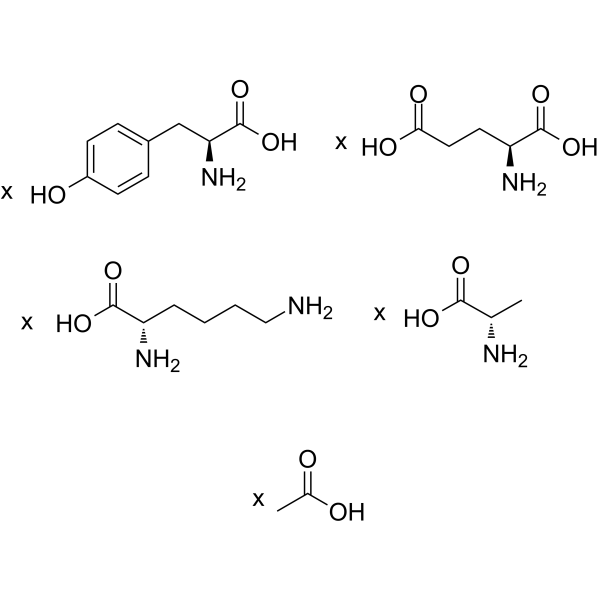
Physicochemical Properties
| Molecular Formula | (C9H11NO3.C6H14N2O2.C5H9NO4.C3H7NO2)X.XC2H4O2 |
| Molecular Weight | 623.65 |
| Exact Mass | 623.301 |
| CAS # | 147245-92-9 |
| PubChem CID | 3081884 |
| Appearance | Off-white to light yellow solid powder |
| Boiling Point | 385.2ºC at 760mmHg |
| Melting Point | >239°C (dec.) (lit.) |
| Flash Point | 186.7ºC |
| Vapour Pressure | 1.27E-06mmHg at 25°C |
| LogP | 2.147 |
| Hydrogen Bond Donor Count | 12 |
| Hydrogen Bond Acceptor Count | 18 |
| Rotatable Bond Count | 13 |
| Heavy Atom Count | 43 |
| Complexity | 519 |
| Defined Atom Stereocenter Count | 4 |
| SMILES | CC(=O)O.NCCCCC(C(=O)O)N.OC(CCC(C(=O)O)N)=O.CC(C(=O)O)N.OC(C(CC1=CC=C(O)C=C1)N)=O |
| InChi Key | FHEAIOHRHQGZPC-KIWGSFCNSA-N |
| InChi Code | InChI=1S/C9H11NO3.C6H14N2O2.C5H9NO4.C3H7NO2.C2H4O2/c10-8(9(12)13)5-6-1-3-7(11)4-2-6;7-4-2-1-3-5(8)6(9)10;6-3(5(9)10)1-2-4(7)8;1-2(4)3(5)6;1-2(3)4/h1-4,8,11H,5,10H2,(H,12,13);5H,1-4,7-8H2,(H,9,10);3H,1-2,6H2,(H,7,8)(H,9,10);2H,4H2,1H3,(H,5,6);1H3,(H,3,4)/t8-;5-;3-;2-;/m0000./s1 |
| Chemical Name | acetic acid;(2S)-2-amino-3-(4-hydroxyphenyl)propanoic acid;(2S)-2-aminopentanedioic acid;(2S)-2-aminopropanoic acid;(2S)-2,6-diaminohexanoic acid |
| HS Tariff Code | 2934.99.9001 |
| Storage |
Powder-20°C 3 years 4°C 2 years In solvent -80°C 6 months -20°C 1 month Note: Please store this product in a sealed and protected environment, avoid exposure to moisture. |
| Shipping Condition | Room temperature (This product is stable at ambient temperature for a few days during ordinary shipping and time spent in Customs) |
Biological Activity
| ln Vitro | BDNF levels are raised by glutaramer acetate (25–100 mg/kg; Sc; 5 days)[3]. The N171-82Q transgenic mouse line, used in the huntington's disease (HD) animal model, shows a faster-moving illness course. Beginning at 8 weeks of age and continuing until 20 weeks of age, which is close to the age at which the disease would cause death, mice were given 1 mg/mouse; sc; 5×week. Several motor function assessments show improved performance when administered with glutaraldehyde acetate. The rotarod test, which is administered to 15-week-old N171-82Q transgenic mice over a 4-day period, shows a considerable improvement in performance when administered with glutaramer acetate[3]. |
| References |
[1]. McKeage K. Glatiramer Acetate 40 mg/mL in Relapsing-Remitting Multiple Sclerosis: A Review. CNS Drugs. 2015;29(5):425-432. [2]. Arnon R, et al. Mechanism of action of glatiramer acetate in multiple sclerosis and its potential for the development of new applications. Proc Natl Acad Sci U S A. 2004;101 Suppl 2(Suppl 2):14593-14598. [3]. Corey-Bloom J, et al. Beneficial effects of glatiramer acetate in Huntington's disease mouse models: Evidence for BDNF-elevating and immunomodulatory mechanisms. Brain Res. 2017;1673:102-110. [4]. Aharoni R, et al. Glatiramer acetate-specific T cells in the brain express T helper 2/3 cytokines and brain-derived neurotrophic factor in situ [published correction appears in Proc Natl Acad Sci U S A. 2005 Aug 23;102(34):12288]. Proc Natl Acad Sci U S A |
| Additional Infomation |
A random polymer of L-ALANINE, L-GLUTAMIC ACID, L-LYSINE, and L-TYROSINE that structurally resembles MYELIN BASIC PROTEIN. It is used in the treatment of RELAPSING-REMITTING MULTIPLE SCLEROSIS. See also: Glatiramer Acetate (annotation moved to). |
Solubility Data
| Solubility (In Vitro) | H2O: 50 mg/mL |
| Solubility (In Vivo) |
Note: Listed below are some common formulations that may be used to formulate products with low water solubility (e.g. < 1 mg/mL), you may test these formulations using a minute amount of products to avoid loss of samples. Injection Formulations (e.g. IP/IV/IM/SC) Injection Formulation 1: DMSO : Tween 80: Saline = 10 : 5 : 85 (i.e. 100 μL DMSO stock solution → 50 μL Tween 80 → 850 μL Saline) *Preparation of saline: Dissolve 0.9 g of sodium chloride in 100 mL ddH ₂ O to obtain a clear solution. Injection Formulation 2: DMSO : PEG300 :Tween 80 : Saline = 10 : 40 : 5 : 45 (i.e. 100 μL DMSO → 400 μLPEG300 → 50 μL Tween 80 → 450 μL Saline) Injection Formulation 3: DMSO : Corn oil = 10 : 90 (i.e. 100 μL DMSO → 900 μL Corn oil) Example: Take the Injection Formulation 3 (DMSO : Corn oil = 10 : 90) as an example, if 1 mL of 2.5 mg/mL working solution is to be prepared, you can take 100 μL 25 mg/mL DMSO stock solution and add to 900 μL corn oil, mix well to obtain a clear or suspension solution (2.5 mg/mL, ready for use in animals). Injection Formulation 4: DMSO : 20% SBE-β-CD in saline = 10 : 90 [i.e. 100 μL DMSO → 900 μL (20% SBE-β-CD in saline)] *Preparation of 20% SBE-β-CD in Saline (4°C,1 week): Dissolve 2 g SBE-β-CD in 10 mL saline to obtain a clear solution. Injection Formulation 5: 2-Hydroxypropyl-β-cyclodextrin : Saline = 50 : 50 (i.e. 500 μL 2-Hydroxypropyl-β-cyclodextrin → 500 μL Saline) Injection Formulation 6: DMSO : PEG300 : castor oil : Saline = 5 : 10 : 20 : 65 (i.e. 50 μL DMSO → 100 μLPEG300 → 200 μL castor oil → 650 μL Saline) Injection Formulation 7: Ethanol : Cremophor : Saline = 10: 10 : 80 (i.e. 100 μL Ethanol → 100 μL Cremophor → 800 μL Saline) Injection Formulation 8: Dissolve in Cremophor/Ethanol (50 : 50), then diluted by Saline Injection Formulation 9: EtOH : Corn oil = 10 : 90 (i.e. 100 μL EtOH → 900 μL Corn oil) Injection Formulation 10: EtOH : PEG300:Tween 80 : Saline = 10 : 40 : 5 : 45 (i.e. 100 μL EtOH → 400 μLPEG300 → 50 μL Tween 80 → 450 μL Saline) Oral Formulations Oral Formulation 1: Suspend in 0.5% CMC Na (carboxymethylcellulose sodium) Oral Formulation 2: Suspend in 0.5% Carboxymethyl cellulose Example: Take the Oral Formulation 1 (Suspend in 0.5% CMC Na) as an example, if 100 mL of 2.5 mg/mL working solution is to be prepared, you can first prepare 0.5% CMC Na solution by measuring 0.5 g CMC Na and dissolve it in 100 mL ddH2O to obtain a clear solution; then add 250 mg of the product to 100 mL 0.5% CMC Na solution, to make the suspension solution (2.5 mg/mL, ready for use in animals). Oral Formulation 3: Dissolved in PEG400 Oral Formulation 4: Suspend in 0.2% Carboxymethyl cellulose Oral Formulation 5: Dissolve in 0.25% Tween 80 and 0.5% Carboxymethyl cellulose Oral Formulation 6: Mixing with food powders Note: Please be aware that the above formulations are for reference only. InvivoChem strongly recommends customers to read literature methods/protocols carefully before determining which formulation you should use for in vivo studies, as different compounds have different solubility properties and have to be formulated differently. (Please use freshly prepared in vivo formulations for optimal results.) |
| Preparing Stock Solutions | 1 mg | 5 mg | 10 mg | |
| 1 mM | 1.6035 mL | 8.0173 mL | 16.0346 mL | |
| 5 mM | 0.3207 mL | 1.6035 mL | 3.2069 mL | |
| 10 mM | 0.1603 mL | 0.8017 mL | 1.6035 mL |