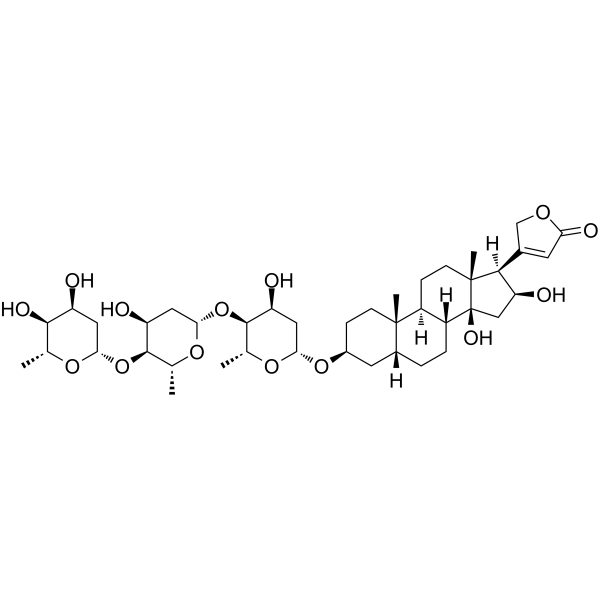
Physicochemical Properties
| Molecular Formula | C41H64O14 |
| Molecular Weight | 780.94 |
| Exact Mass | 780.43 |
| Elemental Analysis | C, 63.06; H, 8.26; O, 28.68 |
| CAS # | 4562-36-1 |
| Related CAS # | Digitoxin;71-63-6 |
| PubChem CID | 91540 |
| Appearance | White to off-white solid powder |
| Density | 1.36g/cm3 |
| Boiling Point | 932ºC at 760 mmHg |
| Melting Point | 265ºC |
| Flash Point | 278.6ºC |
| Index of Refraction | 1.602 |
| LogP | 2.218 |
| Hydrogen Bond Donor Count | 6 |
| Hydrogen Bond Acceptor Count | 14 |
| Rotatable Bond Count | 7 |
| Heavy Atom Count | 55 |
| Complexity | 1450 |
| Defined Atom Stereocenter Count | 21 |
| SMILES | C[C@@H]1[C@H]([C@H](C[C@@H](O1)O[C@@H]2[C@H](O[C@H](C[C@@H]2O)O[C@@H]3[C@H](O[C@H](C[C@@H]3O)O[C@H]4CC[C@]5([C@@H](C4)CC[C@@H]6[C@@H]5CC[C@]7([C@@]6(C[C@@H]([C@@H]7C8=CC(=O)OC8)O)O)C)C)C)C)O)O |
| InChi Key | LKRDZKPBAOKJBT-CNPIRKNPSA-N |
| InChi Code | InChI=1S/C41H64O14/c1-19-36(47)27(42)14-33(50-19)54-38-21(3)52-34(16-29(38)44)55-37-20(2)51-32(15-28(37)43)53-24-8-10-39(4)23(13-24)6-7-26-25(39)9-11-40(5)35(22-12-31(46)49-18-22)30(45)17-41(26,40)48/h12,19-21,23-30,32-38,42-45,47-48H,6-11,13-18H2,1-5H3/t19-,20-,21-,23-,24+,25+,26-,27+,28+,29+,30+,32+,33+,34+,35+,36-,37-,38-,39+,40-,41+/m1/s1 |
| Chemical Name | 3-[(3S,5R,8R,9S,10S,13R,14S,16S,17R)-3-[(2R,4S,5S,6R)-5-[(2S,4S,5S,6R)-5-[(2S,4S,5S,6R)-4,5-dihydroxy-6-methyloxan-2-yl]oxy-4-hydroxy-6-methyloxan-2-yl]oxy-4-hydroxy-6-methyloxan-2-yl]oxy-14,16-dihydroxy-10,13-dimethyl-1,2,3,4,5,6,7,8,9,11,12,15,16,17-tetradecahydrocyclopenta[a]phenanthren-17-yl]-2H-furan-5-one |
| Synonyms | Gitoxin; 4562-36-1; Anhydrogitalin; Pseudodigitoxin; Bigitalin; Gitoxigenin 3-O-tridigitoxoside; VOR2TD6SO4; CHEBI:28503; |
| HS Tariff Code | 2934.99.9001 |
| Storage |
Powder-20°C 3 years 4°C 2 years In solvent -80°C 6 months -20°C 1 month |
| Shipping Condition | Room temperature (This product is stable at ambient temperature for a few days during ordinary shipping and time spent in Customs) |
Biological Activity
| Targets |
Na+/K+-ATPase (Ki: 0.12 ± 0.03 nM) [1] |
| ln Vitro |
Na+/K+-ATPase inhibition: Gitoxin potently inhibited Na+/K+-ATPase activity in a dose-dependent manner, with a Ki value of 0.12 ± 0.03 nM. Kinetic analysis revealed non-competitive inhibition, with significant reductions in Vmax (from 12.5 ± 1.2 μmol Pi/mg protein/h to 4.8 ± 0.6 μmol Pi/mg protein/h) and no change in Km (0.8 ± 0.1 mM for ATP) [1]. |
| Enzyme Assay |
Na+/K+-ATPase activity assay: Purified Na+/K+-ATPase from porcine kidney was incubated with Gitoxin (0.01–10 nM) in a reaction buffer containing 100 mM NaCl, 20 mM KCl, 5 mM MgCl₂, and 5 mM ATP. The reaction was initiated by adding enzyme and incubated at 37°C for 30 minutes. Inorganic phosphate (Pi) released was quantified using a colorimetric assay with ammonium molybdate, and enzyme activity was calculated based on Pi production. Ki values were determined by fitting dose-response curves to the non-competitive inhibition model [1]. |
| Toxicity/Toxicokinetics |
91540 cat LD50 oral >25 mg/kg Archives Internationales de Pharmacodynamie et de Therapie., 159(1), 1966 [PMID:5918760] 91540 cat LDLo intravenous 590 ug/kg Toxicon., 8(85), 1970 [PMID:5465749] 91540 cat LDLo unreported 222 ug/kg Journal of the American Pharmaceutical Association, Scientific Edition., 37(364), 1948 91540 guinea pig LD50 oral >130 mg/kg Archives Internationales de Pharmacodynamie et de Therapie., 159(1), 1966 [PMID:5918760] 91540 guinea pig LDLo intravenous 4400 ug/kg CARDIAC: CARDIOMYOPATHY INCLUDING INFARCTION; LUNGS, THORAX, OR RESPIRATION: DYSPNEA Archives Internationales de Pharmacodynamie et de Therapie., 155(251), 1965 [PMID:5841182] |
| References |
[1]. Effects of digoxin and gitoxin on the enzymatic activity and kinetic parameters of Na+/K+-ATPase. J Enzyme Inhib Med Chem. 2004 Oct;19(5):409-15. |
| Additional Infomation |
Gitoxin is a cardenolide glycoside that is gitoxigenin in which the 3beta-hydroxy group has been glycosylated with tridigitoxose. It is functionally related to a gitoxigenin. Gitoxin has been reported in Digitalis viridiflora, Digitalis purpurea, and other organisms with data available. - Mechanism of action: Gitoxin binds to the α-subunit of Na+/K+-ATPase, stabilizing the phosphorylated intermediate state and inhibiting ion transport. This leads to increased intracellular Na+ concentration, activating Na+/Ca²+ exchange and elevating cytosolic Ca²+, thereby enhancing myocardial contractility [1]. - Comparison with digoxin: Gitoxin showed slightly higher inhibitory potency (Ki: 0.12 nM) compared to digoxin (Ki: 0.18 nM) against Na+/K+-ATPase, suggesting comparable therapeutic efficacy with potentially lower toxicity [1]. |
Solubility Data
| Solubility (In Vitro) | May dissolve in DMSO (in most cases), if not, try other solvents such as H2O, Ethanol, or DMF with a minute amount of products to avoid loss of samples |
| Solubility (In Vivo) |
Note: Listed below are some common formulations that may be used to formulate products with low water solubility (e.g. < 1 mg/mL), you may test these formulations using a minute amount of products to avoid loss of samples. Injection Formulations (e.g. IP/IV/IM/SC) Injection Formulation 1: DMSO : Tween 80: Saline = 10 : 5 : 85 (i.e. 100 μL DMSO stock solution → 50 μL Tween 80 → 850 μL Saline) *Preparation of saline: Dissolve 0.9 g of sodium chloride in 100 mL ddH ₂ O to obtain a clear solution. Injection Formulation 2: DMSO : PEG300 :Tween 80 : Saline = 10 : 40 : 5 : 45 (i.e. 100 μL DMSO → 400 μLPEG300 → 50 μL Tween 80 → 450 μL Saline) Injection Formulation 3: DMSO : Corn oil = 10 : 90 (i.e. 100 μL DMSO → 900 μL Corn oil) Example: Take the Injection Formulation 3 (DMSO : Corn oil = 10 : 90) as an example, if 1 mL of 2.5 mg/mL working solution is to be prepared, you can take 100 μL 25 mg/mL DMSO stock solution and add to 900 μL corn oil, mix well to obtain a clear or suspension solution (2.5 mg/mL, ready for use in animals). Injection Formulation 4: DMSO : 20% SBE-β-CD in saline = 10 : 90 [i.e. 100 μL DMSO → 900 μL (20% SBE-β-CD in saline)] *Preparation of 20% SBE-β-CD in Saline (4°C,1 week): Dissolve 2 g SBE-β-CD in 10 mL saline to obtain a clear solution. Injection Formulation 5: 2-Hydroxypropyl-β-cyclodextrin : Saline = 50 : 50 (i.e. 500 μL 2-Hydroxypropyl-β-cyclodextrin → 500 μL Saline) Injection Formulation 6: DMSO : PEG300 : castor oil : Saline = 5 : 10 : 20 : 65 (i.e. 50 μL DMSO → 100 μLPEG300 → 200 μL castor oil → 650 μL Saline) Injection Formulation 7: Ethanol : Cremophor : Saline = 10: 10 : 80 (i.e. 100 μL Ethanol → 100 μL Cremophor → 800 μL Saline) Injection Formulation 8: Dissolve in Cremophor/Ethanol (50 : 50), then diluted by Saline Injection Formulation 9: EtOH : Corn oil = 10 : 90 (i.e. 100 μL EtOH → 900 μL Corn oil) Injection Formulation 10: EtOH : PEG300:Tween 80 : Saline = 10 : 40 : 5 : 45 (i.e. 100 μL EtOH → 400 μLPEG300 → 50 μL Tween 80 → 450 μL Saline) Oral Formulations Oral Formulation 1: Suspend in 0.5% CMC Na (carboxymethylcellulose sodium) Oral Formulation 2: Suspend in 0.5% Carboxymethyl cellulose Example: Take the Oral Formulation 1 (Suspend in 0.5% CMC Na) as an example, if 100 mL of 2.5 mg/mL working solution is to be prepared, you can first prepare 0.5% CMC Na solution by measuring 0.5 g CMC Na and dissolve it in 100 mL ddH2O to obtain a clear solution; then add 250 mg of the product to 100 mL 0.5% CMC Na solution, to make the suspension solution (2.5 mg/mL, ready for use in animals). Oral Formulation 3: Dissolved in PEG400 Oral Formulation 4: Suspend in 0.2% Carboxymethyl cellulose Oral Formulation 5: Dissolve in 0.25% Tween 80 and 0.5% Carboxymethyl cellulose Oral Formulation 6: Mixing with food powders Note: Please be aware that the above formulations are for reference only. InvivoChem strongly recommends customers to read literature methods/protocols carefully before determining which formulation you should use for in vivo studies, as different compounds have different solubility properties and have to be formulated differently. (Please use freshly prepared in vivo formulations for optimal results.) |
| Preparing Stock Solutions | 1 mg | 5 mg | 10 mg | |
| 1 mM | 1.2805 mL | 6.4025 mL | 12.8051 mL | |
| 5 mM | 0.2561 mL | 1.2805 mL | 2.5610 mL | |
| 10 mM | 0.1281 mL | 0.6403 mL | 1.2805 mL |