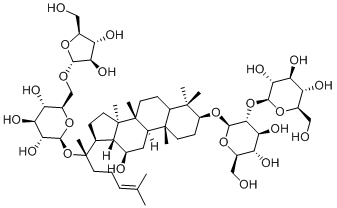
Ginsenoside Rc (NSC-310104) is a novel and potent AMPK inhibitor and TRPV1 antagonist. It is a natural Ginsenoside from Panax ginseng.
Physicochemical Properties
| Molecular Formula | C53H90O22 |
| Molecular Weight | 1079.28 |
| Exact Mass | 1078.592 |
| CAS # | 11021-14-0 |
| PubChem CID | 12855889 |
| Appearance | White to yellow solid powder |
| Density | 1.4±0.1 g/cm3 |
| Boiling Point | 1128.3±65.0 °C at 760 mmHg |
| Flash Point | 636.2±34.3 °C |
| Vapour Pressure | 0.0±0.6 mmHg at 25°C |
| Index of Refraction | 1.622 |
| LogP | 5.1 |
| Hydrogen Bond Donor Count | 14 |
| Hydrogen Bond Acceptor Count | 22 |
| Rotatable Bond Count | 16 |
| Heavy Atom Count | 75 |
| Complexity | 1950 |
| Defined Atom Stereocenter Count | 29 |
| SMILES | CC(=CCC[C@@](C)([C@H]1CC[C@@]2([C@@H]1[C@@H](C[C@H]3[C@]2(CC[C@@H]4[C@@]3(CC[C@@H](C4(C)C)O[C@H]5[C@@H]([C@H]([C@@H]([C@H](O5)CO)O)O)O[C@H]6[C@@H]([C@H]([C@@H]([C@H](O6)CO)O)O)O)C)C)O)C)O[C@H]7[C@@H]([C@H]([C@@H]([C@H](O7)CO[C@H]8[C@@H]([C@H]([C@@H](O8)CO)O)O)O)O)O)C |
| InChi Key | JDCPEKQWFDWQLI-LUQKBWBOSA-N |
| InChi Code | InChI=1S/C53H90O22/c1-23(2)10-9-14-53(8,75-47-43(67)39(63)37(61)29(72-47)22-68-45-41(65)36(60)28(21-56)69-45)24-11-16-52(7)33(24)25(57)18-31-50(5)15-13-32(49(3,4)30(50)12-17-51(31,52)6)73-48-44(40(64)35(59)27(20-55)71-48)74-46-42(66)38(62)34(58)26(19-54)70-46/h10,24-48,54-67H,9,11-22H2,1-8H3/t24-,25+,26+,27+,28-,29+,30-,31+,32-,33-,34+,35+,36-,37+,38-,39-,40-,41+,42+,43+,44+,45+,46-,47-,48-,50-,51+,52+,53-/m0/s1 |
| Chemical Name | (2S,3R,4S,5S,6R)-2-[(2R,3R,4S,5S,6R)-2-[[(3S,5R,8R,9R,10R,12R,13R,14R,17S)-17-[(2S)-2-[(2S,3R,4S,5S,6R)-6-[[(2R,3R,4R,5S)-3,4-dihydroxy-5-(hydroxymethyl)oxolan-2-yl]oxymethyl]-3,4,5-trihydroxyoxan-2-yl]oxy-6-methylhept-5-en-2-yl]-12-hydroxy-4,4,8,10,14-pentamethyl-2,3,5,6,7,9,11,12,13,15,16,17-dodecahydro-1H-cyclopenta[a]phenanthren-3-yl]oxy]-4,5-dihydroxy-6-(hydroxymethyl)oxan-3-yl]oxy-6-(hydroxymethyl)oxane-3,4,5-triol |
| Synonyms | NSC-310104 NSC310104 NSC 310104 |
| HS Tariff Code | 2934.99.9001 |
| Storage |
Powder-20°C 3 years 4°C 2 years In solvent -80°C 6 months -20°C 1 month |
| Shipping Condition | Room temperature (This product is stable at ambient temperature for a few days during ordinary shipping and time spent in Customs) |
Biological Activity
| ln Vitro | One of the main ginsenosides in Panax ginseng, ginsenoside Rc, is known to improve ion channel currents mediated by gamma-aminobutyric acid (GABA) receptor A (GABAA). In oocytes receiving GABA, ginsenoside Rc increases GABAA-mediated expression [1]. Ginsenoside Rc also significantly suppresses the expression of cytokines derived from macrophages, including IL-1β and TNF-α. Additionally, in macrophage-activated RAW264.7 macrophages, human synovial cells, and HEK293 cells, ginsenoside Rc significantly inhibits the activation of TANK-binding switch 1/IκB pathway epsilon/interferon regulatory factor 3 and p38/ATF-2 signaling. ..Ginsenoside Rc controls the expression of p38/ATF-2 and ε/interferon regulatory factor 3 in the TANK binding switch 1/IκB pathway. While ginsenoside Rc treatment does not, it inhibits the nuclear translocation of phosphorylated FRA-1 and phosphorylated ATF-2. By blocking AP-1 activation, ginsenoside Rc inhibits the translocation of p65 at the highest time points (30 and 60 minutes), which controls the expression of pro-inflammatory cytokine TNF-α released by macrophages [2]. |
| References |
[1]. Effects of Ginsenoside Metabolites on GABAA Receptor-Mediated Ion Currents. J Ginseng Res. 2012 Jan;36(1):55-60. [2]. Ginsenoside Rc from Panax ginseng exerts anti-inflammatory activity by targeting TANK-bindingkinase 1/interferon regulatory factor-3 and p38/ATF-2. J Ginseng Res. 2017 Apr;41(2):127-133. |
| Additional Infomation |
Ginsenoside Rc is a ginsenoside found in Panax ginseng that is dammarane which is substituted by hydroxy groups at the 3beta, 12beta and 20 pro-S positions, in which the hydroxy groups at positions 3 and 20 have been converted to the corresponding beta-D-glucopyranosyl-(1->2)-beta-D-glucopyranoside and alpha-L-arabinofuranosyl-(1->6)-beta-D-glucopyranoside respectively, and in which a double bond has been introduced at the 24-25 position. It has a role as a plant metabolite and a hypoglycemic agent. It is a 12beta-hydroxy steroid, a beta-D-glucoside, a disaccharide derivative, a ginsenoside and a tetracyclic triterpenoid. It derives from a hydride of a dammarane. Ginsenoside Rc has been reported in Panax pseudoginseng, Panax japonicus, and other organisms with data available. See also: American Ginseng (part of); Asian Ginseng (part of); Panax notoginseng root (part of). |
Solubility Data
| Solubility (In Vitro) |
DMSO : ~100 mg/mL (~92.66 mM) H2O : ~50 mg/mL (~46.33 mM) |
| Solubility (In Vivo) |
Solubility in Formulation 1: 33.33 mg/mL (30.88 mM) in PBS (add these co-solvents sequentially from left to right, and one by one), clear solution; with sonication. (Please use freshly prepared in vivo formulations for optimal results.) |
| Preparing Stock Solutions | 1 mg | 5 mg | 10 mg | |
| 1 mM | 0.9265 mL | 4.6327 mL | 9.2654 mL | |
| 5 mM | 0.1853 mL | 0.9265 mL | 1.8531 mL | |
| 10 mM | 0.0927 mL | 0.4633 mL | 0.9265 mL |