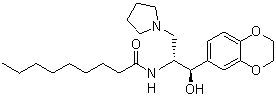
Genz-123346 is a novel, potent and selective glucosylceramide synthase inhibitor with potential anticancer activity. The cytotoxic anti-cancer agents' ability to kill tumor cells can be increased when cells are exposed to non-toxic concentrations of Genz-123346 and other GCS inhibitors. P-gp (ABCB1, gP-170) and other multi-drug resistance efflux pumps are substrates of Genz-123346 and a few other GCS inhibitors. The primary cause of the chemosensitization caused by Genz-123346 in cell lines that were chosen to overexpress P-gp or that express P-gp endogenously was its impact on P-gp function.
Physicochemical Properties
| Molecular Formula | C24H38N2O4 |
| Molecular Weight | 418.5695 |
| Exact Mass | 418.283 |
| Elemental Analysis | C, 68.87; H, 9.15; N, 6.69; O, 15.29 |
| CAS # | 491833-30-8 |
| Related CAS # | Genz-123346; 943344-58-9 |
| PubChem CID | 23652732 |
| Appearance | White to off-white solid powder |
| Density | 1.1±0.1 g/cm3 |
| Boiling Point | 623.9±55.0 °C at 760 mmHg |
| Flash Point | 331.1±31.5 °C |
| Vapour Pressure | 0.0±1.9 mmHg at 25°C |
| Index of Refraction | 1.539 |
| LogP | 4.14 |
| Hydrogen Bond Donor Count | 2 |
| Hydrogen Bond Acceptor Count | 5 |
| Rotatable Bond Count | 12 |
| Heavy Atom Count | 30 |
| Complexity | 498 |
| Defined Atom Stereocenter Count | 2 |
| SMILES | O([H])[C@]([H])(C1C([H])=C([H])C2=C(C=1[H])OC([H])([H])C([H])([H])O2)[C@@]([H])(C([H])([H])N1C([H])([H])C([H])([H])C([H])([H])C1([H])[H])N([H])C(C([H])([H])C([H])([H])C([H])([H])C([H])([H])C([H])([H])C([H])([H])C([H])([H])C([H])([H])[H])=O |
| InChi Key | JMNXWOFCUJJYEO-HYBUGGRVSA-N |
| InChi Code | InChI=1S/C24H38N2O4/c1-2-3-4-5-6-7-10-23(27)25-20(18-26-13-8-9-14-26)24(28)19-11-12-21-22(17-19)30-16-15-29-21/h11-12,17,20,24,28H,2-10,13-16,18H2,1H3,(H,25,27)/t20-,24-/m1/s1 |
| Chemical Name | N-[(1R,2R)-1-(2,3-dihydro-1,4-benzodioxin-6-yl)-1-hydroxy-3-pyrrolidin-1-ylpropan-2-yl]nonanamide |
| Synonyms | Genz123346; Genz-123346; Genz-123346; 491833-30-8; Genz-123346 free base; Genz-123346 (free base); 8JW4ZYR2CT; N-((1R,2R)-1-(2,3-dihydrobenzo[b][1,4]dioxin-6-yl)-1-hydroxy-3-(pyrrolidin-1-yl)propan-2-yl)nonanamide; N-[(1R,2R)-1-(2,3-Dihydrobenzo[b][1,4]dioxin-6-yl)-1-hydroxy-3-(pyrrolidin-1-yl)propan-2-yl]nonanamide; Genz123346;Genz 123346 |
| HS Tariff Code | 2934.99.9001 |
| Storage |
Powder-20°C 3 years 4°C 2 years In solvent -80°C 6 months -20°C 1 month |
| Shipping Condition | Room temperature (This product is stable at ambient temperature for a few days during ordinary shipping and time spent in Customs) |
Biological Activity
| Targets | GM1 ( IC50 = 14 nM ); glucosylceramide (GlcCer) synthase; GL1 synthase; glucosylceramide synthase |
| ln Vitro | Cells exposed to nontoxic concentrations of Genz-123346 and other GCS inhibitors can increase the ability of cytotoxic anti-cancer agents to kill tumor cells. Genz-123346 and a few other GCS inhibitors serve as substrates for efflux pumps that are resistant to multiple drugs, like P-gp (ABCB1, gP-170). The primary cause of Genz-123346's chemosensitization in cell lines chosen to overexpress P-gp or that express P-gp endogenously is its effects on P-gp function[2]. Genz-123346(Genz) is an autophagy flux enhancer[3]. |
| ln Vivo | Genz-123346 decreased glucose and A1C levels and enhanced glucose tolerance in the Zucker diabetic fatty rat. Additionally, drug therapy maintained the animals' capacity to secrete insulin and stopped the loss of pancreatic beta-cell function. Treatment with Genz-123346 normalized A1C levels and enhanced glucose tolerance in the diet-induced obese mouse. The medication has been demonstrated to have an oral bioavailability of 10% in mice and 30% in rats, with a half-life in plasma of 30 to 60 minutes[1]. Genz-123346 treatment reduces renal GlcCer and GM3 levels in a dose-dependent manner, effectively inhibiting cystic disease. A direct effect of Genz-123346 on the Akt-mTOR signaling pathway is observed, with reduced phosphorylation of Akt and ribosomal protein S6[4]. |
| Enzyme Assay | Glucosylceramide synthase (GCS) is a key enzyme engaged in the biosynthesis of glycosphingolipids and in regulating ceramide metabolism. Studies exploring alterations in GCS activity suggest that the glycolase may have a role in chemosensitizing tumor cells to various cancer drugs. The chemosensitizing effect of inhibitors of GCS (e.g. PDMP and selected analogues) has been observed with a variety of tumor cells leading to the proposal that the sensitizing activity of GCS inhibitors is primarily through increases in intracellular ceramide leading to induction of apoptosis. The current study examined the chemosensitizing activity of the novel GCS inhibitor, Genz-123346 in cell culture. Exposure of cells to Genz-123346 and to other GCS inhibitors at non-toxic concentrations can enhance the killing of tumor cells by cytotoxic anti-cancer agents. This activity was unrelated to lowering intracellular glycosphingolipid levels. Genz-123346 and a few other GCS inhibitors are substrates for multi-drug resistance efflux pumps such as P-gp (ABCB1, gP-170). In cell lines selected to over-express P-gp or which endogenously express P-gp, chemosensitization by Genz-123346 was primarily due to the effects on P-gp function. RNA interference studies using siRNA or shRNA confirmed that lowering GCS expression in tumor cells did not affect their responsiveness to commonly used cytotoxic drugs.[2] |
| Cell Assay |
Inhibition of glucosylceramide synthase stimulates autophagy flux in neurons[3] In this study, researchers identified two previously described glucosylceramide (GlcCer) synthase inhibitors, DL-threo-1-Phenyl-2-palmitoylamino-3-morpholino-1-propanol and Genz-123346(Genz), as enhancers of autophagy flux. We also demonstrate that GlcCer synthase inhibitors exert their effects on autophagy by inhibiting AKT-mammalian target of rapamycin (mTOR) signaling. More importantly, siRNA knock down of GlcCer synthase had the similar effect as pharmacological inhibition, confirming the on-target effect. In addition, we discovered that inhibition of GlcCer synthase increased the number and size of lysosomal/late endosomal structures. Although inhibition of GlcCer synthase decreases levels of mutant α-synuclein in neurons, it does so, according to our data, through autophagy-independent mechanisms. Our findings demonstrate a direct link between glycosphingolipid biosynthesis and autophagy in primary neurons, which may represent a novel pathway with potential therapeutic value for the treatment of Parkinson's disease. Inhibition of GlcCer synthase enhances autophagy by inhibiting AKT-mTOR signaling, and increases the number and size of lysosomal/late endosomal structures. Furthermore, inhibition of GlcCer synthase decreased levels of mutant α-synuclein in neurons, which may represent a potential therapeutic target for Parkinson's disease. |
| Animal Protocol |
Rats: In water, Genz-123346 dissolves. After receiving Genz-123346 (75 mg/kg) for six weeks, Zucker diabetic fatty rats are fasted for the entire night. The fasted rats are put under anesthesia and given five human insulin shots into their hepatic portal veins the next morning. Two minutes after injection, the liver and quadriceps muscle are removed and instantly frozen in liquid nitrogen. The immunoprecipitated insulin receptor By using immunoblotting, the immunoprecipitates are examined[1]. Mice: For eight weeks, C57BL/6 mice are given a high-fat (45% of kcal) diet. Obese mice with similar body weight gain, insulin, and glucose levels are placed in the treated or control groups. After that, the mice are given water or Genz-123346 every day for ten weeks[1]. Polycystic kidney disease (PKD) represents a family of genetic disorders characterized by renal cystic growth and progression to kidney failure. No treatment is currently available for people with PKD, although possible therapeutic interventions are emerging. Despite genetic and clinical heterogeneity, PKDs have in common defects of cystic epithelia, including increased proliferation, apoptosis and activation of growth regulatory pathways. Sphingolipids and glycosphingolipids are emerging as major regulators of these cellular processes. We sought to evaluate the therapeutic potential for glycosphingolipid modulation as a new approach to treat PKD. Here we demonstrate that kidney glucosylceramide (GlcCer) and ganglioside GM3 levels are higher in human and mouse PKD tissue as compared to normal tissue, regardless of the causative mutation. Blockade of GlcCer accumulation with the GlcCer synthase inhibitor Genz-123346 effectively inhibits cystogenesis in mouse models orthologous to human autosomal dominant PKD (Pkd1 conditional knockout mice) and nephronophthisis (jck and pcy mice). Molecular analysis in vitro and in vivo indicates that Genz-123346 acts through inhibition of the two key pathways dysregulated in PKD: Akt protein kinase-mammalian target of rapamycin signaling and cell cycle machinery. Taken together, our data suggest that inhibition of GlcCer synthesis represents a new and effective treatment option for PKD.[4] |
| References |
[1]. Inhibiting glycosphingolipid synthesis improves glycemic control and insulin sensitivity in animal models of type 2 diabetes. Diabetes. 2007 May;56(5):1210-8. [2]. The chemosensitizing activity of inhibitors of glucosylceramide synthase is mediated primarily through modulation of P-gp function. Int J Oncol. 2011 Mar;38(3):701-11. [3]. Inhibition of glucosylceramide synthase stimulates autophagy flux in neurons. J Neurochem. 2014 Jun;129(5):884-94 [4]. Inhibition of glucosylceramide accumulation results in effective blockade of polycystic kidney disease in mouse models. Nat Med. 2010 Jul;16(7):788-92. |
| Additional Infomation | Previous reports have shown that glycosphingolipids can modulate the activity of the insulin receptor, and studies in transgenic mice suggest a link between altered levels of various gangliosides and the development of insulin resistance. Here, we show that an inhibitor of glycosphingolipid synthesis can improve glucose control and increase insulin sensitivity in two different diabetic animal models. In the Zucker diabetic fatty rat, the glucosylceramide synthase inhibitor (1R,2R)-nonanoic acid[2-(2',3'-dihydro-benzo [1, 4] dioxin-6'-yl)-2-hydroxy-1-pyrrolidin-1-ylmethyl-ethyl]- amide-l-tartaric acid salt (Genz-123346) lowered glucose and A1C levels and improved glucose tolerance. Drug treatment also prevented the loss of pancreatic beta-cell function normally observed in the Zucker diabetic fatty rat and preserved the ability of the animals to secrete insulin. In the diet-induced obese mouse, treatment with Genz-123346 normalized A1C levels and improved glucose tolerance. Analysis of the phosphorylation state of the insulin receptor and downstream effectors showed increased insulin signaling in the muscles of the treated Zucker diabetic fatty rats and diet-induced obese mice. These results suggest that inhibiting glycosphingolipid synthesis can significantly improve insulin sensitivity and glucose homeostasis and may therefore represent a novel therapeutic approach for the treatment of type 2 diabetes.[3] |
Solubility Data
| Solubility (In Vitro) |
DMSO: ~84 mg/mL (~200.7 mM) Ethanol: ~84 mg/mL |
| Solubility (In Vivo) |
Solubility in Formulation 1: ≥ 3 mg/mL (7.17 mM) (saturation unknown) in 10% DMSO + 40% PEG300 + 5% Tween80 + 45% Saline (add these co-solvents sequentially from left to right, and one by one), clear solution. For example, if 1 mL of working solution is to be prepared, you can add 100 μL of 30.0 mg/mL clear DMSO stock solution to 400 μL PEG300 and mix evenly; then add 50 μL Tween-80 to the above solution and mix evenly; then add 450 μL normal saline to adjust the volume to 1 mL. Preparation of saline: Dissolve 0.9 g of sodium chloride in 100 mL ddH₂ O to obtain a clear solution. Solubility in Formulation 2: ≥ 3 mg/mL (7.17 mM) (saturation unknown) in 10% DMSO + 90% (20% SBE-β-CD in Saline) (add these co-solvents sequentially from left to right, and one by one), clear solution. For example, if 1 mL of working solution is to be prepared, you can add 100 μL of 30.0 mg/mL clear DMSO stock solution to 900 μL of 20% SBE-β-CD physiological saline solution and mix evenly. Preparation of 20% SBE-β-CD in Saline (4°C,1 week): Dissolve 2 g SBE-β-CD in 10 mL saline to obtain a clear solution. Solubility in Formulation 3: ≥ 3 mg/mL (7.17 mM) (saturation unknown) in 10% DMSO + 90% Corn Oil (add these co-solvents sequentially from left to right, and one by one), clear solution. For example, if 1 mL of working solution is to be prepared, you can add 100 μL of 30.0 mg/mL clear DMSO stock solution to 900 μL of corn oil and mix evenly. (Please use freshly prepared in vivo formulations for optimal results.) |
| Preparing Stock Solutions | 1 mg | 5 mg | 10 mg | |
| 1 mM | 2.3891 mL | 11.9454 mL | 23.8909 mL | |
| 5 mM | 0.4778 mL | 2.3891 mL | 4.7782 mL | |
| 10 mM | 0.2389 mL | 1.1945 mL | 2.3891 mL |