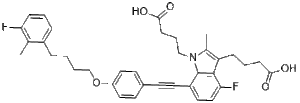
Gemilukast (formerly also known as ONO-6950) is a novel, potent and orally bioavailable dual CysLT1 and CysLT2 (cysteinyl leukotriene 1 and 2) antagonist with IC50s of 1.7, 25 nM for human CysLT1 and CysLT2, respectively.. Gemilukast exhibited potent in vivo efficacy at an oral dose of 0.1 mg/kg given 24 h before LTD4 challenge in a CysLT1-dependent guinea pig asthmatic model. In addition, gemilukast dose-dependently reduced LTC4-induced bronchoconstriction in both CysLT1- and CysLT2-dependent guinea pig asthmatic models, and it reduced antigen-induced constriction of isolated human bronchi. Gemilukast is currently being evaluated in phase II trials for the treatment of asthma.
Physicochemical Properties
| Molecular Formula | C36H37F2NO5 |
| Molecular Weight | 601.679497480392 |
| Exact Mass | 601.263 |
| Elemental Analysis | C, 71.86; H, 6.20; F, 6.32; N, 2.33; O, 13.30 |
| CAS # | 1232861-58-3 |
| Related CAS # | 1232861-58-3 (free acid);1232861-64-1 (disodium);1232873-69-6 (eight hydrate and disodium); |
| PubChem CID | 46830962 |
| Appearance | White to off-white solid powder |
| Density | 1.2±0.1 g/cm3 |
| Boiling Point | 806.6±65.0 °C at 760 mmHg |
| Flash Point | 441.6±34.3 °C |
| Vapour Pressure | 0.0±3.0 mmHg at 25°C |
| Index of Refraction | 1.570 |
| LogP | 9.21 |
| Hydrogen Bond Donor Count | 2 |
| Hydrogen Bond Acceptor Count | 7 |
| Rotatable Bond Count | 16 |
| Heavy Atom Count | 44 |
| Complexity | 988 |
| Defined Atom Stereocenter Count | 0 |
| SMILES | O=C(CCCC1=C(C)N(CCCC(O)=O)C2C1=C(C=CC=2C#CC1C=CC(OCCCCC2C(C)=C(F)C=CC=2)=CC=1)F)O |
| InChi Key | SILHYVDKGHXGBL-UHFFFAOYSA-N |
| InChi Code | InChI=1S/C36H37F2NO5/c1-24-27(9-5-11-31(24)37)8-3-4-23-44-29-19-15-26(16-20-29)14-17-28-18-21-32(38)35-30(10-6-12-33(40)41)25(2)39(36(28)35)22-7-13-34(42)43/h5,9,11,15-16,18-21H,3-4,6-8,10,12-13,22-23H2,1-2H3,(H,40,41)(H,42,43) |
| Chemical Name | 4,4'-(4-fluoro-7-((4-(4-(3-fluoro-2-methylphenyl)butoxy)phenyl)ethynyl)-2-methyl-1H-indole-1,3-diyl)dibutyric acid |
| Synonyms | ONO-6950; ONO 6950; ONO6950 |
| HS Tariff Code | 2934.99.9001 |
| Storage |
Powder-20°C 3 years 4°C 2 years In solvent -80°C 6 months -20°C 1 month |
| Shipping Condition | Room temperature (This product is stable at ambient temperature for a few days during ordinary shipping and time spent in Customs) |
Biological Activity
| Targets |
- Cysteinyl leukotriene receptor 1 (CysLT₁) – Ki = 0.44 nM (human recombinant CysLT₁); IC₅₀ = 0.72 nM (guinea pig lung CysLT₁) [1] - Cysteinyl leukotriene receptor 2 (CysLT₂) – Ki = 2.5 nM (human recombinant CysLT₂); IC₅₀ = 3.1 nM (guinea pig lung CysLT₂) [1] |
| ln Vitro |
Gemilukast is an orally active antagonist of the human biscysteinyl leukotriene 1 and 2 receptors (CysLT1 and CysLT2), with IC50 values of 1.7 and 25 nM, respectively [1]. Both gemilukast (ONO-6950) and montelukast, with IC50 values of 1.7 and 0.46 nM, respectively, block the calcium response mediated by the human CysLT1 receptor [2].
- Gemilukast (ONO-6950) acts as a dual competitive antagonist of CysLT₁ and CysLT₂ in vitro. It inhibits LTD₄ (a CysLT agonist)-induced Ca²⁺ mobilization in human embryonic kidney (HEK) 293 cells expressing recombinant human CysLT₁ or CysLT₂: the IC₅₀ values are 0.78 nM (CysLT₁) and 3.5 nM (CysLT₂). In guinea pig lung membrane preparations, Gemilukast (ONO-6950) blocks LTD₄ binding to CysLT₁ and CysLT₂ with IC₅₀ values of 0.72 nM and 3.1 nM, respectively. It shows no significant binding to other receptors (e.g., histamine H₁, muscarinic M₃) at concentrations up to 1 μM, indicating high receptor selectivity [1] - Gemilukast (ONO-6950) inhibits LTD₄-induced contraction of isolated guinea pig tracheal smooth muscle in vitro. At concentrations of 1–100 nM, it concentration-dependently reduces tracheal contraction: 10 nM Gemilukast (ONO-6950) inhibits contraction by ~60%, and 100 nM achieves ~90% inhibition. This effect is reversible and specific to CysLT-mediated contraction (no effect on histamine-induced tracheal contraction) [2] |
| ln Vivo |
Oral dosing of 0.03 to 10 mg/kg gimilukast dosage-dependently reduced LTC4-induced bronchoconstriction, with practically full inhibition at a dose of 3 mg/kg. At dosages of 1 mg/kg or above, the inhibitory impact of gemilukast on LTC4-induced bronchoconstriction was substantially stronger than that of montelukast. Gemilukast (0.03 to 1 mg/kg, orally) dose-dependently decreased LTD4-induced airway vascular hyperpermeability and was entirely suppressed at 0.3 mg/kg. Oral treatment of 0.1 to 3 mg/kg of gemimirukast dose-dependently reduced OVA-induced bronchoconstriction. The inhibitory impact of 3 mg/kg gimelukast was substantially greater than that of montelukast alone and was comparable to the combined therapy of montelukast and BayCysLT2RA [2].
- Gemilukast (ONO-6950) inhibits antigen-induced bronchoconstriction in sensitized guinea pigs. When administered orally at doses of 0.1–10 mg/kg 1 hour before antigen challenge, it dose-dependently reduces the maximum bronchoconstrictive response: 1 mg/kg inhibits the response by ~70%, and 10 mg/kg achieves ~95% inhibition. The duration of action is >8 hours (1 mg/kg oral dose still inhibits bronchoconstriction by ~50% at 8 hours post-administration) [2] - Gemilukast (ONO-6950) suppresses antigen-induced airway hyperresponsiveness (AHR) to histamine in guinea pigs. Oral administration of 1 mg/kg once daily for 3 consecutive days (before antigen challenge) reduces AHR by ~60% compared to vehicle-treated controls. It also decreases antigen-induced eosinophil infiltration in bronchoalveolar lavage fluid (BALF) by ~55% at 1 mg/kg oral dose [2] - In a guinea pig model of late-phase bronchoconstriction (LPBC), Gemilukast (ONO-6950) (10 mg/kg, oral) inhibits LPBC (observed 4–8 hours post-antigen challenge) by ~80%, whereas a selective CysLT₁ antagonist (montelukast) only inhibits LPBC by ~30% under the same conditions, highlighting the advantage of dual CysLT₁/CysLT₂ antagonism [2] |
| Enzyme Assay |
- CysLT₁/CysLT₂ receptor binding assay (guinea pig lung membranes): Guinea pig lung tissues were homogenized and centrifuged to prepare crude membrane fractions. Membranes were incubated with [³H]-LTD₄ (a radiolabeled CysLT agonist) and serial concentrations of Gemilukast (ONO-6950) (0.01–100 nM) at 25°C for 60 minutes. Unbound [³H]-LTD₄ was removed by filtration, and bound radioactivity was measured using a liquid scintillation counter. The IC₅₀ values for CysLT₁ and CysLT₂ were calculated by nonlinear regression analysis of competition binding curves [1] - Ca²⁺ mobilization assay (HEK293 cells): HEK293 cells stably expressing human CysLT₁ or CysLT₂ were loaded with a Ca²⁺-sensitive fluorescent dye (e.g., Fluo-4 AM) at 37°C for 30 minutes. Cells were then incubated with serial concentrations of Gemilukast (ONO-6950) (0.01–100 nM) for 15 minutes, followed by stimulation with LTD₄ (10 nM). Fluorescence intensity (reflecting intracellular Ca²⁺ levels) was measured using a fluorescence microplate reader, and IC₅₀ values were calculated based on the inhibition of LTD₄-induced fluorescence increase [1] |
| Cell Assay |
- Isolated guinea pig tracheal smooth muscle contraction assay: Guinea pigs were euthanized, and tracheal rings were prepared and mounted in organ baths containing Krebs-Henseleit solution (maintained at 37°C with 95% O₂/5% CO₂). Tracheal rings were pre-contracted with LTD₄ (10 nM) to establish a baseline contraction. Serial concentrations of Gemilukast (ONO-6950) (1–100 nM) were added to the baths, and changes in tracheal tension were recorded using an isometric force transducer. The percentage inhibition of contraction relative to baseline was calculated for each concentration [2] |
| Animal Protocol |
- Antigen-induced bronchoconstriction model (guinea pigs): Male Hartley guinea pigs (300–400 g) were sensitized by intraperitoneal injection of ovalbumin (OVA, 10 μg) + aluminum hydroxide (1 mg) on day 0 and day 7. On day 14, guinea pigs were randomly divided into groups (n=6 per group): vehicle control (0.5% methylcellulose), Gemilukast (ONO-6950) (0.1, 1, 10 mg/kg, oral), and positive control (montelukast, 10 mg/kg, oral). Drugs were administered 1 hour before OVA aerosol challenge (1% OVA for 5 minutes). Respiratory resistance (Rrs) was measured using a whole-body plethysmograph before and up to 2 hours post-challenge to assess bronchoconstriction [2] - Airway hyperresponsiveness (AHR) model: Sensitized guinea pigs (as above) were treated with Gemilukast (ONO-6950) (0.1, 1, 10 mg/kg, oral) or vehicle once daily for 3 days (days 11–13). On day 14, AHR to histamine was evaluated by measuring Rrs before and after aerosol administration of increasing histamine concentrations (0.03–10 mg/mL). The concentration of histamine required to increase Rrs by 200% (PC₂₀₀) was calculated; a higher PC₂₀₀ indicated reduced AHR [2] - Late-phase bronchoconstriction (LPBC) model: Sensitized guinea pigs were treated with Gemilukast (ONO-6950) (10 mg/kg, oral) or vehicle 1 hour before OVA challenge. Rrs was measured at 0–2 hours (early phase) and 4–8 hours (late phase) post-challenge to quantify LPBC inhibition [2] |
| ADME/Pharmacokinetics |
- In rats, oral administration of Gemilukast (ONO-6950) (10 mg/kg) shows good oral bioavailability (~65%) and a half-life (t₁/₂) of ~4.2 hours. Plasma concentrations reach a maximum (Cₘₐₓ) of ~3.8 μg/mL at ~1.5 hours post-administration [1] - In guinea pigs, oral Gemilukast (ONO-6950) (1 mg/kg) has a Cₘₐₓ of ~0.9 μg/mL and t₁/₂ of ~3.5 hours. It distributes well into lung tissue, with lung/plasma concentration ratio of ~5.2 at 2 hours post-administration, which correlates with its pulmonary anti-asthmatic efficacy [1] - Gemilukast (ONO-6950) is primarily metabolized in the liver via cytochrome P450 (CYP) enzymes (predominantly CYP3A4 in humans). The main metabolite is inactive and excreted primarily via feces (~70% of oral dose within 72 hours) [1] |
| Toxicity/Toxicokinetics |
- In vitro, Gemilukast (ONO-6950) shows no cytotoxicity in HEK293 cells or guinea pig lung epithelial cells at concentrations up to 10 μM (cell viability >90% by MTT assay) [1] - In a 14-day repeated-dose toxicity study in rats, oral Gemilukast (ONO-6950) (doses up to 100 mg/kg/day) causes no significant changes in body weight, food intake, or serum liver/kidney function markers (ALT, AST, BUN, creatinine). No histopathological abnormalities are observed in the lungs, liver, or kidneys [1] - Plasma protein binding of Gemilukast (ONO-6950) is high (>99%) in humans, rats, and guinea pigs (measured by ultrafiltration) [1] |
| References |
[1]. Discovery of Gemilukast (ONO-6950), a Dual CysLT1 and CysLT2 Antagonist As a Therapeutic Agent for Asthma. J Med Chem. 2015 Aug 13;58(15):6093-113. [2]. Effects of ONO-6950, a novel dual cysteinyl leukotriene 1 and 2 receptors antagonist, in a guinea pig model of asthma. Eur J Pharmacol. 2015 Oct 15;765:242-8. |
| Additional Infomation |
- Gemilukast (ONO-6950) is a novel dual CysLT₁/CysLT₂ antagonist developed for the treatment of asthma. Unlike selective CysLT₁ antagonists (e.g., montelukast), its dual antagonism targets both CysLT receptors, which are involved in different phases of asthmatic responses (CysLT₁ in early-phase bronchoconstriction, CysLT₂ in late-phase inflammation and AHR) [1, 2] - The high lung/plasma concentration ratio of Gemilukast (ONO-6950) ensures targeted drug delivery to the respiratory tract, minimizing systemic exposure and potential off-target effects [1] - In preclinical asthma models, Gemilukast (ONO-6950) demonstrates superior efficacy in inhibiting late-phase bronchoconstriction and airway inflammation compared to selective CysLT₁ antagonists, supporting its potential as a more effective therapeutic agent for asthma [2] |
Solubility Data
| Solubility (In Vitro) | DMSO : ~250 mg/mL (~415.50 mM) |
| Solubility (In Vivo) |
Solubility in Formulation 1: ≥ 2.08 mg/mL (3.46 mM) (saturation unknown) in 10% DMSO + 40% PEG300 + 5% Tween80 + 45% Saline (add these co-solvents sequentially from left to right, and one by one), clear solution. For example, if 1 mL of working solution is to be prepared, you can add 100 μL of 20.8 mg/mL clear DMSO stock solution to 400 μL PEG300 and mix evenly; then add 50 μL Tween-80 to the above solution and mix evenly; then add 450 μL normal saline to adjust the volume to 1 mL. Preparation of saline: Dissolve 0.9 g of sodium chloride in 100 mL ddH₂ O to obtain a clear solution. Solubility in Formulation 2: ≥ 2.08 mg/mL (3.46 mM) (saturation unknown) in 10% DMSO + 90% Corn Oil (add these co-solvents sequentially from left to right, and one by one), clear solution. For example, if 1 mL of working solution is to be prepared, you can add 100 μL of 20.8 mg/mL clear DMSO stock solution to 900 μL of corn oil and mix evenly. (Please use freshly prepared in vivo formulations for optimal results.) |
| Preparing Stock Solutions | 1 mg | 5 mg | 10 mg | |
| 1 mM | 1.6620 mL | 8.3101 mL | 16.6201 mL | |
| 5 mM | 0.3324 mL | 1.6620 mL | 3.3240 mL | |
| 10 mM | 0.1662 mL | 0.8310 mL | 1.6620 mL |