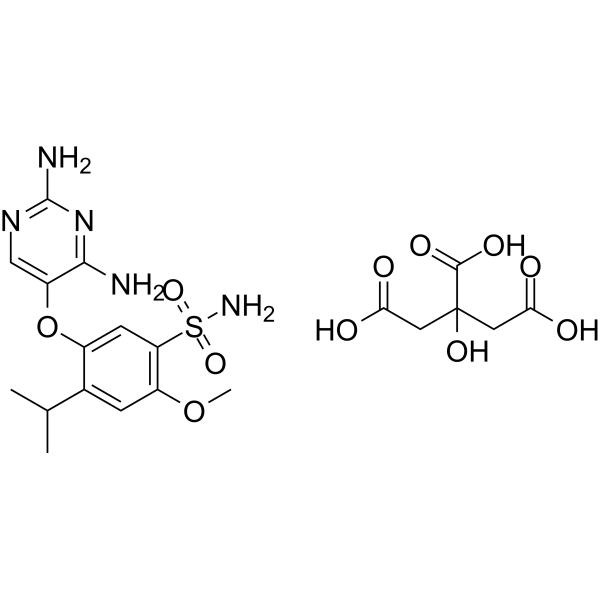
Physicochemical Properties
| Molecular Weight | 545.52 |
| Exact Mass | 545.14 |
| Elemental Analysis | C, 44.04; H, 4.99; N, 12.84; O, 32.26; S, 5.88 |
| CAS # | 2310299-91-1 |
| Related CAS # | Gefapixant;1015787-98-0 |
| PubChem CID | 145720531 |
| Appearance | Solid powder |
| Hydrogen Bond Donor Count | 7 |
| Hydrogen Bond Acceptor Count | 16 |
| Rotatable Bond Count | 10 |
| Heavy Atom Count | 37 |
| Complexity | 739 |
| Defined Atom Stereocenter Count | 0 |
| InChi Key | AIJVJYUOMCRFOE-UHFFFAOYSA-N |
| InChi Code | InChI=1S/C14H19N5O4S.C6H8O7/c1-7(2)8-4-10(22-3)12(24(17,20)21)5-9(8)23-11-6-18-14(16)19-13(11)15;7-3(8)1-6(13,5(11)12)2-4(9)10/h4-7H,1-3H3,(H2,17,20,21)(H4,15,16,18,19);13H,1-2H2,(H,7,8)(H,9,10)(H,11,12) |
| Chemical Name | 5-(2,4-diaminopyrimidin-5-yl)oxy-2-methoxy-4-propan-2-ylbenzenesulfonamide;2-hydroxypropane-1,2,3-tricarboxylic acid |
| Synonyms | Gefapixant citrate; MK-7264; MK 7264; Gefapixant citrate; DFK0FC2VVV; Gefapixant citrate [USAN]; 2310299-91-1; MK-7264; Gefapixant (citrate); UNII-DFK0FC2VVV; MK7264 |
| HS Tariff Code | 2934.99.9001 |
| Storage |
Powder-20°C 3 years 4°C 2 years In solvent -80°C 6 months -20°C 1 month |
| Shipping Condition | Room temperature (This product is stable at ambient temperature for a few days during ordinary shipping and time spent in Customs) |
Biological Activity
| Targets | IC50: ~30 nM (recombinant hP2X3 homotrimers), 100-250 nM (hP2X2/3 heterotrimeric receptors)[1]. |
| ln Vitro | Gemfapic citrate does not inhibit any receptor that contains non-P2X3 subunits (recombinant homotrimeric hP2X1, hP2X2, hP2X4, rP2X5, and hP2X7 channels have IC50 values >10,000 nM) [1]. |
| ln Vivo | In a rat model of knee osteoarthritis (14 days after intra-articular treatment of monoiodoacetate), gemfapic citrate (7 days b.i.d., orally) reduced weight-bearing laterality at both higher dosages. Complete reversal of severe hyperalgesia [2]. |
| Enzyme Assay | The aryloxy-pyrimidinediamine, AF-219 (Ford et al., 2013; Smith et al., 2013) is an orally active small molecule (Mol Wt. ∼350 Daltons) antagonist at human P2X3-containing receptors. The inhibitory potency (IC50) of AF-219 has been reported as ∼30 nM versus recombinant hP2X3 homotrimers and 100–250 nM at hP2X2/3 heterotrimeric receptors, potencies very similar to those reported for recombinant rat receptors, and it displays no inhibitory impact on any non-P2X3 subunit containing receptors (IC50 values ≫ 10,000 nM at recombinant homotrimeric hP2X1, hP2X2, hP2X4, rP2X5 and hP2X7 channels). Reports from other related chemical members of this P2X3 selective pyrimidinediamine class have shown that the mechanism of inhibition is non-competitive (allosteric) and have been mixed regarding species-independency of P2X3 receptor potency estimates: AF-353 (Gever et al., 2010) shows remarkable potency congruency between human and rat recombinant P2X3 homotrimers (IC50 values of 8.7 and 8.9 nM, respectively) whereas the more potent analog AF-792 (also referred to as RO-51; developed initially as a potential prodrug for AF-353) was shown to be less potent at human versus rat P2X3 receptors in one report (Serrano et al., 2012) and yet species-independent in another (Jahangir et al., 2009). It is important to note that some selectivity for P2X3 versus P2X2/3 channels has been a common claim across several chemical classes of inhibitors (see Gum et al., 2012: e.g., AF-219 analogs, nucleotides such as TNP-ATP, benzenetricarboxylic acids such as A-317491), although in most studies values reported are not affinity determinations but IC50 estimates. Under such circumstances true selectivity cannot be categorically inferred, especially for the competitive antagonists (such as TNP-ATP and A-317491) as the IC50 is a parameter that will change with agonist concentration used and depends on agonist potency at the different trimers.[1] |
| ADME/Pharmacokinetics |
Absorption The absolute bioavailability of gefapixant has not been evaluated but is estimated to be ≥78%. At the recommended dose of 45 mg twice daily, steady-state is achieved within 2 days and the steady-state mean plasma AUC and Cmax are 4,144 ng∙hr/mL and 531 ng/mL, respectively. The time to peak plasma concentration (Tmax) following oral administration ranges from one to four hours. The co-administration of gefapixant with a high-fat, high-calorie meal had no effect on its AUC or Cmax. Route of Elimination Gefapixant is primarily eliminated via renal excretion. Following a single oral radiolabeled dose in a healthy male subject, approximately 76.4% of the administered radioactivity was recovered in the urine and 22.6% was recovered in the feces. Unchanged parent drug accounted for 64% of the recovered dose in the feces and accounted for 20% of the recovered dose in the urine. Volume of Distribution Based on population pharmacokinetic analyses, the estimated steady-state apparent volume of distribution is 133.8 L (Vc 101 L and Vp 32.8 L) following oral twice-daily administration of gefapixant 45 mg. Clearance Population pharmacokinetic analyses integrating data from Phase 1, 2, and 3 data showed a geometric mean apparent clearance (Cl/F) of 10.8 L/h. In clinical pharmacology studies, the observed clearance was 14.8 L/h and renal clearance was approximately 8.7 L/h. Metabolism / Metabolites Gefapixant is relatively minimally metabolized. Following oral administration, only 14% of the administered dose was recovered as metabolites in the urine and feces. Unchanged parent drug is the major (87%) drug-related component in plasma, with circulating metabolites accounting for <10% each. The primary biotransformation pathways observed in gefapixant ADME studies included hydroxylation, O-demethylation, dehydrogenation, oxidation, and direct glucuronidation. Secondary biotransformation pathways included glucuronidation of O-demethylated metabolite as well as the formation of a metabolite that was O-demethylated and hydrogenated. The three most abundant circulating metabolites were: M1 (a glucuronide of O-demethylated gefapixant), M5 (a directly glucuronidated parent) and M13 (a hydroxylated metabolite.), which accounted for 1.0%, 6.3%, and 5.8%, respectively, of the total drug-related components in plasma. Biological Half-Life The terminal half-life of gefapixant is 6-10 hours. |
| Toxicity/Toxicokinetics |
Protein Binding
Gefapixant exhibits relatively low protein binding (55%) _in vitro_, and thus drug-drug interactions resulting from protein displacement are not expected. |
| References |
[1]. The therapeutic promise of ATP antagonism at P2X3 receptors in respiratory and urological disorders. Front Cell Neurosci. 2013; 7: 267. [2]. Ford AP, In pursuit of P2X3 antagonists: novel therapeutics for chronic pain and afferent sensitization. Purinergic Signal. 2012 Feb;8(Suppl 1):3-26. [3]. Validation of a visual analog scale for assessing cough severity in patients with chronic cough. Ther Adv Respir Dis. 2021 Jan-Dec;15:17534666211049743. |
| Additional Infomation |
Drug Indication Treatment of unexplained or chronic refractory cough |
Solubility Data
| Solubility (In Vitro) | May dissolve in DMSO (in most cases), if not, try other solvents such as H2O, Ethanol, or DMF with a minute amount of products to avoid loss of samples |
| Solubility (In Vivo) |
Note: Listed below are some common formulations that may be used to formulate products with low water solubility (e.g. < 1 mg/mL), you may test these formulations using a minute amount of products to avoid loss of samples. Injection Formulations (e.g. IP/IV/IM/SC) Injection Formulation 1: DMSO : Tween 80: Saline = 10 : 5 : 85 (i.e. 100 μL DMSO stock solution → 50 μL Tween 80 → 850 μL Saline) *Preparation of saline: Dissolve 0.9 g of sodium chloride in 100 mL ddH ₂ O to obtain a clear solution. Injection Formulation 2: DMSO : PEG300 :Tween 80 : Saline = 10 : 40 : 5 : 45 (i.e. 100 μL DMSO → 400 μLPEG300 → 50 μL Tween 80 → 450 μL Saline) Injection Formulation 3: DMSO : Corn oil = 10 : 90 (i.e. 100 μL DMSO → 900 μL Corn oil) Example: Take the Injection Formulation 3 (DMSO : Corn oil = 10 : 90) as an example, if 1 mL of 2.5 mg/mL working solution is to be prepared, you can take 100 μL 25 mg/mL DMSO stock solution and add to 900 μL corn oil, mix well to obtain a clear or suspension solution (2.5 mg/mL, ready for use in animals). Injection Formulation 4: DMSO : 20% SBE-β-CD in saline = 10 : 90 [i.e. 100 μL DMSO → 900 μL (20% SBE-β-CD in saline)] *Preparation of 20% SBE-β-CD in Saline (4°C,1 week): Dissolve 2 g SBE-β-CD in 10 mL saline to obtain a clear solution. Injection Formulation 5: 2-Hydroxypropyl-β-cyclodextrin : Saline = 50 : 50 (i.e. 500 μL 2-Hydroxypropyl-β-cyclodextrin → 500 μL Saline) Injection Formulation 6: DMSO : PEG300 : castor oil : Saline = 5 : 10 : 20 : 65 (i.e. 50 μL DMSO → 100 μLPEG300 → 200 μL castor oil → 650 μL Saline) Injection Formulation 7: Ethanol : Cremophor : Saline = 10: 10 : 80 (i.e. 100 μL Ethanol → 100 μL Cremophor → 800 μL Saline) Injection Formulation 8: Dissolve in Cremophor/Ethanol (50 : 50), then diluted by Saline Injection Formulation 9: EtOH : Corn oil = 10 : 90 (i.e. 100 μL EtOH → 900 μL Corn oil) Injection Formulation 10: EtOH : PEG300:Tween 80 : Saline = 10 : 40 : 5 : 45 (i.e. 100 μL EtOH → 400 μLPEG300 → 50 μL Tween 80 → 450 μL Saline) Oral Formulations Oral Formulation 1: Suspend in 0.5% CMC Na (carboxymethylcellulose sodium) Oral Formulation 2: Suspend in 0.5% Carboxymethyl cellulose Example: Take the Oral Formulation 1 (Suspend in 0.5% CMC Na) as an example, if 100 mL of 2.5 mg/mL working solution is to be prepared, you can first prepare 0.5% CMC Na solution by measuring 0.5 g CMC Na and dissolve it in 100 mL ddH2O to obtain a clear solution; then add 250 mg of the product to 100 mL 0.5% CMC Na solution, to make the suspension solution (2.5 mg/mL, ready for use in animals). Oral Formulation 3: Dissolved in PEG400 Oral Formulation 4: Suspend in 0.2% Carboxymethyl cellulose Oral Formulation 5: Dissolve in 0.25% Tween 80 and 0.5% Carboxymethyl cellulose Oral Formulation 6: Mixing with food powders Note: Please be aware that the above formulations are for reference only. InvivoChem strongly recommends customers to read literature methods/protocols carefully before determining which formulation you should use for in vivo studies, as different compounds have different solubility properties and have to be formulated differently. (Please use freshly prepared in vivo formulations for optimal results.) |
| Preparing Stock Solutions | 1 mg | 5 mg | 10 mg | |
| 1 mM | 1.8331 mL | 9.1656 mL | 18.3311 mL | |
| 5 mM | 0.3666 mL | 1.8331 mL | 3.6662 mL | |
| 10 mM | 0.1833 mL | 0.9166 mL | 1.8331 mL |