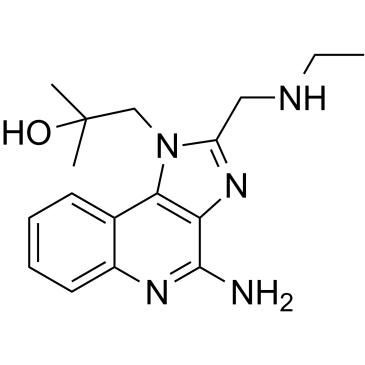
Gardiquimod, an imidazoquinoline compound, is a novel, potent and specific agonist of TLR7 (toll-like receptor 7) with antitumor and immunomodulatory effects. It also inhibits HIV-1 reverse transcriptase. Gardiquimod can promote the proliferation of murine splenocytes, stimulate the activation of splenic T, NK and natural killer T (NKT) cells, increase the cytolytic activity of splenocytes against B16 and MCA-38 tumor cell lines, and enhance the expression of costimulatory molecules and IL-12 by macrophages and bone marrow-derived dendritic cells (DCs). In a murine model, Gardiquimod improved the antitumor effects of tumor lysate-loaded DCs, resulting in delayed growth of subcutaneous B16 melanoma tumors and suppression of pulmonary metastasis. Gardiquimod demonstrated more potent antitumor activity than imiquimod. These results suggest that TLR7/8 agonists such as Gardiquimod may serve as potent innate and adaptive immune response modifiers in tumor therapy. More importantly, they can be used as vaccine adjuvants to potentiate the efficiency of DC-based tumor immunotherapy.
Physicochemical Properties
| Molecular Formula | C17H23N5O |
| Molecular Weight | 313.3974 |
| Exact Mass | 313.19 |
| CAS # | 1020412-43-4 |
| Related CAS # | Gardiquimod diTFA;1159840-61-5 |
| PubChem CID | 44592366 |
| Appearance | White to off-white solid powder |
| LogP | 3.019 |
| Hydrogen Bond Donor Count | 3 |
| Hydrogen Bond Acceptor Count | 5 |
| Rotatable Bond Count | 5 |
| Heavy Atom Count | 23 |
| Complexity | 404 |
| Defined Atom Stereocenter Count | 0 |
| SMILES | 0 |
| Synonyms | Gardiquimod TFA salt Gardiquimod |
| HS Tariff Code | 2934.99.9001 |
| Storage |
Powder-20°C 3 years 4°C 2 years In solvent -80°C 6 months -20°C 1 month |
| Shipping Condition | Room temperature (This product is stable at ambient temperature for a few days during ordinary shipping and time spent in Customs) |
Biological Activity
| ln Vitro | HIV-1 reverse transcriptase's ability to synthesize cDNA is markedly inhibited by gardiquimod (6–60 μM) [1]. |
| ln Vivo | Dendritic cells (DC) and gadiquimod (1 mg/kg per mouse; intraperitoneal injection; every day for 7 days) together amplify the natural killer (NK) impact against tumors [2]. |
| Animal Protocol |
Animal/Disease Models: Male athymic nude mice (Balb-nu/nu, 5 weeks old) (carrying human HepG2 liver cancer xenografts) [2] Doses: 1 mg/kg per mouse Doses: intraperitoneal (ip) injection; one time/day , lasting 7 days. Experimental Results: Dramatically inhibited the growth of human HepG2 liver cancer xenografts. |
| References |
[1]. Gardiquimod: a Toll-like receptor-7 agonist that inhibits HIV type 1 infection of human macrophages and activated T cells. AIDS Res Hum Retroviruses. 2013 Jun;29(6):907-18. [2]. TLR7/8 agonists promote NK-DC cross-talk to enhance NK cell anti-tumor effects in hepatocellular carcinoma. Cancer Lett. 2015 Dec 28;369(2):298-306. |
Solubility Data
| Solubility (In Vitro) |
DMF :≥ 20 mg/mL (~63.82 mM) DMSO : ≥ 20 mg/mL (~63.82 mM) Ethanol :≥ 12 mg/mL (~38.29 mM) |
| Solubility (In Vivo) |
Note: Listed below are some common formulations that may be used to formulate products with low water solubility (e.g. < 1 mg/mL), you may test these formulations using a minute amount of products to avoid loss of samples. Injection Formulations (e.g. IP/IV/IM/SC) Injection Formulation 1: DMSO : Tween 80: Saline = 10 : 5 : 85 (i.e. 100 μL DMSO stock solution → 50 μL Tween 80 → 850 μL Saline) *Preparation of saline: Dissolve 0.9 g of sodium chloride in 100 mL ddH ₂ O to obtain a clear solution. Injection Formulation 2: DMSO : PEG300 :Tween 80 : Saline = 10 : 40 : 5 : 45 (i.e. 100 μL DMSO → 400 μLPEG300 → 50 μL Tween 80 → 450 μL Saline) Injection Formulation 3: DMSO : Corn oil = 10 : 90 (i.e. 100 μL DMSO → 900 μL Corn oil) Example: Take the Injection Formulation 3 (DMSO : Corn oil = 10 : 90) as an example, if 1 mL of 2.5 mg/mL working solution is to be prepared, you can take 100 μL 25 mg/mL DMSO stock solution and add to 900 μL corn oil, mix well to obtain a clear or suspension solution (2.5 mg/mL, ready for use in animals). Injection Formulation 4: DMSO : 20% SBE-β-CD in saline = 10 : 90 [i.e. 100 μL DMSO → 900 μL (20% SBE-β-CD in saline)] *Preparation of 20% SBE-β-CD in Saline (4°C,1 week): Dissolve 2 g SBE-β-CD in 10 mL saline to obtain a clear solution. Injection Formulation 5: 2-Hydroxypropyl-β-cyclodextrin : Saline = 50 : 50 (i.e. 500 μL 2-Hydroxypropyl-β-cyclodextrin → 500 μL Saline) Injection Formulation 6: DMSO : PEG300 : castor oil : Saline = 5 : 10 : 20 : 65 (i.e. 50 μL DMSO → 100 μLPEG300 → 200 μL castor oil → 650 μL Saline) Injection Formulation 7: Ethanol : Cremophor : Saline = 10: 10 : 80 (i.e. 100 μL Ethanol → 100 μL Cremophor → 800 μL Saline) Injection Formulation 8: Dissolve in Cremophor/Ethanol (50 : 50), then diluted by Saline Injection Formulation 9: EtOH : Corn oil = 10 : 90 (i.e. 100 μL EtOH → 900 μL Corn oil) Injection Formulation 10: EtOH : PEG300:Tween 80 : Saline = 10 : 40 : 5 : 45 (i.e. 100 μL EtOH → 400 μLPEG300 → 50 μL Tween 80 → 450 μL Saline) Oral Formulations Oral Formulation 1: Suspend in 0.5% CMC Na (carboxymethylcellulose sodium) Oral Formulation 2: Suspend in 0.5% Carboxymethyl cellulose Example: Take the Oral Formulation 1 (Suspend in 0.5% CMC Na) as an example, if 100 mL of 2.5 mg/mL working solution is to be prepared, you can first prepare 0.5% CMC Na solution by measuring 0.5 g CMC Na and dissolve it in 100 mL ddH2O to obtain a clear solution; then add 250 mg of the product to 100 mL 0.5% CMC Na solution, to make the suspension solution (2.5 mg/mL, ready for use in animals). Oral Formulation 3: Dissolved in PEG400 Oral Formulation 4: Suspend in 0.2% Carboxymethyl cellulose Oral Formulation 5: Dissolve in 0.25% Tween 80 and 0.5% Carboxymethyl cellulose Oral Formulation 6: Mixing with food powders Note: Please be aware that the above formulations are for reference only. InvivoChem strongly recommends customers to read literature methods/protocols carefully before determining which formulation you should use for in vivo studies, as different compounds have different solubility properties and have to be formulated differently. (Please use freshly prepared in vivo formulations for optimal results.) |
| Preparing Stock Solutions | 1 mg | 5 mg | 10 mg | |
| 1 mM | 3.1908 mL | 15.9541 mL | 31.9081 mL | |
| 5 mM | 0.6382 mL | 3.1908 mL | 6.3816 mL | |
| 10 mM | 0.3191 mL | 1.5954 mL | 3.1908 mL |