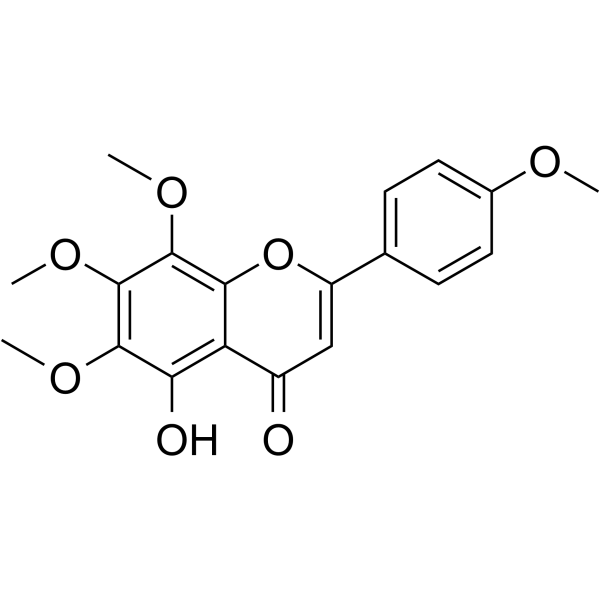
Physicochemical Properties
| Molecular Formula | C19H18O7 |
| Molecular Weight | 358.3420 |
| Exact Mass | 358.105 |
| CAS # | 2798-20-1 |
| PubChem CID | 96539 |
| Appearance | Light yellow to green yellow solid powder |
| Density | 1.3±0.1 g/cm3 |
| Boiling Point | 582.0±50.0 °C at 760 mmHg |
| Melting Point | 180-181ºC |
| Flash Point | 210.8±23.6 °C |
| Vapour Pressure | 0.0±1.7 mmHg at 25°C |
| Index of Refraction | 1.593 |
| LogP | 2.27 |
| Hydrogen Bond Donor Count | 1 |
| Hydrogen Bond Acceptor Count | 7 |
| Rotatable Bond Count | 5 |
| Heavy Atom Count | 26 |
| Complexity | 526 |
| Defined Atom Stereocenter Count | 0 |
| InChi Key | LXEVSYZNYDZSOB-UHFFFAOYSA-N |
| InChi Code | InChI=1S/C19H18O7/c1-22-11-7-5-10(6-8-11)13-9-12(20)14-15(21)17(23-2)19(25-4)18(24-3)16(14)26-13/h5-9,21H,1-4H3 |
| Chemical Name | 5-hydroxy-6,7,8-trimethoxy-2-(4-methoxyphenyl)chromen-4-one |
| HS Tariff Code | 2934.99.9001 |
| Storage |
Powder-20°C 3 years 4°C 2 years In solvent -80°C 6 months -20°C 1 month Note: This product requires protection from light (avoid light exposure) during transportation and storage. |
| Shipping Condition | Room temperature (This product is stable at ambient temperature for a few days during ordinary shipping and time spent in Customs) |
Biological Activity
| Targets |
- Caspase family (caspase-3, caspase-8, caspase-9) [1] - Apoptosis-related proteins (Bax, Bcl-2) [1] - Human leukemia cells (HL-60: IC50 = 12.5 ± 1.3 μM; U937: IC50 = 15.7 ± 1.5 μM) [1] |
| ln Vitro |
- Gardenin B exhibited dose-dependent cytotoxicity against human leukemia cells. For HL-60 cells, IC50 was 12.5 ± 1.3 μM; for U937 cells, IC50 was 15.7 ± 1.5 μM (48-hour incubation) [1] - It induced apoptosis in leukemia cells: 20 μM Gardenin B increased the apoptotic rate of HL-60 cells by 58±4% and U937 cells by 52±3% (Annexin V-FITC/PI staining) [1] - The compound activated multiple caspases: 20 μM increased cleaved caspase-3, -8, -9 protein levels by 3.2±0.3, 2.8±0.2, and 2.5±0.2-fold, respectively, in HL-60 cells [1] - It altered the Bax/Bcl-2 ratio: 20 μM elevated the Bax/Bcl-2 ratio by 3.8±0.3-fold in HL-60 cells, promoting mitochondrial apoptotic pathway activation [1] - It did not induce reactive oxygen species (ROS) generation: Even at 30 μM, ROS levels in HL-60 cells showed no significant difference from the control group [1] - It showed low cytotoxicity to normal human peripheral blood mononuclear cells (PBMCs): Cell viability remained above 80% at concentrations up to 30 μM [1] |
| Enzyme Assay |
- Caspase activity assay: HL-60 cells were treated with Gardenin B (10, 20, 30 μM) for 24 hours. Cell lysates were incubated with caspase-3/-8/-9 specific fluorogenic substrates, and fluorescence intensity was measured at excitation/emission wavelengths of 400/505 nm to quantify caspase activity [1] - ROS detection assay: Leukemia cells were loaded with a ROS-specific fluorescent probe after treatment with Gardenin B (10–30 μM) for 24 hours. Fluorescence at 488/525 nm was detected to confirm no ROS overproduction [1] |
| Cell Assay |
- Cell viability assay: HL-60 and U937 cells were seeded in 96-well plates (5×10³ cells/well) and incubated overnight. Gardenin B (5–30 μM) was added, and cells were cultured for 48 hours. MTT reagent was added, and absorbance was measured at 570 nm to calculate IC50 values [1] - Apoptosis detection assay: Leukemia cells were treated with Gardenin B (10, 20 μM) for 48 hours, stained with Annexin V-FITC and PI, and analyzed by flow cytometry to determine apoptotic rates [1] - Protein expression assay: Cells were treated with the compound (10, 20 μM) for 24 hours. Total protein was extracted for Western blot analysis of cleaved caspase-3/-8/-9, Bax, and Bcl-2 [1] - Normal cell cytotoxicity assay: Human PBMCs were treated with Gardenin B (10–30 μM) for 48 hours, and cell viability was measured by MTT assay [1] |
| Toxicity/Toxicokinetics |
- Selective toxicity: Potent cytotoxicity to leukemia cells (IC50 12.5–15.7 μM) but low toxicity to normal PBMCs (viability >80% at 30 μM) [1] - No oxidative stress induction: Did not generate ROS in leukemia cells, avoiding non-specific oxidative damage [1] |
| References |
[1]. Gardenin B-induced cell death in human leukemia cells involves multiple caspases but is independent of the generation of reactive oxygen species. Chem Biol Interact. 2016 Aug 25;256:220-7. |
| Additional Infomation |
Gardenin B is a tetramethoxyflavone that is tangeretin in which the methoxy group at position 5 has been replaced by a hydroxy group. It has a role as a plant metabolite. It is a tetramethoxyflavone and a monohydroxyflavone. It is functionally related to a tangeretin. Gardenin B has been reported in Citrus tankan, Citrus reticulata, and other organisms with data available. - Gardenin B is a natural flavonoid compound isolated from plant sources [1] - Its anti-leukemia mechanism involves activating the caspase-dependent apoptotic pathway (intrinsic and extrinsic pathways) by upregulating Bax, downregulating Bcl-2, and cleaving caspases-3/-8/-9 [1] - It induces cell death independent of ROS generation, distinguishing it from ROS-mediated anti-cancer agents [1] - It shows potential as a targeted anti-leukemia candidate due to its selective toxicity to leukemia cells [1] |
Solubility Data
| Solubility (In Vitro) | DMSO : ~10 mg/mL (~27.91 mM) |
| Solubility (In Vivo) |
Solubility in Formulation 1: 2.5 mg/mL (6.98 mM) in 10% DMSO + 90% (20% SBE-β-CD in Saline) (add these co-solvents sequentially from left to right, and one by one), suspension solution; with sonication. For example, if 1 mL of working solution is to be prepared, you can add 100 μL of 25.0 mg/mL clear DMSO stock solution to 900 μL of 20% SBE-β-CD physiological saline solution and mix evenly. Preparation of 20% SBE-β-CD in Saline (4°C,1 week): Dissolve 2 g SBE-β-CD in 10 mL saline to obtain a clear solution. Solubility in Formulation 2: 1.67 mg/mL (4.66 mM) in 10% DMSO + 40% PEG300 + 5% Tween80 + 45% Saline (add these co-solvents sequentially from left to right, and one by one), suspension solution; with ultrasonication. For example, if 1 mL of working solution is to be prepared, you can add 100 μL of 16.7 mg/mL clear DMSO stock solution to 400 μL PEG300 and mix evenly; then add 50 μL Tween-80 to the above solution and mix evenly; then add 450 μL normal saline to adjust the volume to 1 mL. Preparation of saline: Dissolve 0.9 g of sodium chloride in 100 mL ddH₂ O to obtain a clear solution. (Please use freshly prepared in vivo formulations for optimal results.) |
| Preparing Stock Solutions | 1 mg | 5 mg | 10 mg | |
| 1 mM | 2.7906 mL | 13.9532 mL | 27.9065 mL | |
| 5 mM | 0.5581 mL | 2.7906 mL | 5.5813 mL | |
| 10 mM | 0.2791 mL | 1.3953 mL | 2.7906 mL |