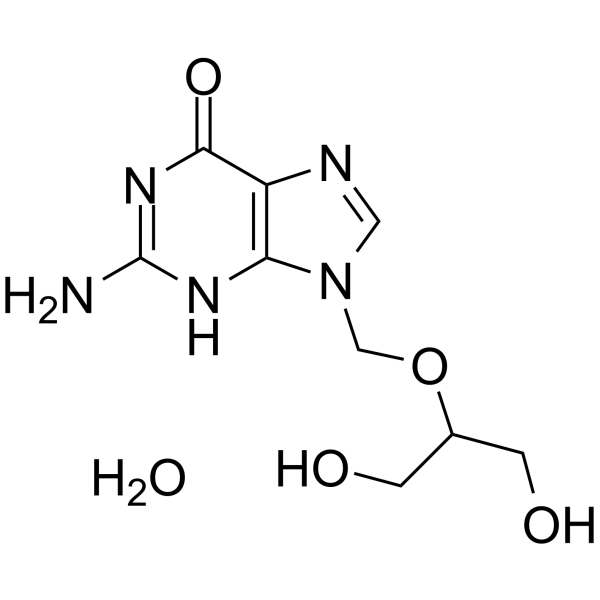
Ganciclovir hydrate is a novel and potent antiviral medication used to treat or prevent cytomegalovirus (CMV) infections. Ganciclovir (2'-Nor-2'-deoxyguanosine, BW-759) is a novel and potent herpes simplex virus (HSV) inhibitor. It is a synthetic analog of 2'-deoxy-guanosineused to treat or prevent cytomegalovirus (CMV) infections. It acts by inhibiting the replication of human CMV with an IC50 value of 0.01 μM and is effective against strains of CMV from human, monkey, mouse, and guinea pig.
Physicochemical Properties
| Molecular Formula | C9H15N5O5 |
| Molecular Weight | 273.245901346207 |
| Exact Mass | 273.107 |
| Elemental Analysis | C, 39.56; H, 5.53; N, 25.63; O, 29.28 |
| CAS # | 1359968-33-4 |
| Related CAS # | Ganciclovir;82410-32-0;Ganciclovir sodium;107910-75-8 |
| PubChem CID | 76449958 |
| Appearance | White to off-white solid powder. |
| Hydrogen Bond Donor Count | 4 |
| Hydrogen Bond Acceptor Count | 6 |
| Rotatable Bond Count | 5 |
| Heavy Atom Count | 19 |
| Complexity | 429 |
| Defined Atom Stereocenter Count | 0 |
| InChi Key | KLXHZXWXXKSKRU-UHFFFAOYSA-N |
| InChi Code | InChI=1S/C9H13N5O4.H2O/c10-9-12-7-6(8(17)13-9)11-3-14(7)4-18-5(1-15)2-16;/h3,5,15-16H,1-2,4H2,(H3,10,12,13,17);1H2 |
| Chemical Name | 2-amino-9-(((1,3-dihydroxypropan-2-yl)oxy)methyl)-3H-purin-6(9H)-one hydrate |
| Synonyms | BW-759; RS-21592; BW 759; RS 21592; BW759; BIOLF-62; RS21592; Ganciclovir; Ganciclovir Sodium; trade names: Cytovene; Cymevene; Vitrasert. |
| HS Tariff Code | 2934.99.9001 |
| Storage |
Powder-20°C 3 years 4°C 2 years In solvent -80°C 6 months -20°C 1 month |
| Shipping Condition | Room temperature (This product is stable at ambient temperature for a few days during ordinary shipping and time spent in Customs) |
Biological Activity
| Targets | FHV-1(IC50=5.2 μM) |
| ln Vitro |
Acyclic deoxyguanosine analog ganciclovir (BW 759) has better anti-CMV activity than acyclovir while sharing structural similarities with the latter. Compared to 72 μM for acyclovir, the median Ganciclovir concentration needed to inhibit viral replication by 50% is 2.15 μM[4]. Ganciclovir-5'-triphosphate (ganciclovir-TP) inhibits the replication of viral DNA, which is the main mechanism by which ganciclovir works against CMV. A particular and strong inhibition of the viral DNA polymerase is part of this inhibition. Three main cellular enzymes convert ganciclovir to its triphosphate form: phosphoglycerate kinase, guanylate kinase, and a deoxyguanosine kinase that is activated by CMV-infected cells[5]. |
| ln Vivo |
Ganciclovir (BW 759) (50 mg/kg; intraperitoneal; twice daily for five injections) can diffuse into the brain and the perilymphatic space of the inner ear and dramatically reduce white blood cells, red blood cells, and platelets in newborn mice[3]. Ganciclovir (1–80 mg/kg; i.h.; daily for 5 days) postpones mortality and wasting syndrome brought on by the murine cytomegalovirus (MCMV)[6]. |
| Animal Protocol |
Animal Model: Albino rats and non-inbred Oncins France 1 (OF1) mice are not immune to MCMV[3] Dosage: 50 mg/kg Administration: Intraperitoneal injection, twice daily for three days (adult rats) or five injections (mice) (Pharmacokinetic Study) Result: Ganciclovir's intracochlear diffusion in adult rats has been demonstrated to reach blood-level concentrations. Transplacental diffusion was seen in gestating mice, exhibiting a 0.5 fetal-to-maternal blood ratio. Ganciclovir's plasma concentration profile in neonatal mice peaked at two hours and then gradually decreased. The concentration in adult mice peaked one hour after injection, but by two hours later, it was no longer detectable. reduced platelets, red blood cells, and white blood cells in neonatal mice significantly. |
| References |
[1]. Ganciclovir. A review of its antiviral activity, pharmacokinetic properties and therapeutic efficacy in cytomegalovirus infections. Drugs. 1990;39(4):597-638. [2]. In vitro efficacy of ganciclovir, cidofovir, penciclovir, foscarnet, idoxuridine, and acyclovir against feline herpesvirus type-1. Am J Vet Res. 2004 Apr;65(4):399-403. [3]. Pharmacokinetics and tissue diffusion of ganciclovir in mice and rats. Antiviral Res. 2016;132:111-115. [4]. Evaluation of ganciclovir for cytomegalovirus disease. DICP. 1989 Jan;23(1):5-12. [5]. Antiviral activity and mechanism of action of ganciclovir. Rev Infect Dis. 1988 Jul-Aug;10 Suppl 3:S490-4. [6]. Duan J, Paris W, Kibler P, Bousquet C, Liuzzi M, Cordingley MG. Dose and duration-dependence of ganciclovir treatment against murine cytomegalovirus infection in severe combined immunodeficient mice. Antiviral Res. 1998;39(3):189-197. |
Solubility Data
| Solubility (In Vitro) | May dissolve in DMSO (in most cases), if not, try other solvents such as H2O, Ethanol, or DMF with a minute amount of products to avoid loss of samples |
| Solubility (In Vivo) |
Note: Listed below are some common formulations that may be used to formulate products with low water solubility (e.g. < 1 mg/mL), you may test these formulations using a minute amount of products to avoid loss of samples. Injection Formulations (e.g. IP/IV/IM/SC) Injection Formulation 1: DMSO : Tween 80: Saline = 10 : 5 : 85 (i.e. 100 μL DMSO stock solution → 50 μL Tween 80 → 850 μL Saline) *Preparation of saline: Dissolve 0.9 g of sodium chloride in 100 mL ddH ₂ O to obtain a clear solution. Injection Formulation 2: DMSO : PEG300 :Tween 80 : Saline = 10 : 40 : 5 : 45 (i.e. 100 μL DMSO → 400 μLPEG300 → 50 μL Tween 80 → 450 μL Saline) Injection Formulation 3: DMSO : Corn oil = 10 : 90 (i.e. 100 μL DMSO → 900 μL Corn oil) Example: Take the Injection Formulation 3 (DMSO : Corn oil = 10 : 90) as an example, if 1 mL of 2.5 mg/mL working solution is to be prepared, you can take 100 μL 25 mg/mL DMSO stock solution and add to 900 μL corn oil, mix well to obtain a clear or suspension solution (2.5 mg/mL, ready for use in animals). Injection Formulation 4: DMSO : 20% SBE-β-CD in saline = 10 : 90 [i.e. 100 μL DMSO → 900 μL (20% SBE-β-CD in saline)] *Preparation of 20% SBE-β-CD in Saline (4°C,1 week): Dissolve 2 g SBE-β-CD in 10 mL saline to obtain a clear solution. Injection Formulation 5: 2-Hydroxypropyl-β-cyclodextrin : Saline = 50 : 50 (i.e. 500 μL 2-Hydroxypropyl-β-cyclodextrin → 500 μL Saline) Injection Formulation 6: DMSO : PEG300 : castor oil : Saline = 5 : 10 : 20 : 65 (i.e. 50 μL DMSO → 100 μLPEG300 → 200 μL castor oil → 650 μL Saline) Injection Formulation 7: Ethanol : Cremophor : Saline = 10: 10 : 80 (i.e. 100 μL Ethanol → 100 μL Cremophor → 800 μL Saline) Injection Formulation 8: Dissolve in Cremophor/Ethanol (50 : 50), then diluted by Saline Injection Formulation 9: EtOH : Corn oil = 10 : 90 (i.e. 100 μL EtOH → 900 μL Corn oil) Injection Formulation 10: EtOH : PEG300:Tween 80 : Saline = 10 : 40 : 5 : 45 (i.e. 100 μL EtOH → 400 μLPEG300 → 50 μL Tween 80 → 450 μL Saline) Oral Formulations Oral Formulation 1: Suspend in 0.5% CMC Na (carboxymethylcellulose sodium) Oral Formulation 2: Suspend in 0.5% Carboxymethyl cellulose Example: Take the Oral Formulation 1 (Suspend in 0.5% CMC Na) as an example, if 100 mL of 2.5 mg/mL working solution is to be prepared, you can first prepare 0.5% CMC Na solution by measuring 0.5 g CMC Na and dissolve it in 100 mL ddH2O to obtain a clear solution; then add 250 mg of the product to 100 mL 0.5% CMC Na solution, to make the suspension solution (2.5 mg/mL, ready for use in animals). Oral Formulation 3: Dissolved in PEG400 Oral Formulation 4: Suspend in 0.2% Carboxymethyl cellulose Oral Formulation 5: Dissolve in 0.25% Tween 80 and 0.5% Carboxymethyl cellulose Oral Formulation 6: Mixing with food powders Note: Please be aware that the above formulations are for reference only. InvivoChem strongly recommends customers to read literature methods/protocols carefully before determining which formulation you should use for in vivo studies, as different compounds have different solubility properties and have to be formulated differently. (Please use freshly prepared in vivo formulations for optimal results.) |
| Preparing Stock Solutions | 1 mg | 5 mg | 10 mg | |
| 1 mM | 3.6597 mL | 18.2983 mL | 36.5965 mL | |
| 5 mM | 0.7319 mL | 3.6597 mL | 7.3193 mL | |
| 10 mM | 0.3660 mL | 1.8298 mL | 3.6597 mL |