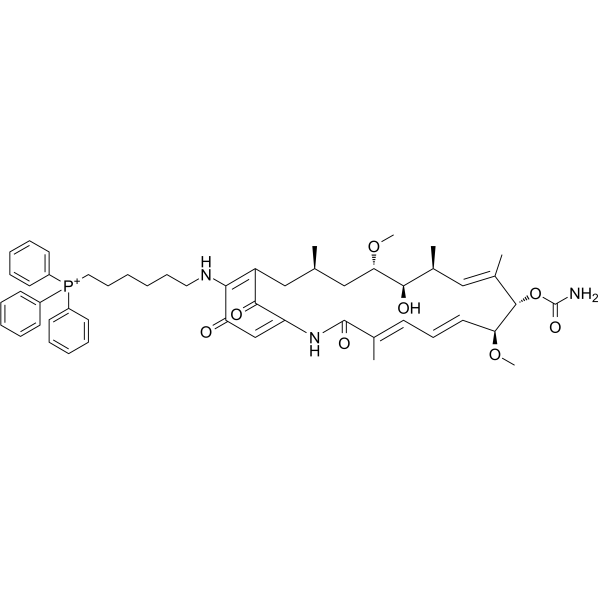
Physicochemical Properties
| Molecular Formula | C52H65N3O8P |
| Molecular Weight | 891.061575651169 |
| Exact Mass | 890.45 |
| CAS # | 1131626-46-4 |
| Related CAS # | Gamitrinib TPP hexafluorophosphate;1131626-47-5 |
| PubChem CID | 25232582 |
| Appearance | Typically exists as solid at room temperature |
| LogP | 7.8 |
| Hydrogen Bond Donor Count | 4 |
| Hydrogen Bond Acceptor Count | 9 |
| Rotatable Bond Count | 15 |
| Heavy Atom Count | 64 |
| Complexity | 1690 |
| Defined Atom Stereocenter Count | 6 |
| SMILES | C[C@H]1C[C@@H]([C@@H]([C@H](/C=C(/[C@@H]([C@H](/C=C\C=C(\C(=O)NC2=CC(=O)C(=C(C1)C2=O)NCCCCCC[P+](C3=CC=CC=C3)(C4=CC=CC=C4)C5=CC=CC=C5)/C)OC)OC(=O)N)\C)C)O)OC |
| InChi Key | OAUJLFPWRFHSNE-FEHIUCOBSA-O |
| InChi Code | InChI=1S/C52H64N3O8P/c1-35-31-42-47(54-29-18-7-8-19-30-64(39-22-12-9-13-23-39,40-24-14-10-15-25-40)41-26-16-11-17-27-41)44(56)34-43(49(42)58)55-51(59)36(2)21-20-28-45(61-5)50(63-52(53)60)38(4)33-37(3)48(57)46(32-35)62-6/h9-17,20-28,33-35,37,45-46,48,50,57H,7-8,18-19,29-32H2,1-6H3,(H3-,53,54,55,56,58,59,60)/p+1/b28-20-,36-21+,38-33+/t35-,37+,45+,46+,48-,50+/m1/s1 |
| Chemical Name | 6-[[(4E,6Z,8S,9S,10E,12S,13R,14S,16R)-9-carbamoyloxy-13-hydroxy-8,14-dimethoxy-4,10,12,16-tetramethyl-3,20,22-trioxo-2-azabicyclo[16.3.1]docosa-1(21),4,6,10,18-pentaen-19-yl]amino]hexyl-triphenylphosphanium |
| HS Tariff Code | 2934.99.9001 |
| Storage |
Powder-20°C 3 years 4°C 2 years In solvent -80°C 6 months -20°C 1 month |
| Shipping Condition | Room temperature (This product is stable at ambient temperature for a few days during ordinary shipping and time spent in Customs) |
Biological Activity
| ln Vitro | Glioblastoma cell lines generated from patients were indiscriminately destroyed by gamitinib TPP at concentrations of 15-20 μM after 16 hours of exposure. This cell death reaction, which is indicative of mitochondrial apoptosis, is accompanied by the activation of the caspase-9 promoter and effectors, the release of cytochrome c into the cytoplasm, the loss of intraorganellar membrane potential, and the annexin V cell reactivity. Gambitrinib TPP does not cause the death of normal fetal human astrocytes (FHAS), because Hsp90 is only found in the mitochondria of tumor cells and not in normal tissues. Normal or tumor cells were unaffected by non-subcellular targeting of 17-AAG under comparable circumstances [1]. |
| ln Vivo | It's interesting to note that established glioblastomas were able to grow slower after two cycles of intracranial TRAIL combined with systemic G-TPP, and the animals' body weight did not significantly drop during the course of treatment. Brain sections from these mice were analyzed; however, brain sections from animals receiving monotherapy did not show tumor cell proliferation, internucleosomal DNA fragmentation, or loss of caspase-3 activity, which is consistent with apoptosis being widely activated in vivo [1]. |
| References |
[1]. Exploiting the mitochondrial unfolded protein response for cancer therapy in mice and human cells. J Clin Invest. 2011 Apr 1; 121(4): 1349–1360. |
| Additional Infomation | Gamitrinib is a resorcinolic-based mitochondrial-targeted heat shock protein 90 (Hsp90) family inhibitor, with potential antineoplastic activity. Upon administration, gamitrinib targets and inhibits the activity of Hsp90 heat shock proteins, such as TNF receptor-associated protein-1 (TRAP1). This induces the accumulation of the mitochondrial kinase PINK1 and the cytosolic E3 ubiquitin (Ub) ligase Parkin, ubiquitylates substrate proteins, and induces PINK1/Parkin-dependent mitophagy. Gamitrinib induces acute mitochondrial dysfunction, loss of membrane potential and membrane rupture leading to the induction of apoptosis in susceptible tumor cells. Hsp90, a chaperone complex protein upregulated in a variety of tumor cell types, regulates the folding and degradation of many oncogenic signaling proteins. |
Solubility Data
| Solubility (In Vitro) | May dissolve in DMSO (in most cases), if not, try other solvents such as H2O, Ethanol, or DMF with a minute amount of products to avoid loss of samples |
| Solubility (In Vivo) |
Note: Listed below are some common formulations that may be used to formulate products with low water solubility (e.g. < 1 mg/mL), you may test these formulations using a minute amount of products to avoid loss of samples. Injection Formulations (e.g. IP/IV/IM/SC) Injection Formulation 1: DMSO : Tween 80: Saline = 10 : 5 : 85 (i.e. 100 μL DMSO stock solution → 50 μL Tween 80 → 850 μL Saline) *Preparation of saline: Dissolve 0.9 g of sodium chloride in 100 mL ddH ₂ O to obtain a clear solution. Injection Formulation 2: DMSO : PEG300 :Tween 80 : Saline = 10 : 40 : 5 : 45 (i.e. 100 μL DMSO → 400 μLPEG300 → 50 μL Tween 80 → 450 μL Saline) Injection Formulation 3: DMSO : Corn oil = 10 : 90 (i.e. 100 μL DMSO → 900 μL Corn oil) Example: Take the Injection Formulation 3 (DMSO : Corn oil = 10 : 90) as an example, if 1 mL of 2.5 mg/mL working solution is to be prepared, you can take 100 μL 25 mg/mL DMSO stock solution and add to 900 μL corn oil, mix well to obtain a clear or suspension solution (2.5 mg/mL, ready for use in animals). Injection Formulation 4: DMSO : 20% SBE-β-CD in saline = 10 : 90 [i.e. 100 μL DMSO → 900 μL (20% SBE-β-CD in saline)] *Preparation of 20% SBE-β-CD in Saline (4°C,1 week): Dissolve 2 g SBE-β-CD in 10 mL saline to obtain a clear solution. Injection Formulation 5: 2-Hydroxypropyl-β-cyclodextrin : Saline = 50 : 50 (i.e. 500 μL 2-Hydroxypropyl-β-cyclodextrin → 500 μL Saline) Injection Formulation 6: DMSO : PEG300 : castor oil : Saline = 5 : 10 : 20 : 65 (i.e. 50 μL DMSO → 100 μLPEG300 → 200 μL castor oil → 650 μL Saline) Injection Formulation 7: Ethanol : Cremophor : Saline = 10: 10 : 80 (i.e. 100 μL Ethanol → 100 μL Cremophor → 800 μL Saline) Injection Formulation 8: Dissolve in Cremophor/Ethanol (50 : 50), then diluted by Saline Injection Formulation 9: EtOH : Corn oil = 10 : 90 (i.e. 100 μL EtOH → 900 μL Corn oil) Injection Formulation 10: EtOH : PEG300:Tween 80 : Saline = 10 : 40 : 5 : 45 (i.e. 100 μL EtOH → 400 μLPEG300 → 50 μL Tween 80 → 450 μL Saline) Oral Formulations Oral Formulation 1: Suspend in 0.5% CMC Na (carboxymethylcellulose sodium) Oral Formulation 2: Suspend in 0.5% Carboxymethyl cellulose Example: Take the Oral Formulation 1 (Suspend in 0.5% CMC Na) as an example, if 100 mL of 2.5 mg/mL working solution is to be prepared, you can first prepare 0.5% CMC Na solution by measuring 0.5 g CMC Na and dissolve it in 100 mL ddH2O to obtain a clear solution; then add 250 mg of the product to 100 mL 0.5% CMC Na solution, to make the suspension solution (2.5 mg/mL, ready for use in animals). Oral Formulation 3: Dissolved in PEG400 Oral Formulation 4: Suspend in 0.2% Carboxymethyl cellulose Oral Formulation 5: Dissolve in 0.25% Tween 80 and 0.5% Carboxymethyl cellulose Oral Formulation 6: Mixing with food powders Note: Please be aware that the above formulations are for reference only. InvivoChem strongly recommends customers to read literature methods/protocols carefully before determining which formulation you should use for in vivo studies, as different compounds have different solubility properties and have to be formulated differently. (Please use freshly prepared in vivo formulations for optimal results.) |
| Preparing Stock Solutions | 1 mg | 5 mg | 10 mg | |
| 1 mM | 1.1223 mL | 5.6113 mL | 11.2226 mL | |
| 5 mM | 0.2245 mL | 1.1223 mL | 2.2445 mL | |
| 10 mM | 0.1122 mL | 0.5611 mL | 1.1223 mL |