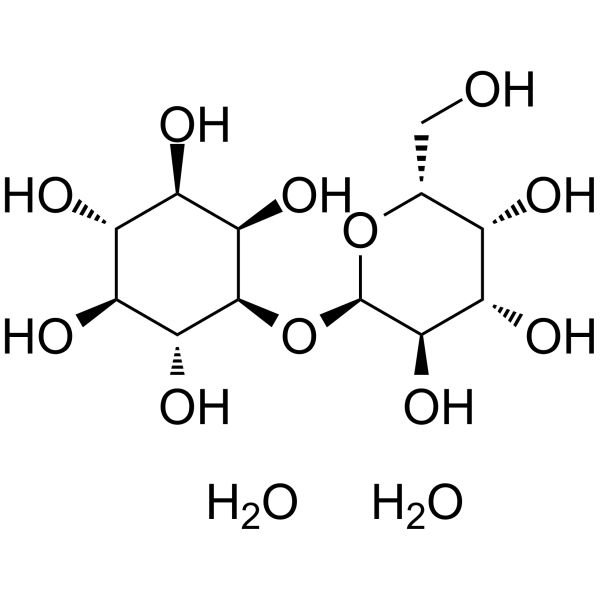
Physicochemical Properties
| Molecular Formula | C12H24O12 |
| Molecular Weight | 360.311765670776 |
| Exact Mass | 378.137 |
| CAS # | 1217474-91-3 |
| PubChem CID | 16218555 |
| Appearance | White to off-white solid powder |
| Hydrogen Bond Donor Count | 11 |
| Hydrogen Bond Acceptor Count | 13 |
| Rotatable Bond Count | 3 |
| Heavy Atom Count | 25 |
| Complexity | 379 |
| Defined Atom Stereocenter Count | 9 |
| SMILES | C([C@@H]1[C@@H]([C@@H]([C@H]([C@H](O1)OC2[C@@H]([C@H](C([C@H]([C@H]2O)O)O)O)O)O)O)O)O.O.O |
| InChi Key | HGCURVXTXVAIIR-XIENVMDPSA-N |
| InChi Code | InChI=1S/C12H22O11.2H2O/c13-1-2-3(14)4(15)10(21)12(22-2)23-11-8(19)6(17)5(16)7(18)9(11)20;;/h2-21H,1H2;2*1H2/t2-,3+,4+,5?,6-,7+,8-,9-,10-,11?,12-;;/m1../s1 |
| Chemical Name | (1R,2R,4S,5R)-6-[(2R,3R,4S,5R,6R)-3,4,5-trihydroxy-6-(hydroxymethyl)oxan-2-yl]oxycyclohexane-1,2,3,4,5-pentol;dihydrate |
| Synonyms | Galactinol dihydrate; GalactinolHydrate; 16908-86-4; 1217474-91-3; Galactinol (dihydrate); (1R,2R,4S,5R)-6-[(2R,3R,4S,5R,6R)-3,4,5-trihydroxy-6-(hydroxymethyl)oxan-2-yl]oxycyclohexane-1,2,3,4,5-pentol;dihydrate; GALACTINOL HYDRATE; (1R,2S,4R,5R)-6-[(2R,3R,4S,5R,6R)-3,4,5-trihydroxy-6-(hydroxymethyl)oxan-2-yl]oxycyclohexane-1,2,3,4,5-pentol;dihydrate; |
| HS Tariff Code | 2934.99.9001 |
| Storage |
Powder-20°C 3 years 4°C 2 years In solvent -80°C 6 months -20°C 1 month Note: Please store this product in a sealed and protected environment, avoid exposure to moisture. |
| Shipping Condition | Room temperature (This product is stable at ambient temperature for a few days during ordinary shipping and time spent in Customs) |
Biological Activity
| Targets | Radicals scavenger |
| ln Vitro |
Galactinol synthase (GolS) is a key enzyme in the synthesis of raffinose family oligosaccharides that function as osmoprotectants in plant cells. In leaves of Arabidopsis (Arabidopsis thaliana) plants overexpressing heat shock transcription factor A2 (HsfA2), the transcription of GolS1, -2, and -4 and raffinose synthase 2 (RS2) was highly induced; thus, levels of Galactinol and raffinose increased compared with those in wild-type plants under control growth conditions. In leaves of the wild-type plants, treatment with 50 mum methylviologen (MV) increased the transcript levels of not only HsfA2, but also GolS1, -2, -3, -4, and -8 and RS2, -4, -5, and -6, the total activities of GolS isoenzymes, and the levels of Galactinol and raffinose. GolS1- or GolS2-overexpressing Arabidopsis plants (Ox-GolS1-11, Ox-GolS2-8, and Ox-GolS2-29) had increased levels of galactinol and raffinose in the leaves compared with wild-type plants under control growth conditions. High intracellular levels of Galactinol and raffinose in the transgenic plants were correlated with increased tolerance to MV treatment and salinity or chilling stress. Galactinol and raffinose effectively protected salicylate from attack by hydroxyl radicals in vitro. These findings suggest the possibility that galactinol and raffinose scavenge hydroxyl radicals as a novel function to protect plant cells from oxidative damage caused by MV treatment, salinity, or chilling [1].
Reduced seed longevity or storability is a major problem in seed storage and contributes to increased costs in crop production. Here we investigated whether seed Galactinol contents could be predictive for seed storability behavior in Arabidopsis, cabbage and tomato. The analyses revealed a positive correlation between galactinol content and seed longevity in the three species tested, which indicates that this correlation is conserved in the Brassicaceae and beyond. Quantitative trait loci (QTL) mapping in tomato revealed a co-locating QTL for Galactinol content and seed longevity on chromosome 2. A candidate for this QTL is the GALACTINOL SYNTHASE gene (Solyc02g084980.2.1) that is located in the QTL interval. GALACTINOL SYNTHASE is a key enzyme of the raffinose family oligosaccharide (RFO) pathway. To investigate the role of enzymes in the RFO pathway in more detail, we applied a reverse genetics approach using T-DNA knock-out lines in genes encoding enzymes of this pathway (GALACTINOL SYNTHASE 1, GALACTINOL SYNTHASE 2, RAFFINOSE SYNTHASE, STACHYOSE SYNTHASE and ALPHA-GALACTOSIDASE) and overexpressors of the cucumber GALACTINOL SYNTHASE 2 gene in Arabidopsis. The galactinol synthase 2 mutant and the galactinol synthase 1 galactinol synthase 2 double mutant contained the lowest seed galactinol content which coincided with lower seed longevity. These results show that galactinol content of mature dry seed can be used as a biomarker for seed longevity in Brassicaceae and tomato [2]. |
| Enzyme Assay |
Determination of the Rate Constant for the Reaction between Galactinol and Raffinose and Hydroxyl Radicals [1] The hydroxyl radical-scavenging activity of a compound can be analyzed with the competitive trapping assay (Smirnoff and Cumbes, 1989; Akashi et al., 2001). The second-order rate constant for the reaction between the compound and hydroxyl radicals is calculated according to the kinetic competition model for ROS scavengers (Mitsuta et al., 1990). The constant for salicylate, 1.2 × 10¹⁰ m−1 s−1 (Maskos et al., 1990), was used to calculate the constant for the competitor. |
| References |
[1]. Galactinol and raffinose constitute a novel function to protect plants from oxidative damage. Plant Physiol. 2008 Jul;147(3):1251-63. [2]. Galactinol as marker for seed longevity. Plant Sci. 2016 May;246:112-118. |
| Additional Infomation |
Galactinol dihydrate is a disaccharide.
Alpha-D-galactosyl-(1->3)-1D-myo-inositol is an alpha-D-galactoside having a 1D-myo-inositol substituent at the anomeric position. It has a role as a plant metabolite and a mouse metabolite. It is an alpha-D-galactoside and a monosaccharide derivative. It is functionally related to a myo-inositol. Galactinol has been reported in Glycine max, Lens culinaris, and other organisms with data available. The level of raffinose was higher than that of galactinol in the Ox-GolS1-11 plants, indicating that the endogenous activity of RS isoenzymes is higher than the total activity of GolS isoenzymes in the transgenic plants. In contrast, in Ox-GolS2 plants, the levels of galactinol were greater than those of raffinose (Fig. 7C). The second-order rate constant for the reaction between galactinol and hydroxyl radicals was almost the same as that of raffinose (Table I). It seems likely that both galactinol and raffinose as antioxidants may contribute almost equally to the stress tolerance. The Ox-GolS1-11 plants showed a distinctly MV-tolerant phenotype, although the total levels of galactinol and raffinose in the Ox-GolS1-11 plants were very low compared with those in the Ox-GolS2-8 and Ox-GolS2-29 plants (Figs. 9 and 10). This finding suggests the possibility that the initial intracellular levels of galactinol and raffinose in the Ox-GolS1-11 plants are at least necessary to achieve a positive effect on the protection of cellular components from oxidative damage caused by environmental stresses (Figs. 9–11; Supplemental Fig. S5). The total amounts of galactinol and raffinose in the MV-treated wild-type plants at 6 h under light intensity of 100 μE m−2 s−1 or those in the MV-treated wild-type plants at 3 h under light intensity of 1,600 μE m−2 s−1 were approximately 1.9- and 2.4-fold higher, respectively, than those in the Ox-GolS1-11 plants that showed a clearly MV-tolerant phenotype (Figs. 5–7).[1] |
Solubility Data
| Solubility (In Vitro) | H2O : ~125 mg/mL (~330.40 mM) |
| Solubility (In Vivo) |
Note: Listed below are some common formulations that may be used to formulate products with low water solubility (e.g. < 1 mg/mL), you may test these formulations using a minute amount of products to avoid loss of samples. Injection Formulations (e.g. IP/IV/IM/SC) Injection Formulation 1: DMSO : Tween 80: Saline = 10 : 5 : 85 (i.e. 100 μL DMSO stock solution → 50 μL Tween 80 → 850 μL Saline) *Preparation of saline: Dissolve 0.9 g of sodium chloride in 100 mL ddH ₂ O to obtain a clear solution. Injection Formulation 2: DMSO : PEG300 :Tween 80 : Saline = 10 : 40 : 5 : 45 (i.e. 100 μL DMSO → 400 μLPEG300 → 50 μL Tween 80 → 450 μL Saline) Injection Formulation 3: DMSO : Corn oil = 10 : 90 (i.e. 100 μL DMSO → 900 μL Corn oil) Example: Take the Injection Formulation 3 (DMSO : Corn oil = 10 : 90) as an example, if 1 mL of 2.5 mg/mL working solution is to be prepared, you can take 100 μL 25 mg/mL DMSO stock solution and add to 900 μL corn oil, mix well to obtain a clear or suspension solution (2.5 mg/mL, ready for use in animals). Injection Formulation 4: DMSO : 20% SBE-β-CD in saline = 10 : 90 [i.e. 100 μL DMSO → 900 μL (20% SBE-β-CD in saline)] *Preparation of 20% SBE-β-CD in Saline (4°C,1 week): Dissolve 2 g SBE-β-CD in 10 mL saline to obtain a clear solution. Injection Formulation 5: 2-Hydroxypropyl-β-cyclodextrin : Saline = 50 : 50 (i.e. 500 μL 2-Hydroxypropyl-β-cyclodextrin → 500 μL Saline) Injection Formulation 6: DMSO : PEG300 : castor oil : Saline = 5 : 10 : 20 : 65 (i.e. 50 μL DMSO → 100 μLPEG300 → 200 μL castor oil → 650 μL Saline) Injection Formulation 7: Ethanol : Cremophor : Saline = 10: 10 : 80 (i.e. 100 μL Ethanol → 100 μL Cremophor → 800 μL Saline) Injection Formulation 8: Dissolve in Cremophor/Ethanol (50 : 50), then diluted by Saline Injection Formulation 9: EtOH : Corn oil = 10 : 90 (i.e. 100 μL EtOH → 900 μL Corn oil) Injection Formulation 10: EtOH : PEG300:Tween 80 : Saline = 10 : 40 : 5 : 45 (i.e. 100 μL EtOH → 400 μLPEG300 → 50 μL Tween 80 → 450 μL Saline) Oral Formulations Oral Formulation 1: Suspend in 0.5% CMC Na (carboxymethylcellulose sodium) Oral Formulation 2: Suspend in 0.5% Carboxymethyl cellulose Example: Take the Oral Formulation 1 (Suspend in 0.5% CMC Na) as an example, if 100 mL of 2.5 mg/mL working solution is to be prepared, you can first prepare 0.5% CMC Na solution by measuring 0.5 g CMC Na and dissolve it in 100 mL ddH2O to obtain a clear solution; then add 250 mg of the product to 100 mL 0.5% CMC Na solution, to make the suspension solution (2.5 mg/mL, ready for use in animals). Oral Formulation 3: Dissolved in PEG400 Oral Formulation 4: Suspend in 0.2% Carboxymethyl cellulose Oral Formulation 5: Dissolve in 0.25% Tween 80 and 0.5% Carboxymethyl cellulose Oral Formulation 6: Mixing with food powders Note: Please be aware that the above formulations are for reference only. InvivoChem strongly recommends customers to read literature methods/protocols carefully before determining which formulation you should use for in vivo studies, as different compounds have different solubility properties and have to be formulated differently. (Please use freshly prepared in vivo formulations for optimal results.) |
| Preparing Stock Solutions | 1 mg | 5 mg | 10 mg | |
| 1 mM | 2.7754 mL | 13.8769 mL | 27.7539 mL | |
| 5 mM | 0.5551 mL | 2.7754 mL | 5.5508 mL | |
| 10 mM | 0.2775 mL | 1.3877 mL | 2.7754 mL |