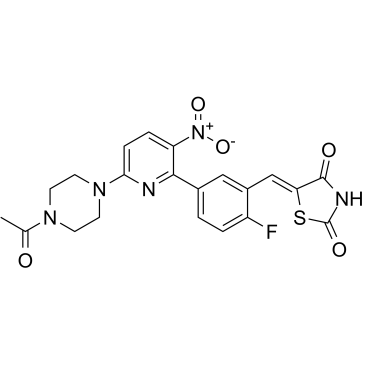
Physicochemical Properties
| Molecular Formula | C21H18FN5O5S |
| Molecular Weight | 471.46152639389 |
| Exact Mass | 471.101 |
| CAS # | 853953-65-8 |
| PubChem CID | 11282832 |
| Appearance | Light yellow to green yellow solid powder |
| LogP | 2.4 |
| Hydrogen Bond Donor Count | 1 |
| Hydrogen Bond Acceptor Count | 9 |
| Rotatable Bond Count | 3 |
| Heavy Atom Count | 33 |
| Complexity | 843 |
| Defined Atom Stereocenter Count | 0 |
| SMILES | O=C1NC(=O)C(=CC2C(F)=CC=C(C3C([N+](=O)[O-])=CC=C(N4CCN(C(C)=O)CC4)N=3)C=2)S1 |
| InChi Key | WZGVKWZJGXGNDP-BOPFTXTBSA-N |
| InChi Code | InChI=1S/C21H18FN5O5S/c1-12(28)25-6-8-26(9-7-25)18-5-4-16(27(31)32)19(23-18)13-2-3-15(22)14(10-13)11-17-20(29)24-21(30)33-17/h2-5,10-11H,6-9H2,1H3,(H,24,29,30)/b17-11- |
| Chemical Name | (5Z)-5-[[5-[6-(4-acetylpiperazin-1-yl)-3-nitropyridin-2-yl]-2-fluorophenyl]methylidene]-1,3-thiazolidine-2,4-dione |
| HS Tariff Code | 2934.99.9001 |
| Storage |
Powder-20°C 3 years 4°C 2 years In solvent -80°C 6 months -20°C 1 month |
| Shipping Condition | Room temperature (This product is stable at ambient temperature for a few days during ordinary shipping and time spent in Customs) |
Biological Activity
| Targets |
GW604714X targets mitochondrial pyruvate carrier (MPC) with an IC₅₀ value of 7 nM (inhibition of pyruvate uptake in rat liver mitochondria) [1] |
| ln Vitro |
GW604714X inhibits the mitochondrial pyruvate carrier (MPC) with Ki values <0.1 μM in direct measurements of pyruvate transport into rat liver and yeast mitochondria [1]. The concentrations of the inhibitor binding sites and their Ki (nM) values were obtained by inhibitor titration of pyruvate-dependent respiration by cardiac mitochondria; these were 56.0 nM and 0.057 nM for GW604714X, respectively [1]. Transport of 0.5 mM [14C]-l-lactate into rat erythrocytes is inhibited by GW604714X through the monocarboxylate transporter MCT1. At 10 μM, GW604714X reduces initial absorbance to 30% of control values [1]. GW604714X dose-dependently inhibited [¹⁴C]-pyruvate uptake into isolated rat liver mitochondria, with complete inhibition achieved at 100 nM [1] - In HepG2 human hepatoma cells, GW604714X (10 nM) reduced pyruvate-dependent oxygen consumption rate (OCR) by ~60%, while having no effect on glucose-dependent OCR [1] - Treatment of HepG2 cells with GW604714X (1–100 nM) increased extracellular lactate accumulation in a dose-dependent manner, reflecting impaired mitochondrial pyruvate metabolism [1] - GW604714X (up to 1 μM) did not inhibit lactate dehydrogenase, pyruvate dehydrogenase, or uptake of other substrates (α-ketoglutarate, malate) by mitochondria, demonstrating high target specificity [1] - Molecular docking analysis showed GW604714X binds to the hydrophobic pocket of MPC’s active site, forming hydrogen bonds with key amino acid residues [2] |
| Enzyme Assay |
Mitochondrial pyruvate uptake assay: Rat liver mitochondria were isolated and suspended in incubation buffer. Serial dilutions of GW604714X were added, followed by [¹⁴C]-labeled pyruvate. After incubation at 30°C for 30 seconds, the reaction was terminated by rapid filtration. Radioactivity associated with mitochondria was measured to calculate pyruvate uptake inhibition and IC₅₀ value [1] - Molecular docking assay: The 3D structure of MPC was constructed based on homology modeling. The structure of GW604714X was optimized, and docking simulations were performed to predict binding affinity and interaction mode with MPC’s active site. Binding energy and key intermolecular interactions were analyzed [2] |
| Cell Assay |
Oxygen consumption rate (OCR) measurement: HepG2 cells were seeded in Seahorse XF96 plates and cultured overnight. Cells were treated with GW604714X (1–100 nM) for 1 hour, then switched to glucose-free medium. OCR was measured before and after addition of pyruvate (10 mM) using a Seahorse extracellular flux analyzer to evaluate pyruvate-dependent mitochondrial respiration [1] - Lactate detection assay: HepG2 cells were cultured in 24-well plates and treated with GW604714X (1–100 nM) for 24 hours. Cell culture supernatants were collected, and lactate concentration was determined using a colorimetric assay based on lactate dehydrogenase-catalyzed reaction [1] - Substrate specificity assay: Isolated mitochondria were incubated with GW604714X (1 μM) and [¹⁴C]-labeled α-ketoglutarate or malate. Radioactivity uptake was measured to assess cross-reactivity with other mitochondrial carriers [1] |
| References |
[1]. Identification and characterisation of a new class of highly specific and potent inhibitors of the mitochondrial pyruvate carrier. Biochim Biophys Acta. Apr-May 2005;1707(2-3):221-30. [2]. Alzheimer's and Parkinson's Disease Novel Therapeutic Target: The Mitochondrial Pyruvate Carrier - Ligand Docking to Screen Natural Compounds Related to Classic Inhibitors. DOI:10.4018/IJKDB.2017070104. |
| Additional Infomation |
GW604714X is the first reported highly specific and potent inhibitor of MPC, belonging to a heterocyclic chemical class [1] - The compound acts by blocking pyruvate translocation across the inner mitochondrial membrane, thereby disrupting the link between glycolysis and mitochondrial oxidative metabolism [1] - GW604714X serves as a prototype for developing MPC-targeting drugs and a tool compound for studying MPC function in metabolic disorders [1] - In silico analysis of GW604714X’s binding mode to MPC provides a structural basis for screening natural product-derived MPC inhibitors for Alzheimer’s and Parkinson’s disease therapy [2] |
Solubility Data
| Solubility (In Vitro) | DMF : 5.26 mg/mL (~11.16 mM) |
| Solubility (In Vivo) |
Note: Listed below are some common formulations that may be used to formulate products with low water solubility (e.g. < 1 mg/mL), you may test these formulations using a minute amount of products to avoid loss of samples. Injection Formulations (e.g. IP/IV/IM/SC) Injection Formulation 1: DMSO : Tween 80: Saline = 10 : 5 : 85 (i.e. 100 μL DMSO stock solution → 50 μL Tween 80 → 850 μL Saline) *Preparation of saline: Dissolve 0.9 g of sodium chloride in 100 mL ddH ₂ O to obtain a clear solution. Injection Formulation 2: DMSO : PEG300 :Tween 80 : Saline = 10 : 40 : 5 : 45 (i.e. 100 μL DMSO → 400 μLPEG300 → 50 μL Tween 80 → 450 μL Saline) Injection Formulation 3: DMSO : Corn oil = 10 : 90 (i.e. 100 μL DMSO → 900 μL Corn oil) Example: Take the Injection Formulation 3 (DMSO : Corn oil = 10 : 90) as an example, if 1 mL of 2.5 mg/mL working solution is to be prepared, you can take 100 μL 25 mg/mL DMSO stock solution and add to 900 μL corn oil, mix well to obtain a clear or suspension solution (2.5 mg/mL, ready for use in animals). Injection Formulation 4: DMSO : 20% SBE-β-CD in saline = 10 : 90 [i.e. 100 μL DMSO → 900 μL (20% SBE-β-CD in saline)] *Preparation of 20% SBE-β-CD in Saline (4°C,1 week): Dissolve 2 g SBE-β-CD in 10 mL saline to obtain a clear solution. Injection Formulation 5: 2-Hydroxypropyl-β-cyclodextrin : Saline = 50 : 50 (i.e. 500 μL 2-Hydroxypropyl-β-cyclodextrin → 500 μL Saline) Injection Formulation 6: DMSO : PEG300 : castor oil : Saline = 5 : 10 : 20 : 65 (i.e. 50 μL DMSO → 100 μLPEG300 → 200 μL castor oil → 650 μL Saline) Injection Formulation 7: Ethanol : Cremophor : Saline = 10: 10 : 80 (i.e. 100 μL Ethanol → 100 μL Cremophor → 800 μL Saline) Injection Formulation 8: Dissolve in Cremophor/Ethanol (50 : 50), then diluted by Saline Injection Formulation 9: EtOH : Corn oil = 10 : 90 (i.e. 100 μL EtOH → 900 μL Corn oil) Injection Formulation 10: EtOH : PEG300:Tween 80 : Saline = 10 : 40 : 5 : 45 (i.e. 100 μL EtOH → 400 μLPEG300 → 50 μL Tween 80 → 450 μL Saline) Oral Formulations Oral Formulation 1: Suspend in 0.5% CMC Na (carboxymethylcellulose sodium) Oral Formulation 2: Suspend in 0.5% Carboxymethyl cellulose Example: Take the Oral Formulation 1 (Suspend in 0.5% CMC Na) as an example, if 100 mL of 2.5 mg/mL working solution is to be prepared, you can first prepare 0.5% CMC Na solution by measuring 0.5 g CMC Na and dissolve it in 100 mL ddH2O to obtain a clear solution; then add 250 mg of the product to 100 mL 0.5% CMC Na solution, to make the suspension solution (2.5 mg/mL, ready for use in animals). Oral Formulation 3: Dissolved in PEG400 Oral Formulation 4: Suspend in 0.2% Carboxymethyl cellulose Oral Formulation 5: Dissolve in 0.25% Tween 80 and 0.5% Carboxymethyl cellulose Oral Formulation 6: Mixing with food powders Note: Please be aware that the above formulations are for reference only. InvivoChem strongly recommends customers to read literature methods/protocols carefully before determining which formulation you should use for in vivo studies, as different compounds have different solubility properties and have to be formulated differently. (Please use freshly prepared in vivo formulations for optimal results.) |
| Preparing Stock Solutions | 1 mg | 5 mg | 10 mg | |
| 1 mM | 2.1211 mL | 10.6054 mL | 21.2107 mL | |
| 5 mM | 0.4242 mL | 2.1211 mL | 4.2421 mL | |
| 10 mM | 0.2121 mL | 1.0605 mL | 2.1211 mL |