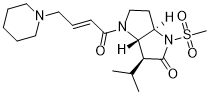
GW311616 (GW-311616), the free base form of GW311616A, is a novel, potent, intracellular, orally bioavailable, long duration inhibitor of human neutrophil elastase(HNE) with IC50 of 22 nM.
Physicochemical Properties
| Molecular Formula | C19H31N3O4S |
| Molecular Weight | 397.53214 |
| Exact Mass | 397.203 |
| CAS # | 198062-54-3 |
| Related CAS # | GW311616 hydrochloride;197890-44-1 |
| PubChem CID | 9800961 |
| Appearance | Light brown to brown solid powder |
| Boiling Point | 604.3ºC at 760mmHg |
| Flash Point | 319.3ºC |
| Vapour Pressure | 7.06E-15mmHg at 25°C |
| LogP | 2.768 |
| Hydrogen Bond Donor Count | 0 |
| Hydrogen Bond Acceptor Count | 5 |
| Rotatable Bond Count | 5 |
| Heavy Atom Count | 27 |
| Complexity | 707 |
| Defined Atom Stereocenter Count | 3 |
| SMILES | CC(C)[C@H]1[C@H]2[C@@H](CCN2C(=O)/C=C/CN3CCCCC3)N(C1=O)S(=O)(=O)C |
| InChi Key | NDNKNUMSTIMSHQ-URZKGLGPSA-N |
| InChi Code | InChI=1S/C19H31N3O4S/c1-14(2)17-18-15(22(19(17)24)27(3,25)26)9-13-21(18)16(23)8-7-12-20-10-5-4-6-11-20/h7-8,14-15,17-18H,4-6,9-13H2,1-3H3/b8-7+/t15-,17+,18-/m1/s1 |
| Chemical Name | Pyrrolo(3,2-b)pyrrol-2(1H)-one, hexahydro-3-(1-methylethyl)-1-(methylsulfonyl)-4-((2E)-1-oxo-4-(1-piperidinyl)-2-buten-1-yl)-, (3S,3aS,6aR)- |
| Synonyms | GW311616; (+)-GW 311616; GW 311616; GW-311616; (+)-GW-311616; (+)-GW311616. |
| HS Tariff Code | 2934.99.9001 |
| Storage |
Powder-20°C 3 years 4°C 2 years In solvent -80°C 6 months -20°C 1 month |
| Shipping Condition | Room temperature (This product is stable at ambient temperature for a few days during ordinary shipping and time spent in Customs) |
Biological Activity
| ln Vitro | NE activity in U937 and K562 cell lines is dramatically inhibited by GW-311616 (150 μM; 48 hours) [2]. Leukemia cells are treated with GW-311616 (20-320 μM; 48 hours; U937 cells) to cause apoptosis and limit cell growth [2]. When U937 cells are treated with GW-311616 (150 μM), Bax protein expression increases while Bcl-2 expression decreases [2]. |
| ln Vivo | In dogs, GW-311616 (2 mg/kg; oral) quickly removes circulating neutrophil elastase (NE) with >90% inhibition sustained over a 4-day period. Oral GW-311616 neutrophil infiltration in the bone marrow is not responsible for this sustained impact. GW-311616's intermediate terminal elimination half-lives (t1/2) in dogs (2 mg/kg, po) and rats (2 mg/kg, po) are 1.1 and 1.5 hours, respectively [3]. |
| Cell Assay |
Cell viability assay [2] Cell Types: U937 and K562 Cell Tested Concentrations: 150 μM Incubation Duration: 48 hrs (hours) Experimental Results: NE activity was Dramatically inhibited. Apoptosis analysis [2] Cell Types: U937 Cell Tested Concentrations: 20 μM, 40 μM, 80 μM, 160 μM, 320 μM Incubation Duration: 48 hrs (hours) Experimental Results: Increased cell apoptosis rate. Western Blot Analysis [2] Cell Types: U937 cells Tested Concentrations: 150 μM Incubation Duration: 48 hrs (hours) Experimental Results: The expression level of Bax protein increased, and the expression level of Bcl-2 protein diminished. |
| Animal Protocol |
Animal/Disease Models: Dog (9 months old) [3] Doses: 0.22 mg/kg, 0.66 mg/kg, and 2 mg/kg (pharmacokinetic/PK/PK study) Route of Administration: Oral Experimental Results: At 0.22 mg/kg, > Inhibition of elastase was achieved 6 hrs (hrs (hours)) after 50% administration, and activity returned to control values. A single oral dose of 2 mg/kg can rapidly eliminate circulating enzyme activity, and the inhibitory effect can be maintained for more than 4 days, with an inhibition rate greater than 90%. |
| References |
[1]. Neutrophil elastase inhibitors as treatment for COPD. Expert Opin Investig Drugs. 2002 Jul;11(7):965-80. [2]. Neutrophil elastase and its therapeutic effect on leukemia cells. Mol Med Rep. 2015 Sep;12(3):4165-4172. [3]. The discovery of a potent, intracellular, orally bioavailable, long duration inhibitor of human neutrophil elastase--GW311616A a development candidate. Bioorg Med Chem Lett. 2001 Apr 9;11(7):895-8. |
Solubility Data
| Solubility (In Vitro) | DMSO : ~66.67 mg/mL (~167.71 mM) |
| Solubility (In Vivo) |
Solubility in Formulation 1: 2.5 mg/mL (6.29 mM) in 10% DMSO + 40% PEG300 + 5% Tween80 + 45% Saline (add these co-solvents sequentially from left to right, and one by one), clear solution; with sonication. For example, if 1 mL of working solution is to be prepared, you can add 100 μL of 25.0 mg/mL clear DMSO stock solution to 400 μL PEG300 and mix evenly; then add 50 μL Tween-80 to the above solution and mix evenly; then add 450 μL normal saline to adjust the volume to 1 mL. Preparation of saline: Dissolve 0.9 g of sodium chloride in 100 mL ddH₂ O to obtain a clear solution. Solubility in Formulation 2: 2.5 mg/mL (6.29 mM) in 10% DMSO + 90% (20% SBE-β-CD in Saline) (add these co-solvents sequentially from left to right, and one by one), clear solution; with ultrasonication. For example, if 1 mL of working solution is to be prepared, you can add 100 μL of 25.0 mg/mL clear DMSO stock solution to 900 μL of 20% SBE-β-CD physiological saline solution and mix evenly. Preparation of 20% SBE-β-CD in Saline (4°C,1 week): Dissolve 2 g SBE-β-CD in 10 mL saline to obtain a clear solution. (Please use freshly prepared in vivo formulations for optimal results.) |
| Preparing Stock Solutions | 1 mg | 5 mg | 10 mg | |
| 1 mM | 2.5155 mL | 12.5777 mL | 25.1553 mL | |
| 5 mM | 0.5031 mL | 2.5155 mL | 5.0311 mL | |
| 10 mM | 0.2516 mL | 1.2578 mL | 2.5155 mL |