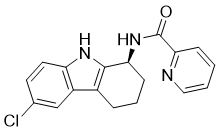
GSK984 (GSK984), the S-isomer of GSK983, is a negative (inactive) control probe for GSK983. GSK-983 is a potent inhibitor of dihydroorotate dehydrogenase (DHODH) with antiviral activity. It blocks RNA virus replication with EC50 values of 10–40 nM, and also blocks cell proliferation.
Physicochemical Properties
| Molecular Formula | C18H16CLN3O |
| Molecular Weight | 325.796 |
| Exact Mass | 325.098 |
| Elemental Analysis | C, 66.36; H, 4.95; Cl, 10.88; N, 12.90; O, 4.91 |
| CAS # | 827591-04-8 |
| Related CAS # | 827591-04-8; |
| PubChem CID | 11472829 |
| Appearance | Typically exists as solid at room temperature |
| Density | 1.4±0.1 g/cm3 |
| Boiling Point | 627.1±55.0 °C at 760 mmHg |
| Flash Point | 333.1±31.5 °C |
| Vapour Pressure | 0.0±1.8 mmHg at 25°C |
| Index of Refraction | 1.695 |
| LogP | 3.28 |
| Hydrogen Bond Donor Count | 2 |
| Hydrogen Bond Acceptor Count | 2 |
| Rotatable Bond Count | 2 |
| Heavy Atom Count | 23 |
| Complexity | 446 |
| Defined Atom Stereocenter Count | 1 |
| SMILES | C1(C(N[C@H]2CCCC3C4=C(NC2=3)C=CC(Cl)=C4)=O)=NC=CC=C1 |
| InChi Key | WJQBOBGVBBZLJU-HNNXBMFYSA-N |
| InChi Code | InChI=1S/C18H16ClN3O/c19-11-7-8-14-13(10-11)12-4-3-6-15(17(12)21-14)22-18(23)16-5-1-2-9-20-16/h1-2,5,7-10,15,21H,3-4,6H2,(H,22,23)/t15-/m0/s1 |
| Chemical Name | N-[(1S)-6-Chloro-2,3,4,9-tetrahydro-1H-carbazol-1-yl]-2-pyridinecarboxamide |
| Synonyms | GSK-984; GSK 984; 827591-04-8; RefChem:782743; 110-657-6; (S)-N-(6-chloro-2,3,4,9-tetrahydro-1H-carbazol-1-yl)picolinamide; N-[(1S)-6-Chloro-2,3,4,9-tetrahydro-1H-carbazol-1-yl]-2-pyridinecarboxamide; n-[(1S)-6-chloro-2,3,4,9-tetrahydro-1h-carbazol-1-yl]pyridine-2-carboxamide; CHEMBL564677; GSK984 |
| HS Tariff Code | 2934.99.9001 |
| Storage |
Powder-20°C 3 years 4°C 2 years In solvent -80°C 6 months -20°C 1 month |
| Shipping Condition | Room temperature (This product is stable at ambient temperature for a few days during ordinary shipping and time spent in Customs) |
Biological Activity
| Targets |
Nrgative control for GSK983 - Dihydroorotate dehydrogenase (DHODH) - The compound GSK984 is a DHODH inhibitor with in vitro activity against the enzyme, though specific IC50 values were not explicitly reported in the patent WO2017117006A1. It is described as a structural analog of GSK983, with reduced antiviral activity compared to its counterpart [1] |
| ln Vitro |
- Enzyme inhibition: 1. DHODH activity suppression: GSK984 demonstrated inhibitory effects on DHODH in biochemical assays, blocking de novo pyrimidine biosynthesis. The compound's mechanism involves competitive binding to the enzyme's active site, as inferred from its structural similarity to GSK983 [1] - Cellular effects: 1. Selective antiproliferative activity: In virus-immortalized cell lines (e.g., HPV-, EBV-, SV40-transformed cells), GSK984 showed reduced efficacy compared to GSK983, with EC50 values >1 μM. Primary human cells (fibroblasts, keratinocytes) exhibited minimal sensitivity at concentrations up to 10 μM [1] 2. Apoptosis induction: At concentrations >20 μM, GSK984 induced caspase-3 activation and Annexin V-positive staining in sensitive cell lines, though this effect was less pronounced compared to GSK983 [1] - Mechanism of action: 1. Pyrimidine depletion: By inhibiting DHODH, GSK984 disrupts de novo pyrimidine synthesis, leading to reduced DNA/RNA replication and cell cycle arrest in S phase [1] |
| Enzyme Assay |
- DHODH activity assay: 1. Recombinant enzyme preparation: Human DHODH was expressed in Escherichia coli and purified using nickel affinity chromatography. 2. Reaction setup: The assay mixture contained DHODH (10 nM), dihydroorotate (50 μM), and GSK984 (0.1–10 μM) in Tris-HCl buffer (pH 7.5). NAD+ (1 mM) was added as a cofactor. 3. Activity measurement: The reaction was monitored spectrophotometrically at 340 nm to quantify NADH production over 30 minutes. IC50 values were calculated using nonlinear regression [1] |
| Cell Assay |
- Cell viability assay: 1. Cell culture: Virus-immortalized cell lines (HeLa, A549) and primary fibroblasts were seeded in 96-well plates (5×10³ cells/well). 2. Drug treatment: Cells were incubated with GSK984 (0.01–100 μM) for 72 hours. 3. MTT reduction: MTT solution (0.5 mg/mL) was added, and absorbance at 570 nm was measured to determine cell viability [1] - Apoptosis detection: 1. Annexin V/PI staining: Treated cells were stained with Annexin V-FITC and propidium iodide, followed by flow cytometry to quantify apoptotic populations [1] |
| Toxicity/Toxicokinetics |
- In vitro cytotoxicity: 1. Selectivity index: GSK984 showed >100-fold selectivity for virus-immortalized cells over primary cells (CC50 ratio: 1–10 μM vs. >100 μM) [1] 2. Cytostatic effects: At sub-apoptotic concentrations (5–10 μM), GSK984 induced G1/S cell cycle arrest, as determined by flow cytometry [1] |
| References | [1]. Use of a dhodh inhibitor in combination with an inhibitor of pyrimidine salvage. WO2017117006A1. 2017/07/06 |
| Additional Infomation |
- Development context: GSK984 was developed as a structural analog of GSK983 to investigate structure-activity relationships (SAR) in DHODH inhibitors. Its reduced antiviral activity compared to GSK983 highlights the importance of specific chemical moieties for potency [1] - Combination therapy: The patent WO2017117006A1 describes GSK984 in combination with pyrimidine salvage pathway inhibitors (e.g., thymidine kinase inhibitors) to synergistically enhance antiviral efficacy [1] - Therapeutic potential: While GSK984 alone showed limited activity, its combination with other agents demonstrated additive effects against DNA viruses (e.g., adenovirus, HPV) in vitro [1] |
Solubility Data
| Solubility (In Vitro) | May dissolve in DMSO (in most cases), if not, try other solvents such as H2O, Ethanol, or DMF with a minute amount of products to avoid loss of samples |
| Solubility (In Vivo) |
Note: Listed below are some common formulations that may be used to formulate products with low water solubility (e.g. < 1 mg/mL), you may test these formulations using a minute amount of products to avoid loss of samples. Injection Formulations (e.g. IP/IV/IM/SC) Injection Formulation 1: DMSO : Tween 80: Saline = 10 : 5 : 85 (i.e. 100 μL DMSO stock solution → 50 μL Tween 80 → 850 μL Saline) *Preparation of saline: Dissolve 0.9 g of sodium chloride in 100 mL ddH ₂ O to obtain a clear solution. Injection Formulation 2: DMSO : PEG300 :Tween 80 : Saline = 10 : 40 : 5 : 45 (i.e. 100 μL DMSO → 400 μLPEG300 → 50 μL Tween 80 → 450 μL Saline) Injection Formulation 3: DMSO : Corn oil = 10 : 90 (i.e. 100 μL DMSO → 900 μL Corn oil) Example: Take the Injection Formulation 3 (DMSO : Corn oil = 10 : 90) as an example, if 1 mL of 2.5 mg/mL working solution is to be prepared, you can take 100 μL 25 mg/mL DMSO stock solution and add to 900 μL corn oil, mix well to obtain a clear or suspension solution (2.5 mg/mL, ready for use in animals). Injection Formulation 4: DMSO : 20% SBE-β-CD in saline = 10 : 90 [i.e. 100 μL DMSO → 900 μL (20% SBE-β-CD in saline)] *Preparation of 20% SBE-β-CD in Saline (4°C,1 week): Dissolve 2 g SBE-β-CD in 10 mL saline to obtain a clear solution. Injection Formulation 5: 2-Hydroxypropyl-β-cyclodextrin : Saline = 50 : 50 (i.e. 500 μL 2-Hydroxypropyl-β-cyclodextrin → 500 μL Saline) Injection Formulation 6: DMSO : PEG300 : castor oil : Saline = 5 : 10 : 20 : 65 (i.e. 50 μL DMSO → 100 μLPEG300 → 200 μL castor oil → 650 μL Saline) Injection Formulation 7: Ethanol : Cremophor : Saline = 10: 10 : 80 (i.e. 100 μL Ethanol → 100 μL Cremophor → 800 μL Saline) Injection Formulation 8: Dissolve in Cremophor/Ethanol (50 : 50), then diluted by Saline Injection Formulation 9: EtOH : Corn oil = 10 : 90 (i.e. 100 μL EtOH → 900 μL Corn oil) Injection Formulation 10: EtOH : PEG300:Tween 80 : Saline = 10 : 40 : 5 : 45 (i.e. 100 μL EtOH → 400 μLPEG300 → 50 μL Tween 80 → 450 μL Saline) Oral Formulations Oral Formulation 1: Suspend in 0.5% CMC Na (carboxymethylcellulose sodium) Oral Formulation 2: Suspend in 0.5% Carboxymethyl cellulose Example: Take the Oral Formulation 1 (Suspend in 0.5% CMC Na) as an example, if 100 mL of 2.5 mg/mL working solution is to be prepared, you can first prepare 0.5% CMC Na solution by measuring 0.5 g CMC Na and dissolve it in 100 mL ddH2O to obtain a clear solution; then add 250 mg of the product to 100 mL 0.5% CMC Na solution, to make the suspension solution (2.5 mg/mL, ready for use in animals). Oral Formulation 3: Dissolved in PEG400 Oral Formulation 4: Suspend in 0.2% Carboxymethyl cellulose Oral Formulation 5: Dissolve in 0.25% Tween 80 and 0.5% Carboxymethyl cellulose Oral Formulation 6: Mixing with food powders Note: Please be aware that the above formulations are for reference only. InvivoChem strongly recommends customers to read literature methods/protocols carefully before determining which formulation you should use for in vivo studies, as different compounds have different solubility properties and have to be formulated differently. (Please use freshly prepared in vivo formulations for optimal results.) |
| Preparing Stock Solutions | 1 mg | 5 mg | 10 mg | |
| 1 mM | 3.0694 mL | 15.3468 mL | 30.6937 mL | |
| 5 mM | 0.6139 mL | 3.0694 mL | 6.1387 mL | |
| 10 mM | 0.3069 mL | 1.5347 mL | 3.0694 mL |