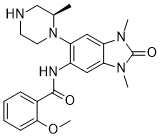
GSK6853 is a novel, potent and selective benzimidazolone BRPF1 bromodomain inhibitor with pIC50 of 8.1 (TR-FRET) and showed greater than 1600-fold selectivity over all other bromodomains tested. The BRPF (Bromodomain and PHD Finger-containing) protein family are important scaffolding proteins for assembly of MYST histone acetyltransferase complexes. Screening GSK6853 against a panel of 48 unrelated assays reveals only off-target activities that are relatively weak compared to the BRPF1 potency. However, to minimize the chance of off-target effects , the recommended concentration is no higher than 1 μM in cell-based assays.
Physicochemical Properties
| Molecular Formula | C22H27N5O3 | |
| Molecular Weight | 409.48 | |
| Exact Mass | 409.211 | |
| CAS # | 1910124-24-1 | |
| Related CAS # |
|
|
| PubChem CID | 121232405 | |
| Appearance | White to off-white solid powder | |
| Density | 1.2±0.1 g/cm3 | |
| Boiling Point | 545.9±50.0 °C at 760 mmHg | |
| Flash Point | 284.0±30.1 °C | |
| Vapour Pressure | 0.0±1.5 mmHg at 25°C | |
| Index of Refraction | 1.621 | |
| LogP | 0.98 | |
| Hydrogen Bond Donor Count | 2 | |
| Hydrogen Bond Acceptor Count | 5 | |
| Rotatable Bond Count | 4 | |
| Heavy Atom Count | 30 | |
| Complexity | 646 | |
| Defined Atom Stereocenter Count | 1 | |
| SMILES | C[C@@H]1CNCCN1C2=CC3=C(C=C2NC(=O)C4=CC=CC=C4OC)N(C(=O)N3C)C |
|
| InChi Key | FQWDVNSBYDXPIO-CQSZACIVSA-N | |
| InChi Code | InChI=1S/C22H27N5O3/c1-14-13-23-9-10-27(14)17-12-19-18(25(2)22(29)26(19)3)11-16(17)24-21(28)15-7-5-6-8-20(15)30-4/h5-8,11-12,14,23H,9-10,13H2,1-4H3,(H,24,28)/t14-/m1/s1 | |
| Chemical Name | N-[1,3-dimethyl-6-[(2R)-2-methylpiperazin-1-yl]-2-oxobenzimidazol-5-yl]-2-methoxybenzamide | |
| Synonyms |
|
|
| HS Tariff Code | 2934.99.9001 | |
| Storage |
Powder-20°C 3 years 4°C 2 years In solvent -80°C 6 months -20°C 1 month |
|
| Shipping Condition | Room temperature (This product is stable at ambient temperature for a few days during ordinary shipping and time spent in Customs) |
Biological Activity
| ln Vitro |
|
||
| ln Vivo | In prospective PK/PD models, the ip route of administration would be appropriate for dosing GSK6853[1]. | ||
| Animal Protocol |
|
||
| References |
[1]. GSK6853, a Chemical Probe for Inhibition of the BRPF1 Bromodomain. ACS Med Chem Lett. 2016 May 9;7(6):552-7. |
Solubility Data
| Solubility (In Vitro) |
|
|||
| Solubility (In Vivo) |
Solubility in Formulation 1: ≥ 2.5 mg/mL (6.11 mM) (saturation unknown) in 10% DMSO + 40% PEG300 + 5% Tween80 + 45% Saline (add these co-solvents sequentially from left to right, and one by one), clear solution. For example, if 1 mL of working solution is to be prepared, you can add 100 μL of 25.0 mg/mL clear DMSO stock solution to 400 μL PEG300 and mix evenly; then add 50 μL Tween-80 to the above solution and mix evenly; then add 450 μL normal saline to adjust the volume to 1 mL. Preparation of saline: Dissolve 0.9 g of sodium chloride in 100 mL ddH₂ O to obtain a clear solution. Solubility in Formulation 2: ≥ 2.5 mg/mL (6.11 mM) (saturation unknown) in 10% DMSO + 90% (20% SBE-β-CD in Saline) (add these co-solvents sequentially from left to right, and one by one), clear solution. For example, if 1 mL of working solution is to be prepared, you can add 100 μL of 25.0 mg/mL clear DMSO stock solution to 900 μL of 20% SBE-β-CD physiological saline solution and mix evenly. Preparation of 20% SBE-β-CD in Saline (4°C,1 week): Dissolve 2 g SBE-β-CD in 10 mL saline to obtain a clear solution. Solubility in Formulation 3: ≥ 2.5 mg/mL (6.11 mM) (saturation unknown) in 10% DMSO + 90% Corn Oil (add these co-solvents sequentially from left to right, and one by one), clear solution. For example, if 1 mL of working solution is to be prepared, you can add 100 μL of 25.0 mg/mL clear DMSO stock solution to 900 μL of corn oil and mix evenly. (Please use freshly prepared in vivo formulations for optimal results.) |
| Preparing Stock Solutions | 1 mg | 5 mg | 10 mg | |
| 1 mM | 2.4421 mL | 12.2106 mL | 24.4212 mL | |
| 5 mM | 0.4884 mL | 2.4421 mL | 4.8842 mL | |
| 10 mM | 0.2442 mL | 1.2211 mL | 2.4421 mL |