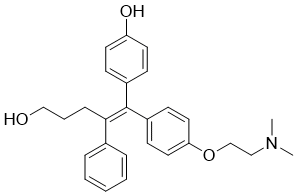
GSK5182 is an orally bioactive, novel, potent, highly selective inverse agonist of estrogen-related receptor γ (ERRγ) with an IC50 of 79 nM. In hepatocellular carcinoma, GSK5182 also causes the production of reactive oxygen species (ROS).
Physicochemical Properties
| Molecular Formula | C27H31NO3 |
| Molecular Weight | 417.55 |
| Exact Mass | 417.23 |
| Elemental Analysis | C, 77.67; H, 7.48; N, 3.35; O, 11.49 |
| CAS # | 877387-37-6 |
| Related CAS # | (E/Z)-GSK5182;2699724-40-6 |
| PubChem CID | 6852176 |
| Appearance | White to off-white solid powder |
| Density | 1.132±0.06 g/cm3(Predicted) |
| Boiling Point | 567.6±50.0 °C(Predicted) |
| LogP | 5.9 |
| Hydrogen Bond Donor Count | 2 |
| Hydrogen Bond Acceptor Count | 4 |
| Rotatable Bond Count | 10 |
| Heavy Atom Count | 31 |
| Complexity | 525 |
| Defined Atom Stereocenter Count | 0 |
| SMILES | C(/C1C=CC(O)=CC=1)(\C1C=CC(OCCN(C)C)=CC=1)=C(\C1C=CC=CC=1)/CCCO |
| InChi Key | ZVSFNBNLNLXEFQ-RQZHXJHFSA-N |
| InChi Code | InChI=1S/C27H31NO3/c1-28(2)18-20-31-25-16-12-23(13-17-25)27(22-10-14-24(30)15-11-22)26(9-6-19-29)21-7-4-3-5-8-21/h3-5,7-8,10-17,29-30H,6,9,18-20H2,1-2H3/b27-26- |
| Chemical Name | 4-[(Z)-1-[4-[2-(dimethylamino)ethoxy]phenyl]-5-hydroxy-2-phenylpent-1-enyl]phenol |
| Synonyms | GSK5182; GSK-5182; GSK 5182 |
| HS Tariff Code | 2934.99.9001 |
| Storage |
Powder-20°C 3 years 4°C 2 years In solvent -80°C 6 months -20°C 1 month |
| Shipping Condition | Room temperature (This product is stable at ambient temperature for a few days during ordinary shipping and time spent in Customs) |
Biological Activity
| Targets | Reactive Oxygen Species; ERRγ (IC50 = 79 nM) |
| ln Vitro |
GSK5182 (0-20 μM; 0-hours; PLC/PRF/5 cells) treatment reduces the number of proliferating PLC/PRF/5 cells significantly and dose-dependently[1]. GSK5182 (0-20 μM; 24 hours; PLC/PRF/5 cells) treatment also results in a decrease in the amount of phosphorylated retinoblastoma protein (p-pRb) and a dose-dependent increase in the expression of p21 and p27[1]. GSK5182 (10-20 μM; PLC/PRF/5 cells) treatment causes a dose-dependent decrease in the proportion of cells in the S phase by causing cell cycle arrest at the G1 phase[1]. |
| ln Vivo | GSK5182 (40 mg/kg; intraperitoneal injection; every day; 25 or 30 days; db/db mice, diet-induced obesity mice) specifically inhibits ERRγ's transcriptional activity and reduces the amount of glucose produced in the liver by blocking hepatic gluconeogenesis. GSK5182 inhibits the hepatic gluconeogenesis program in mouse models to produce anti-diabetic effects. GSK5182 primarily normalizes hyperglycemia by preventing the liver from producing glucose[3]. |
| Cell Assay | The experiment involved culturing mouse articular chondrocytes (3×10⁵) for two days, followed by an infection with different Ad-Esrrg adenovirus concentrations [200 800 MOI (multiplicity of infection)] for two hours, and an additional twenty-four hours of culture in the presence or absence of GSK5182 (2.5-10 μM). Several inflammatory cytokines, including TNF-α (10-50 ng/mL), IL-6 (10-50 ng/mL), and IL-1β (0.1-1 ng/mL), were applied to the cells for a full day. |
| Animal Protocol |
db/db mice (male, 7-12-week-old), diet-induced obesity (DIO) mice[3] 40 mg/kg Intraperitoneal injection; every day; 30 days for db/db mice, 25 days for DIO mice |
| References |
[1]. Estrogen-related receptor γ is upregulated in liver cancer and its inhibition suppresses livercancer cell proliferation via induction of p21 and p27. Exp Mol Med. 2016 Mar 4;48:e213. [2]. ERRγ: a Junior Orphan with a Senior Role in Metabolism. Trends Endocrinol Metab. 2017 Apr;28(4):261-272. [3]. Inverse agonist of nuclear receptor ERRγ mediates antidiabetic effect through inhibition of hepatic gluconeogenesis. Diabetes. 2013 Sep;62(9):3093-102. |
Solubility Data
| Solubility (In Vitro) |
DMSO: 25~84 mg/mL (59.9~201.2 mM) Ethanol: ~84 mg/mL (~201.2 mM) |
| Solubility (In Vivo) |
Note: Listed below are some common formulations that may be used to formulate products with low water solubility (e.g. < 1 mg/mL), you may test these formulations using a minute amount of products to avoid loss of samples. Injection Formulations (e.g. IP/IV/IM/SC) Injection Formulation 1: DMSO : Tween 80: Saline = 10 : 5 : 85 (i.e. 100 μL DMSO stock solution → 50 μL Tween 80 → 850 μL Saline) *Preparation of saline: Dissolve 0.9 g of sodium chloride in 100 mL ddH ₂ O to obtain a clear solution. Injection Formulation 2: DMSO : PEG300 :Tween 80 : Saline = 10 : 40 : 5 : 45 (i.e. 100 μL DMSO → 400 μLPEG300 → 50 μL Tween 80 → 450 μL Saline) Injection Formulation 3: DMSO : Corn oil = 10 : 90 (i.e. 100 μL DMSO → 900 μL Corn oil) Example: Take the Injection Formulation 3 (DMSO : Corn oil = 10 : 90) as an example, if 1 mL of 2.5 mg/mL working solution is to be prepared, you can take 100 μL 25 mg/mL DMSO stock solution and add to 900 μL corn oil, mix well to obtain a clear or suspension solution (2.5 mg/mL, ready for use in animals). Injection Formulation 4: DMSO : 20% SBE-β-CD in saline = 10 : 90 [i.e. 100 μL DMSO → 900 μL (20% SBE-β-CD in saline)] *Preparation of 20% SBE-β-CD in Saline (4°C,1 week): Dissolve 2 g SBE-β-CD in 10 mL saline to obtain a clear solution. Injection Formulation 5: 2-Hydroxypropyl-β-cyclodextrin : Saline = 50 : 50 (i.e. 500 μL 2-Hydroxypropyl-β-cyclodextrin → 500 μL Saline) Injection Formulation 6: DMSO : PEG300 : castor oil : Saline = 5 : 10 : 20 : 65 (i.e. 50 μL DMSO → 100 μLPEG300 → 200 μL castor oil → 650 μL Saline) Injection Formulation 7: Ethanol : Cremophor : Saline = 10: 10 : 80 (i.e. 100 μL Ethanol → 100 μL Cremophor → 800 μL Saline) Injection Formulation 8: Dissolve in Cremophor/Ethanol (50 : 50), then diluted by Saline Injection Formulation 9: EtOH : Corn oil = 10 : 90 (i.e. 100 μL EtOH → 900 μL Corn oil) Injection Formulation 10: EtOH : PEG300:Tween 80 : Saline = 10 : 40 : 5 : 45 (i.e. 100 μL EtOH → 400 μLPEG300 → 50 μL Tween 80 → 450 μL Saline) Oral Formulations Oral Formulation 1: Suspend in 0.5% CMC Na (carboxymethylcellulose sodium) Oral Formulation 2: Suspend in 0.5% Carboxymethyl cellulose Example: Take the Oral Formulation 1 (Suspend in 0.5% CMC Na) as an example, if 100 mL of 2.5 mg/mL working solution is to be prepared, you can first prepare 0.5% CMC Na solution by measuring 0.5 g CMC Na and dissolve it in 100 mL ddH2O to obtain a clear solution; then add 250 mg of the product to 100 mL 0.5% CMC Na solution, to make the suspension solution (2.5 mg/mL, ready for use in animals). Oral Formulation 3: Dissolved in PEG400 Oral Formulation 4: Suspend in 0.2% Carboxymethyl cellulose Oral Formulation 5: Dissolve in 0.25% Tween 80 and 0.5% Carboxymethyl cellulose Oral Formulation 6: Mixing with food powders Note: Please be aware that the above formulations are for reference only. InvivoChem strongly recommends customers to read literature methods/protocols carefully before determining which formulation you should use for in vivo studies, as different compounds have different solubility properties and have to be formulated differently. (Please use freshly prepared in vivo formulations for optimal results.) |
| Preparing Stock Solutions | 1 mg | 5 mg | 10 mg | |
| 1 mM | 2.3949 mL | 11.9746 mL | 23.9492 mL | |
| 5 mM | 0.4790 mL | 2.3949 mL | 4.7898 mL | |
| 10 mM | 0.2395 mL | 1.1975 mL | 2.3949 mL |