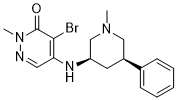
Physicochemical Properties
| Molecular Formula | C17H21BRN4O |
| Molecular Weight | 377.278842687607 |
| Exact Mass | 376.089 |
| Elemental Analysis | C, 54.12; H, 5.61; Br, 21.18; N, 14.85; O, 4.24 |
| CAS # | 2079896-25-4 |
| Related CAS # | GSK4028;2079886-19-2 |
| PubChem CID | 126961735 |
| Appearance | Light yellow to yellow solid powder |
| LogP | 2.5 |
| Hydrogen Bond Donor Count | 1 |
| Hydrogen Bond Acceptor Count | 4 |
| Rotatable Bond Count | 3 |
| Heavy Atom Count | 23 |
| Complexity | 513 |
| Defined Atom Stereocenter Count | 2 |
| SMILES | BrC1C(N(C)N=CC=1N[C@H]1CN(C)C[C@@H](C2C=CC=CC=2)C1)=O |
| InChi Key | VZAFGXCWAWRULT-UONOGXRCSA-N |
| InChi Code | InChI=1S/C17H21BrN4O/c1-21-10-13(12-6-4-3-5-7-12)8-14(11-21)20-15-9-19-22(2)17(23)16(15)18/h3-7,9,13-14,20H,8,10-11H2,1-2H3/t13-,14+/m0/s1 |
| Chemical Name | 4-bromo-2-methyl-5-[[(3R,5R)-1-methyl-5-phenylpiperidin-3-yl]amino]pyridazin-3-one |
| Synonyms | GSK 4027; GSK-4027; 2079896-25-4; CHEMBL4069412; 4-bromo-2-methyl-5-[[(3R,5R)-1-methyl-5-phenylpiperidin-3-yl]amino]pyridazin-3-one; 4-Bromo-2-methyl-5-(((3R,5R)-1-methyl-5-phenylpiperidin-3-yl)amino)pyridazin-3(2H)-one; 4-bromo-2-methyl-5-[[(3~{R},5~{R})-1-methyl-5-phenyl-piperidin-3-yl]amino]pyridazin-3-one; 9ST; GSK4027 |
| HS Tariff Code | 2934.99.9001 |
| Storage |
Powder-20°C 3 years 4°C 2 years In solvent -80°C 6 months -20°C 1 month |
| Shipping Condition | Room temperature (This product is stable at ambient temperature for a few days during ordinary shipping and time spent in Customs) |
Biological Activity
| Targets |
GSK4027 is a potent and selective chemical probe for PCAF (p300/CBP-associated factor) and GCN5 (general control nonderepressible 5) bromodomains. It shows: - pIC50 of 7.4±0.11 for PCAF in TR-FRET assay - Ki of 1.4 nM for both PCAF and GCN5 in BROMOscan panel - pKi of 8.9 for both PCAF and GCN5 - Weak activity against BRD4 BD1 (pIC50 <4.3) and BRD9 (pIC50 5.1±0.08) [1] |
| ln Vitro |
GSK 4027 is a chemical probe of the PCAF/GCN5 bromodomain. Two multidomain proteins linked to retroviral infection, inflammatory pathways, and cancer development are p300/CREB binding protein-associated factor (PCAF/KAT2B) and general control non-inhibitory 5 (GCN5/KAT2A). With pIC50 values of less than 4.3 and 5.1±0.08, respectively, GSK 4027 likewise showed efficacy against BRD4 BD1 and BRD9 in TR-FRET assays. With pKi values of 8.9 and 8.9 for PCAF and GCN5, respectively, GSK 4027's selectivity against the larger bromodomain family was assessed using a BROMOscan panel. With a Ki of 1.4 nM for both bromodomains, GSK 4027 has comparable efficacy against PCAF and GCN5. GSK 4027 treatment of HEK293 cells substituted full-length PCAF in histone H3.3 as predicted, and because of the encouraging measured artificial membrane permeability (500 nm/s), there was little change in biochemical assays. (IC50 60 nM) pIC50 7.2[1].
GSK4027 is a potent and selective chemical probe for PCAF (p300/CBP-associated factor) and GCN5 (general control nonderepressible 5) bromodomains. It shows: - pIC50 of 7.4±0.11 for PCAF in TR-FRET assay - Ki of 1.4 nM for both PCAF and GCN5 in BROMOscan panel - pKi of 8.9 for both PCAF and GCN5 - Weak activity against BRD4 BD1 (pIC50 <4.3) and BRD9 (pIC50 5.1±0.08) [1] |
| Enzyme Assay |
PCAF/GCN5 bromodomain binding was assessed using: 1. Time-resolved fluorescence resonance energy transfer (TR-FRET) assay: - Recombinant GST-tagged PCAF bromodomain (amino acids 719-832) was used - Assay performed in 384-well plates with terbium-labeled anti-GST antibody and fluorescein-labeled tracer - IC50 values converted to pIC50 (-log IC50) - GSK4027 showed pIC50 of 7.4±0.11 for PCAF 2. BROMOscan panel: - Comprehensive selectivity profiling against 35 bromodomains - GSK4027 showed high selectivity for PCAF/GCN5 over other bromodomains [1] |
| Cell Assay |
1. Cellular target engagement: - HEK293 cells treated with GSK4027 for 1 hour - Cellular PCAF displacement from histone H3.3 measured using AlphaScreen technology - pIC50 of 7.2 (IC50=60 nM) observed, consistent with biochemical activity 2. Cytotoxicity assay: - HEK293 cells exposed to GSK4027 for 72 hours - No significant cytotoxicity at concentrations up to 10 μM [1] |
| ADME/Pharmacokinetics |
1. Cellular target engagement: - HEK293 cells treated with GSK4027 for 1 hour - Cellular PCAF displacement from histone H3.3 measured using AlphaScreen technology - pIC50 of 7.2 (IC50=60 nM) observed, consistent with biochemical activity 2. Cytotoxicity assay: - HEK293 cells exposed to GSK4027 for 72 hours - No significant cytotoxicity at concentrations up to 10 μM [1] |
| References |
[1]. Discovery of a Potent, Cell Penetrant, and Selective p300/CBP-Associated Factor (PCAF)/General Control Nonderepressible 5 (GCN5) Bromodomain Chemical Probe. J Med Chem. 2017 Jan 26;60(2):695-709. |
| Additional Infomation |
- GSK4027 was developed as part of a chemical probe discovery program for PCAF/GCN5 bromodomains - The compound shows suitable properties for use as a chemical probe in cellular systems - PCAF and GCN5 are involved in retroviral infection, inflammatory pathways, and cancer development - The probe demonstrates excellent selectivity and cell permeability, making it useful for studying PCAF/GCN5 biology [1] a chemical probe of the GCN5 bromodomain; GSK4027 and GSK4028 are the (R,R) and (S,S) isomers, respectively; structure in first source |
Solubility Data
| Solubility (In Vitro) | DMSO : ~50 mg/mL (~132.53 mM) |
| Solubility (In Vivo) |
Note: Listed below are some common formulations that may be used to formulate products with low water solubility (e.g. < 1 mg/mL), you may test these formulations using a minute amount of products to avoid loss of samples. Injection Formulations (e.g. IP/IV/IM/SC) Injection Formulation 1: DMSO : Tween 80: Saline = 10 : 5 : 85 (i.e. 100 μL DMSO stock solution → 50 μL Tween 80 → 850 μL Saline) *Preparation of saline: Dissolve 0.9 g of sodium chloride in 100 mL ddH ₂ O to obtain a clear solution. Injection Formulation 2: DMSO : PEG300 :Tween 80 : Saline = 10 : 40 : 5 : 45 (i.e. 100 μL DMSO → 400 μLPEG300 → 50 μL Tween 80 → 450 μL Saline) Injection Formulation 3: DMSO : Corn oil = 10 : 90 (i.e. 100 μL DMSO → 900 μL Corn oil) Example: Take the Injection Formulation 3 (DMSO : Corn oil = 10 : 90) as an example, if 1 mL of 2.5 mg/mL working solution is to be prepared, you can take 100 μL 25 mg/mL DMSO stock solution and add to 900 μL corn oil, mix well to obtain a clear or suspension solution (2.5 mg/mL, ready for use in animals). Injection Formulation 4: DMSO : 20% SBE-β-CD in saline = 10 : 90 [i.e. 100 μL DMSO → 900 μL (20% SBE-β-CD in saline)] *Preparation of 20% SBE-β-CD in Saline (4°C,1 week): Dissolve 2 g SBE-β-CD in 10 mL saline to obtain a clear solution. Injection Formulation 5: 2-Hydroxypropyl-β-cyclodextrin : Saline = 50 : 50 (i.e. 500 μL 2-Hydroxypropyl-β-cyclodextrin → 500 μL Saline) Injection Formulation 6: DMSO : PEG300 : castor oil : Saline = 5 : 10 : 20 : 65 (i.e. 50 μL DMSO → 100 μLPEG300 → 200 μL castor oil → 650 μL Saline) Injection Formulation 7: Ethanol : Cremophor : Saline = 10: 10 : 80 (i.e. 100 μL Ethanol → 100 μL Cremophor → 800 μL Saline) Injection Formulation 8: Dissolve in Cremophor/Ethanol (50 : 50), then diluted by Saline Injection Formulation 9: EtOH : Corn oil = 10 : 90 (i.e. 100 μL EtOH → 900 μL Corn oil) Injection Formulation 10: EtOH : PEG300:Tween 80 : Saline = 10 : 40 : 5 : 45 (i.e. 100 μL EtOH → 400 μLPEG300 → 50 μL Tween 80 → 450 μL Saline) Oral Formulations Oral Formulation 1: Suspend in 0.5% CMC Na (carboxymethylcellulose sodium) Oral Formulation 2: Suspend in 0.5% Carboxymethyl cellulose Example: Take the Oral Formulation 1 (Suspend in 0.5% CMC Na) as an example, if 100 mL of 2.5 mg/mL working solution is to be prepared, you can first prepare 0.5% CMC Na solution by measuring 0.5 g CMC Na and dissolve it in 100 mL ddH2O to obtain a clear solution; then add 250 mg of the product to 100 mL 0.5% CMC Na solution, to make the suspension solution (2.5 mg/mL, ready for use in animals). Oral Formulation 3: Dissolved in PEG400 Oral Formulation 4: Suspend in 0.2% Carboxymethyl cellulose Oral Formulation 5: Dissolve in 0.25% Tween 80 and 0.5% Carboxymethyl cellulose Oral Formulation 6: Mixing with food powders Note: Please be aware that the above formulations are for reference only. InvivoChem strongly recommends customers to read literature methods/protocols carefully before determining which formulation you should use for in vivo studies, as different compounds have different solubility properties and have to be formulated differently. (Please use freshly prepared in vivo formulations for optimal results.) |
| Preparing Stock Solutions | 1 mg | 5 mg | 10 mg | |
| 1 mM | 2.6506 mL | 13.2528 mL | 26.5055 mL | |
| 5 mM | 0.5301 mL | 2.6506 mL | 5.3011 mL | |
| 10 mM | 0.2651 mL | 1.3253 mL | 2.6506 mL |