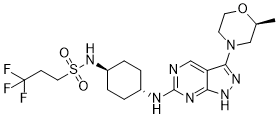
GSK3186899 (also known as DDD-853651) is a novel and potent inhibitor of cdc-2-related kinase 12 (CRK12), with an EC50 of 1.4 μM for L. donovani in an intra-macrophage assay. Visceral leishmaniasis causes considerable mortality and morbidity in many parts of the world. There is an urgent need for the development of new, effective treatments for this disease. GSK3186899 is an anti-leishmanial drug-like chemical series based on a pyrazolopyrimidine scaffold. It is efficacious in a mouse model of visceral leishmaniasis, has suitable physicochemical, pharmacokinetic and toxicological properties for further development, and has been declared a preclinical candidate. Detailed mode-of-action studies indicate that compounds from this series act principally by inhibiting the parasite cdc-2-related kinase 12 (CRK12), thus defining a druggable target for visceral leishmaniasis.
Physicochemical Properties
| Molecular Formula | C19H28F3N7O3S |
| Molecular Weight | 491.530932426453 |
| Exact Mass | 491.192 |
| CAS # | 1972617-87-0 |
| PubChem CID | 122429808 |
| Appearance | Off-white to light yellow solid powder |
| LogP | 2.9 |
| Hydrogen Bond Donor Count | 3 |
| Hydrogen Bond Acceptor Count | 12 |
| Rotatable Bond Count | 7 |
| Heavy Atom Count | 33 |
| Complexity | 746 |
| Defined Atom Stereocenter Count | 1 |
| SMILES | C[C@H]1CN(CCO1)C2=NNC3=NC(=NC=C32)NC4CCC(CC4)NS(=O)(=O)CCC(F)(F)F |
| InChi Key | RQWCISVRFNZHMJ-IHRRRGAJSA-N |
| InChi Code | InChI=1S/C19H28F3N7O3S/c1-12-11-29(7-8-32-12)17-15-10-23-18(25-16(15)26-27-17)24-13-2-4-14(5-3-13)28-33(30,31)9-6-19(20,21)22/h10,12-14,28H,2-9,11H2,1H3,(H2,23,24,25,26,27)/t12-,13-,14-/m0/s1 |
| Chemical Name | 3,3,3-Trifluoro-N-(trans-4-((3-((S)-2-methylmorpholino)-1H-pyrazolo[3,4-d]pyrimidin-6-yl)amino)cyclohexyl)propane-1-sulfonamide |
| Synonyms | GSK3186899; GSK 3186899; GSK-3186899; DDD-853651; DDD853651; DDD 853651 |
| HS Tariff Code | 2934.99.9001 |
| Storage |
Powder-20°C 3 years 4°C 2 years In solvent -80°C 6 months -20°C 1 month |
| Shipping Condition | Room temperature (This product is stable at ambient temperature for a few days during ordinary shipping and time spent in Customs) |
Biological Activity
| Targets |
Cyclin-dependent kinase 12 (CDK12) (IC50 for human CDK12: ~0.01 μM; IC50 for Leishmania donovani amastigotes: ~0.19 μM; IC50 for Leishmania donovani promastigotes: ~0.56 μM) [1] |
| ln Vitro |
GSK3186899 (Compound 7) shown activity against L. Donovani demonstrated high selectivity against mammalian THP-1 host cells (EC50 value >50 μM) in an intramacrophage experiment, with an EC50 value of 1.4 μM. While this is compatible with the clinically utilized medications miltefosine and paromomycin (EC50 values of 0.9 μM and 6.6 μM, respectively), it is not as valid as the data reported for amphotericin B (EC50 value of 0.07 μM in intramacrophage experiment). ) quite. In the cidal sterile amastigote assay, GSK3186899 exhibits activity as well (EC50 value of 0.1 μM). GSK3186899 was cytocidal in 96 hours at a dose of 0.2 μM; the duration was reduced to 48 hours at a concentration of 1.8 μM. When compared to a panel of strains produced from Leishmania, the efficacy of GSK3186899 varied by less than ten times. In a subset of Leishmania strains that utilize human peripheral blood mononuclear cells as their host cells, GSK3186899 is likewise more active [1]. 1. Against Leishmania donovani promastigotes: GSK318689 exhibited dose-dependent inhibitory activity with an IC50 of ~0.56 μM, significantly reducing the proliferation of promastigotes in culture [1] 2. Against Leishmania donovani amastigotes (intracellular stage in macrophages): The drug showed potent inhibitory effects with an IC50 of ~0.19 μM, effectively reducing the number of amastigotes per infected macrophage without significant cytotoxicity to host macrophages (cell viability >80% at concentrations up to 10 μM) [1] 3. Kinase inhibition assay: GSK318689 specifically inhibited recombinant human CDK12/cyclin K complex activity with an IC50 of ~0.01 μM, while showing minimal cross-reactivity with other CDKs (e.g., CDK7, CDK9) at concentrations up to 1 μM [1] 4. Mechanism-related in vitro effects: Treatment with GSK318689 in Leishmania-infected macrophages led to a significant reduction in phosphorylation of the C-terminal domain (CTD) of RNA polymerase II (a key substrate of CDK12), indicating suppression of transcriptional elongation, particularly of long-chain mRNAs in the parasite [1] |
| ln Vivo |
GSK3186899, when administered orally twice daily for ten days at a dose of 25 mg/kg, reduced parasite levels by 99% in a mouse infection model, demonstrating action similar to that of the first-line medication miltefosine. Dosage, frequency, and length all affect how effective a treatment is (10 days is better than 5 days). For GSK3186899, nonclinical safety findings suggest a suitable therapeutic window for the initiation of regulatory preclinical investigations. Non-GLP preclinical analysis of genotoxicity and cardiovascular impacts did not identify any problems that would prevent further research. Furthermore, clinical chemistry and histopathology in a 7-day repeated-dose oral toxicity trial in rats revealed no appreciable side effects at any of the tested doses. Further conclusive safety studies are supported by the in vivo efficacy and safety profile of GSK3186899 [1]. 1. Efficacy in Leishmania donovani-infected BALB/c mice: Oral administration of GSK318689 at 30 mg/kg once daily for 5 days resulted in a ~90% reduction in parasite load in the spleen and an ~80% reduction in the liver, as determined by colony-forming unit (CFU) assay [1] 2. Survival and clinical outcomes: Infected mice treated with GSK318689 showed improved clinical status compared to vehicle-treated controls, with no obvious signs of disease progression (e.g., splenomegaly alleviation) during the experimental period [1] 3. Mechanism validation in vivo: Western blot analysis of parasite isolates from treated mice confirmed reduced phosphorylation of RNA polymerase II CTD, consistent with the in vitro mechanism of CDK12 inhibition [1] |
| Enzyme Assay |
1. Recombinant CDK12/cyclin K kinase activity assay: Recombinant human CDK12 was expressed and purified as a complex with cyclin K. The assay was performed in reaction buffer containing MgCl2 and ATP. Different concentrations of GSK318689 were pre-incubated with the CDK12/cyclin K complex for 30 minutes at room temperature. A biotinylated CTD peptide substrate (derived from RNA polymerase II) was then added to the reaction mixture, which was incubated at 37°C for 60 minutes. The reaction was terminated by adding a stop buffer, and the phosphorylated substrate was detected using a streptavidin-conjugated detection system. Kinase activity was quantified by measuring the signal intensity, and the IC50 value was calculated based on the dose-response curve of inhibition rate versus drug concentration [1] 2. Leishmania CDK12 ortholog inhibition assay: Recombinant Leishmania donovani CDK12 ortholog was prepared, and the assay protocol was similar to the human CDK12 assay, with adjustments to the reaction buffer pH and incubation time to optimize for the parasite enzyme. The inhibitory effect of GSK318689 on the parasite CDK12 was quantified to confirm direct targeting of the parasite kinase [1] |
| Cell Assay |
1. Macrophage infection and parasite proliferation assay: Murine bone marrow-derived macrophages (BMDMs) or RAW 264.7 cells were seeded into 96-well plates at a density of 5×10⁴ cells per well and cultured overnight. Leishmania donovani promastigotes in the log phase were added to the macrophages at a multiplicity of infection (MOI) of 10:1, and the mixture was incubated at 37°C with 5% CO2 for 4 hours to allow infection. Non-internalized promastigotes were removed by washing with culture medium, and serial concentrations of GSK318689 were added to the infected cells. After incubation for 72 hours, the cells were fixed with methanol, stained with Giemsa solution, and examined under a light microscope. The number of amastigotes per infected macrophage was counted (≥100 macrophages per well), and the percentage of infected cells was recorded to calculate the parasite proliferation inhibition rate [1] 2. Macrophage cytotoxicity assay: Uninfected macrophages were seeded in 96-well plates and treated with the same concentration range of GSK318689 as in the infection assay. After 72 hours of incubation, a cell viability reagent was added to each well, and the plates were incubated for an additional 4 hours. The absorbance was measured at a specific wavelength to determine cell viability, and the 50% cytotoxic concentration (CC50) was calculated to assess the drug's safety profile for host cells [1] 3. Western blot for RNA polymerase II phosphorylation: Infected macrophages treated with GSK318689 (1 μM) or vehicle were lysed in RIPA buffer containing protease and phosphatase inhibitors. Protein lysates were separated by SDS-PAGE, transferred to a membrane, and probed with primary antibodies specific for phosphorylated RNA polymerase II CTD (Ser2 and Ser5) and total RNA polymerase II. After incubation with secondary antibodies, the blots were visualized using a chemiluminescent detection system, and band intensities were quantified to compare phosphorylation levels between treated and control groups [1] |
| Animal Protocol |
1. Visceral leishmaniasis mouse model establishment: Female BALB/c mice (6-8 weeks old) were intraperitoneally infected with 2×10⁷ stationary-phase Leishmania donovani amastigotes. The infection was allowed to establish for 7 days before initiating drug treatment [1] 2. Drug formulation and administration: GSK318689 was formulated by dissolving in a mixture of 10% ethanol, 40% polyethylene glycol 400, and 50% sterile water. The drug was administered orally to infected mice at a dose of 30 mg/kg body weight, once daily for 5 consecutive days. Control mice received the same volume of the vehicle mixture without the drug [1] 3. Sample collection and parasite load assessment: Seven days after the last dose, mice were euthanized, and the spleen and liver were excised and weighed. Tissue homogenates were prepared in sterile phosphate-buffered saline (PBS), and serial dilutions of the homogenates were plated on biphasic medium (blood agar overlaid with liquid medium). The plates were incubated at 26°C for 7-10 days, and the number of CFUs was counted to determine the parasite load per gram of tissue [1] 4. Toxicity monitoring: Mice were weighed every 2 days during the treatment period and for 7 days post-treatment to assess changes in body weight. At the time of euthanasia, small portions of the liver and kidneys were fixed in formalin, embedded in paraffin, sectioned, and stained with hematoxylin and eosin (H&E) for histopathological examination to evaluate potential organ toxicity [1] |
| Toxicity/Toxicokinetics |
1. Acute toxicity in mice: At the therapeutic dose of 30 mg/kg (oral, 5 days), GSK318689 did not cause significant changes in mouse body weight compared to vehicle controls. Histopathological examination of the liver and kidneys showed no obvious abnormalities (e.g., inflammation, necrosis, or tissue damage) [1] 2. Host cell toxicity: In vitro, GSK318689 showed minimal cytotoxicity to murine macrophages, with a CC50 >10 μM, resulting in a therapeutic index (CC50/IC50 for amastigotes) of ~53 [1] |
| References | [1]. Wyllie S, et al. Cyclin-dependent kinase 12 is a drug target for visceral leishmaniasis. Nature. 2018 Aug;560(7717):192-197. |
| Additional Infomation |
1. Indication relevance: GSK318689 is a potential therapeutic agent for visceral leishmaniasis, a life-threatening parasitic disease caused by Leishmania donovani infection, which is characterized by systemic parasite replication in the spleen, liver, and bone marrow [1] 2. Mechanism of action: GSK318689 exerts its anti-leishmanial activity by specifically inhibiting CDK12, a conserved kinase that regulates transcriptional elongation. In Leishmania, CDK12 is essential for the expression of long-chain mRNAs encoding proteins involved in parasite survival and proliferation. Inhibition of CDK12 by GSK318689 disrupts this transcriptional program, leading to parasite growth arrest and death [1] 3. Clinical unmet need: Current treatments for visceral leishmaniasis are limited by high toxicity, emerging drug resistance, and complex administration routes. GSK318689 represents a novel targeted therapy with favorable in vitro and in vivo efficacy and safety profiles, addressing the unmet clinical need for safer and more effective treatments [1] |
Solubility Data
| Solubility (In Vitro) | DMSO : ~250 mg/mL (~508.62 mM) |
| Solubility (In Vivo) |
Solubility in Formulation 1: ≥ 2.08 mg/mL (4.23 mM) (saturation unknown) in 10% DMSO + 40% PEG300 + 5% Tween80 + 45% Saline (add these co-solvents sequentially from left to right, and one by one), clear solution. For example, if 1 mL of working solution is to be prepared, you can add 100 μL of 20.8 mg/mL clear DMSO stock solution to 400 μL PEG300 and mix evenly; then add 50 μL Tween-80 to the above solution and mix evenly; then add 450 μL normal saline to adjust the volume to 1 mL. Preparation of saline: Dissolve 0.9 g of sodium chloride in 100 mL ddH₂ O to obtain a clear solution. Solubility in Formulation 2: ≥ 2.08 mg/mL (4.23 mM) (saturation unknown) in 10% DMSO + 90% (20% SBE-β-CD in Saline) (add these co-solvents sequentially from left to right, and one by one), clear solution. For example, if 1 mL of working solution is to be prepared, you can add 100 μL of 20.8 mg/mL clear DMSO stock solution to 900 μL of 20% SBE-β-CD physiological saline solution and mix evenly. Preparation of 20% SBE-β-CD in Saline (4°C,1 week): Dissolve 2 g SBE-β-CD in 10 mL saline to obtain a clear solution. Solubility in Formulation 3: ≥ 2.08 mg/mL (4.23 mM) (saturation unknown) in 10% DMSO + 90% Corn Oil (add these co-solvents sequentially from left to right, and one by one), clear solution. For example, if 1 mL of working solution is to be prepared, you can add 100 μL of 20.8 mg/mL clear DMSO stock solution to 900 μL of corn oil and mix evenly. (Please use freshly prepared in vivo formulations for optimal results.) |
| Preparing Stock Solutions | 1 mg | 5 mg | 10 mg | |
| 1 mM | 2.0345 mL | 10.1723 mL | 20.3446 mL | |
| 5 mM | 0.4069 mL | 2.0345 mL | 4.0689 mL | |
| 10 mM | 0.2034 mL | 1.0172 mL | 2.0345 mL |