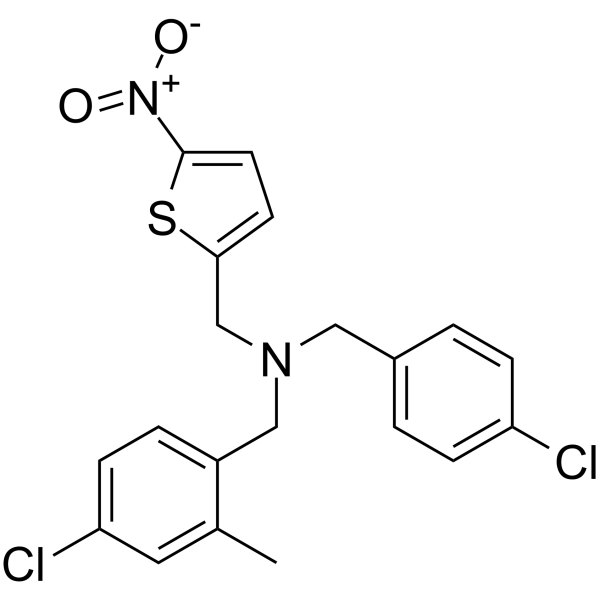
Physicochemical Properties
| Molecular Formula | C20H18CL2N2O2S |
| Molecular Weight | 421.340121746063 |
| Exact Mass | 420.046 |
| CAS # | 1438071-12-5 |
| Related CAS # | GSK2945 hydrochloride |
| PubChem CID | 71682479 |
| Appearance | Typically exists as solid at room temperature |
| LogP | 6.2 |
| Hydrogen Bond Donor Count | 0 |
| Hydrogen Bond Acceptor Count | 4 |
| Rotatable Bond Count | 6 |
| Heavy Atom Count | 27 |
| Complexity | 485 |
| Defined Atom Stereocenter Count | 0 |
| InChi Key | NXCSEAQOKPSNJV-UHFFFAOYSA-N |
| InChi Code | InChI=1S/C20H18Cl2N2O2S/c1-14-10-18(22)7-4-16(14)12-23(11-15-2-5-17(21)6-3-15)13-19-8-9-20(27-19)24(25)26/h2-10H,11-13H2,1H3 |
| Chemical Name | N-[(4-chloro-2-methylphenyl)methyl]-1-(4-chlorophenyl)-N-[(5-nitrothiophen-2-yl)methyl]methanamine |
| HS Tariff Code | 2934.99.9001 |
| Storage |
Powder-20°C 3 years 4°C 2 years In solvent -80°C 6 months -20°C 1 month |
| Shipping Condition | Room temperature (This product is stable at ambient temperature for a few days during ordinary shipping and time spent in Customs) |
Biological Activity
| ln Vitro | GSK2945 increases the transcriptional activity of Rev-erbα and a luciferase reporter with an EC50 of 2.05 μM for Bmal1, a target gene of REV-ERBs, in a dose-dependent manner[1]. Treatment of mouse and human primary hepatocytes with GSK2945 (20 μM) for 12 and 24 hours results in increased levels of Cyp7a1/CYP7A1. Treatment with GSK2945 (20 μM) also raises the mRNA and protein of Lrh-1/LRH-1, a known hepatic activator of Cyp7a1/CYP7A1[1]. |
| ln Vivo | In male C57BL/6 mice, GSK2945 (0-10 mg/kg) administered intraperitoneally twice daily for seven days increases the level of hepatic mouse cholesterol 7α-hydroxylase (Cyp7a1) and decreases plasma cholesterol[1]. |
| Cell Assay |
RT-PCR[1] Cell Types: Mouse (male, CD1) and human (male, Caucasian) primary hepatocytes Tested Concentrations: 20 μM Incubation Duration: 12 hrs (hours) and 24 hrs (hours) Experimental Results: Led to significant increases in mRNA and protein (at 24-h ) expression of Cyp7a1. mRNA and protein (at 24-h) levels of CYP7A1 were increased in human primary hepatocyte. Lrh-1/LRH-1 was upregulated. |
| Animal Protocol |
Animal/Disease Models: Male C57BL/6 mice (8-10 weeks of age)[1] Doses: 0 mg/kg or 10 mg/kg Route of Administration: intraperitoneal (ip) injection; twice every day; for 7 days Experimental Results: Increased hepatic mouse cholesterol 7α -hydroxylase (Cyp7a1) level and lowered plasma cholesterol in wild-type mice. |
| References | [1]. Zhang T, et al. REV-ERBα Regulates CYP7A1 Through Repression of Liver Receptor Homolog-1. Drug Metab Dispos. 2018 Mar;46(3):248-258. |
Solubility Data
| Solubility (In Vitro) | DMSO: 83.33 mg/mL (197.77 mM) |
| Solubility (In Vivo) |
Solubility in Formulation 1: ≥ 2.08 mg/mL (4.94 mM) (saturation unknown) in 10% DMSO + 40% PEG300 + 5% Tween80 + 45% Saline (add these co-solvents sequentially from left to right, and one by one), clear solution. For example, if 1 mL of working solution is to be prepared, you can add 100 μL of 20.8 mg/mL clear DMSO stock solution to 400 μL PEG300 and mix evenly; then add 50 μL Tween-80 to the above solution and mix evenly; then add 450 μL normal saline to adjust the volume to 1 mL. Preparation of saline: Dissolve 0.9 g of sodium chloride in 100 mL ddH₂ O to obtain a clear solution. Solubility in Formulation 2: ≥ 2.08 mg/mL (4.94 mM) (saturation unknown) in 10% DMSO + 90% Corn Oil (add these co-solvents sequentially from left to right, and one by one), clear solution. For example, if 1 mL of working solution is to be prepared, you can add 100 μL of 20.8 mg/mL clear DMSO stock solution to 900 μL of corn oil and mix evenly. (Please use freshly prepared in vivo formulations for optimal results.) |
| Preparing Stock Solutions | 1 mg | 5 mg | 10 mg | |
| 1 mM | 2.3734 mL | 11.8669 mL | 23.7338 mL | |
| 5 mM | 0.4747 mL | 2.3734 mL | 4.7468 mL | |
| 10 mM | 0.2373 mL | 1.1867 mL | 2.3734 mL |