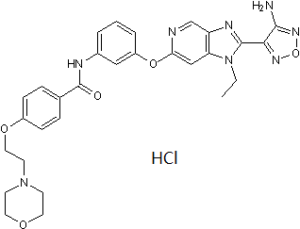
GSK269962 HCl (also called GSK-269962A HCl), the hydrochloride salt of GSK 269962A, is a selective ROCK (Rho-associated protein kinase) inhibitor with potential antihypertensive and cardioprotective activity. It inhibits ROCK with IC50s of 1.6 and 4 nM for ROCK1 and ROCK2, respectively.
Physicochemical Properties
| Molecular Formula | C29H31CLN8O5 | |
| Molecular Weight | 607.060044527054 | |
| Exact Mass | 606.21 | |
| Elemental Analysis | C, 57.38; H, 5.15; Cl, 5.84; N, 18.46; O, 13.18 | |
| CAS # | 2095432-71-4 | |
| Related CAS # | GSK269962A;850664-21-0 | |
| PubChem CID | 57398146 | |
| Appearance | Off-white to light yellow solid powder | |
| Hydrogen Bond Donor Count | 3 | |
| Hydrogen Bond Acceptor Count | 11 | |
| Rotatable Bond Count | 10 | |
| Heavy Atom Count | 43 | |
| Complexity | 860 | |
| Defined Atom Stereocenter Count | 0 | |
| SMILES | Cl.O1CCN(CCOC2C=CC(C(NC3=CC=CC(=C3)OC3=CC4=C(C=N3)N=C(C3C(N)=NON=3)N4CC)=O)=CC=2)CC1 |
|
| InChi Key | UYKVMFKKKLLDGL-UHFFFAOYSA-N | |
| InChi Code | InChI=1S/C29H30N8O5.ClH/c1-2-37-24-17-25(31-18-23(24)33-28(37)26-27(30)35-42-34-26)41-22-5-3-4-20(16-22)32-29(38)19-6-8-21(9-7-19)40-15-12-36-10-13-39-14-11-36;/h3-9,16-18H,2,10-15H2,1H3,(H2,30,35)(H,32,38);1H | |
| Chemical Name | N-[3-[2-(4-amino-1,2,5-oxadiazol-3-yl)-1-ethylimidazo[4,5-c]pyridin-6-yl]oxyphenyl]-4-(2-morpholin-4-ylethoxy)benzamide;hydrochloride | |
| Synonyms |
|
|
| HS Tariff Code | 2934.99.9001 | |
| Storage |
Powder-20°C 3 years 4°C 2 years In solvent -80°C 6 months -20°C 1 month |
|
| Shipping Condition | Room temperature (This product is stable at ambient temperature for a few days during ordinary shipping and time spent in Customs) |
Biological Activity
| Targets |
GSK269962 HCl targets Rho-associated coiled-coil containing protein kinase 1 (ROCK1) (Ki = 0.18 nM) and Rho-associated coiled-coil containing protein kinase 2 (ROCK2) (Ki = 0.46 nM) [1] GSK269962 HCl shows minimal inhibition of other kinases (PKA, PKCα, Akt, ERK1/2) with IC50 > 1000 nM for all, indicating high selectivity for ROCK1/2 [1] |
| ln Vitro |
The half-life of GSK269962A against recombinant human ROCK1 is 1.6 nM. A panel of serine/threonine kinases is selectively inhibited by GSK269962A by more than 30 fold[1]. 1. In recombinant kinase activity assays, GSK269962 HCl potently inhibits ROCK1 and ROCK2 with Ki values of 0.18 nM and 0.46 nM, respectively; it has no significant inhibitory activity against other serine/threonine kinases (e.g., PKA, PKCα) and tyrosine kinases (e.g., EGFR, VEGFR2) at concentrations up to 10 μM [1] 2. In rat aortic smooth muscle cells (RASMCs), GSK269962 HCl (0.1–100 nM) dose-dependently inhibits angiotensin II (Ang II)-induced phosphorylation of myosin light chain 20 (MLC20, a downstream substrate of ROCK), with an IC50 of 1 nM for p-MLC20 inhibition; 10 nM GSK269962 HCl reduces p-MLC20 levels by ~80% compared with Ang II-only treated cells [1] 3. In TNF-α-stimulated human umbilical vein endothelial cells (HUVECs), GSK269962 HCl (10–1000 nM) downregulates the expression of vascular cell adhesion molecule-1 (VCAM-1) and E-selectin; 100 nM GSK269962 HCl inhibits VCAM-1 and E-selectin expression by 70% and 80%, respectively (detected by flow cytometry and RT-PCR) [1] 4. In LPS-stimulated murine macrophage RAW264.7 cells, GSK269962 HCl (10–1000 nM) suppresses nitric oxide (NO) and tumor necrosis factor-α (TNF-α) production with IC50 values of 30 nM and 25 nM, respectively; IL-6 secretion is also inhibited by 60% at 100 nM [1] 5. In isolated rat aortic ring assays, GSK269962 HCl (1 nM–10 μM) causes concentration-dependent relaxation of norepinephrine-precontracted aortic rings, with an EC50 of 12 nM; the vasodilatory effect is observed in both endothelium-intact and endothelium-denuded rings, indicating a direct action on vascular smooth muscle [1] |
| ln Vivo |
GSK269962A is a strong agent that lowers blood pressure. In spontaneously hypertensive rats (SHR), GSK269962A (0.3, 1, and 3 mg/kg; oral gavage) causes a dose-dependent drop in blood pressure. Blood pressure is sharply and significantly lowered[1]. 1. In anesthetized male Sprague-Dawley rats, intravenous (i.v.) administration of GSK269962 HCl (0.1, 0.3, 1 mg/kg) dose-dependently reduces mean arterial pressure (MAP); 1 mg/kg GSK269962 HCl decreases MAP by ~30% from baseline, and the hypotensive effect lasts for approximately 2 hours [1] 2. In the carrageenan-induced paw edema model (male ICR mice), oral administration of GSK269962 HCl (1, 3, 10 mg/kg) 1 hour before carrageenan injection inhibits paw swelling in a dose-dependent manner; 10 mg/kg GSK269962 HCl achieves a 65% inhibition of paw edema at 3 hours post-carrageenan [1] 3. In a murine LPS-induced systemic inflammation model, intraperitoneal (i.p.) injection of GSK269962 HCl (5 mg/kg) reduces serum TNF-α and IL-6 levels by 50% and 45%, respectively, at 6 hours post-LPS challenge [1] |
| Enzyme Assay |
1. ROCK1/ROCK2 kinase activity assay: Purified recombinant human ROCK1 and ROCK2 proteins were incubated with serial concentrations of GSK269962 HCl in reaction buffer containing [γ-³³P]ATP and a synthetic peptide substrate with ROCK phosphorylation sites. The mixture was incubated at 30°C for 60 minutes, and the reaction was terminated by adding a stop solution. Phosphorylated substrates were captured on a filter membrane, and radioactivity was measured using a scintillation counter to calculate enzyme activity. Dose-response curves were generated to determine the Ki values for ROCK1 and ROCK2. For selectivity testing, the same assay was performed with recombinant PKA, PKCα, Akt, and ERK1/2 proteins [1] |
| Cell Assay |
1. RASMC MLC20 phosphorylation assay: Rat aortic smooth muscle cells (RASMCs) were seeded in 6-well plates and serum-starved for 24 hours. Cells were pretreated with GSK269962 HCl (0.1–100 nM) for 30 minutes, then stimulated with Ang II (100 nM) for 10 minutes. Cells were lysed, and total protein was extracted. Phosphorylated MLC20 (p-MLC20) and total MLC20 were detected by Western blot, and band intensity was quantified by densitometry to calculate the inhibition rate of p-MLC20 [1] 2. HUVEC adhesion molecule expression assay: Human umbilical vein endothelial cells (HUVECs) were seeded in 24-well plates and grown to confluence. Cells were pretreated with GSK269962 HCl (10–1000 nM) for 1 hour, then stimulated with TNF-α (10 ng/mL) for 24 hours. Cell surface expression of VCAM-1 and E-selectin was analyzed by flow cytometry, and mRNA levels were detected by RT-PCR [1] 3. RAW264.7 inflammatory mediator assay: Murine macrophage RAW264.7 cells were plated in 24-well plates at a density of 5×10⁵ cells/well. Cells were treated with GSK269962 HCl (10–1000 nM) and stimulated with LPS (1 μg/mL) for 24 hours. Culture supernatants were collected, and NO production was measured by the Griess reaction; TNF-α and IL-6 levels were quantified by ELISA [1] 4. Isolated aortic ring vasodilation assay: Rat thoracic aortas were dissected and cut into 3-mm rings, which were suspended in organ baths filled with oxygenated Krebs buffer at 37°C. Rings were precontracted with norepinephrine (1 μM) until a stable contraction was achieved. Cumulative concentrations of GSK269962 HCl (1 nM–10 μM) were added to the baths, and changes in vascular tension were recorded using a force transducer. The experiment was repeated with endothelium-denuded rings (rubbed with a wooden stick) to determine the site of action [1] |
| Animal Protocol |
Animal/Disease Models: Male SD (Sprague-Dawley) rats (350-400g)[1] Doses: 0.3, 1, and 3 mg/kg Route of Administration: po (oral gavage); 12 hrs (hours) Experimental Results: Induced a dose-dependent reduction in blood pressure. 1. Rat blood pressure measurement protocol: Male Sprague-Dawley rats (250–300 g) were anesthetized, and a carotid artery catheter was connected to a pressure transducer to record baseline mean arterial pressure (MAP). GSK269962 HCl (0.1, 0.3, 1 mg/kg) was administered via tail vein injection (formulated in 5% DMSO/95% saline, injection volume: 1 mL/kg). MAP was continuously monitored for 2 hours, and the magnitude and duration of hypotension were calculated [1] 2. Murine carrageenan paw edema protocol: Male ICR mice (20–25 g) were orally administered GSK269962 HCl (1, 3, 10 mg/kg) or vehicle (0.5% CMC-Na, gavage volume: 0.2 mL/10 g body weight) 1 hour before subplantar injection of 1% carrageenan (20 μL) into the right hind paw. Paw thickness was measured at 3 hours post-carrageenan using a caliper, and edema inhibition rate was calculated [1] 3. Murine LPS-induced inflammation protocol: Male ICR mice were injected intraperitoneally with LPS (5 mg/kg) and simultaneously treated with GSK269962 HCl (1, 5 mg/kg) via i.p. injection (formulated in 10% ethanol/saline, injection volume: 0.1 mL/10 g body weight). At 6 hours post-LPS, blood was collected by enucleation, and serum TNF-α and IL-6 levels were measured by ELISA [1] |
| Toxicity/Toxicokinetics |
1. In vitro cytotoxicity: GSK269962 HCl (up to 10 μM) shows no significant cytotoxicity in RASMCs, HUVECs, and RAW264.7 cells, with cell viability >90% as assessed by MTT assay [1] 2. Acute in vivo toxicity: Single oral administration of GSK269962 HCl (100 mg/kg) in mice causes no mortality or abnormal behavioral changes (e.g., lethargy, ataxia), indicating an LD50 > 100 mg/kg (oral) [1] |
| References |
[1]. Novel Rho kinase inhibitors with anti-inflammatory and vasodilatory activities. J Pharmacol Exp Ther. 2007 Jan;320(1):89-98. |
| Additional Infomation |
1. GSK269962 HCl is a potent and selective small-molecule inhibitor of Rho-associated coiled-coil containing protein kinases (ROCK1/2) developed by GlaxoSmithKline (GSK) [1] 2. GSK269962 HCl exerts its pharmacological effects by inhibiting ROCK-mediated phosphorylation of MLC20 (leading to vascular smooth muscle relaxation) and suppressing the expression of adhesion molecules/proinflammatory cytokines in endothelial cells and macrophages [1] 3. GSK269962 HCl exhibits both vasodilatory and anti-inflammatory activities, making it a potential therapeutic candidate for cardiovascular diseases (e.g., hypertension, pulmonary arterial hypertension) and inflammatory disorders (e.g., rheumatoid arthritis, sepsis) [1] 4. The vasodilatory effect of GSK269962 HCl is independent of endothelial function, as it relaxes both endothelium-intact and denuded aortic rings [1] |
Solubility Data
| Solubility (In Vitro) |
|
|||
| Solubility (In Vivo) |
|
| Preparing Stock Solutions | 1 mg | 5 mg | 10 mg | |
| 1 mM | 1.6473 mL | 8.2364 mL | 16.4728 mL | |
| 5 mM | 0.3295 mL | 1.6473 mL | 3.2946 mL | |
| 10 mM | 0.1647 mL | 0.8236 mL | 1.6473 mL |