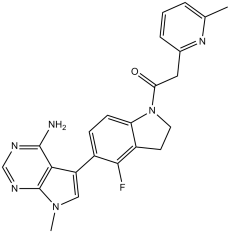
GSK2656157 (GSK-2656157) is a brand-new, powerful, ATP-competitive, and highly selective inhibitor of the PERK (protein kinase R (PKR)-like endoplasmic reticulum kinase) enzyme with an IC50 of 0.9 nM in cell-free assays and 500-fold higher activity against a panel of 300 kinases. Treatment of GSK2656157 results in a decrease in downstream substrates like phospho-eIF2α, ATF4, and CHOP as well as an inhibition of PERK. BxPC3 cells have demonstrated that PERK inhibition has an impact on de novo protein synthesis.
Physicochemical Properties
| Molecular Formula | C23H21FN6O | |
| Molecular Weight | 416.45 | |
| Exact Mass | 416.176 | |
| Elemental Analysis | C, 66.33; H, 5.08; F, 4.56; N, 20.18; O, 3.84 | |
| CAS # | 1337532-29-2 | |
| Related CAS # |
|
|
| PubChem CID | 53469059 | |
| Appearance | white to light yellow solid powder | |
| Density | 1.4±0.1 g/cm3 | |
| Boiling Point | 744.6±60.0 °C at 760 mmHg | |
| Flash Point | 404.1±32.9 °C | |
| Vapour Pressure | 0.0±2.5 mmHg at 25°C | |
| Index of Refraction | 1.722 | |
| LogP | 3.43 | |
| Hydrogen Bond Donor Count | 1 | |
| Hydrogen Bond Acceptor Count | 6 | |
| Rotatable Bond Count | 3 | |
| Heavy Atom Count | 31 | |
| Complexity | 666 | |
| Defined Atom Stereocenter Count | 0 | |
| SMILES | FC1=C(C([H])=C([H])C2=C1C([H])([H])C([H])([H])N2C(C([H])([H])C1=C([H])C([H])=C([H])C(C([H])([H])[H])=N1)=O)C1=C([H])N(C([H])([H])[H])C2C1=C(N([H])[H])N=C([H])N=2 |
|
| InChi Key | PRWSIEBRGXYXAJ-UHFFFAOYSA-N | |
| InChi Code | InChI=1S/C23H21FN6O/c1-13-4-3-5-14(28-13)10-19(31)30-9-8-16-18(30)7-6-15(21(16)24)17-11-29(2)23-20(17)22(25)26-12-27-23/h3-7,11-12H,8-10H2,1-2H3,(H2,25,26,27) | |
| Chemical Name | 1-[5-(4-amino-7-methylpyrrolo[2,3-d]pyrimidin-5-yl)-4-fluoro-2,3-dihydroindol-1-yl]-2-(6-methylpyridin-2-yl)ethanone | |
| Synonyms |
|
|
| HS Tariff Code | 2934.99.9001 | |
| Storage |
Powder-20°C 3 years 4°C 2 years In solvent -80°C 6 months -20°C 1 month |
|
| Shipping Condition | Room temperature (This product is stable at ambient temperature for a few days during ordinary shipping and time spent in Customs) |
Biological Activity
| Targets | EIF2AK3 (PERK) (IC50 = 0.9 nM); EIF2AK1 (HRI) (IC50 = 460 nM); BRK (IC50 = 905 nM); EIF2AK2 (PKR) (IC50 = 905 nM); MEKK3 (IC50 = 954 nM); Aurora B (IC50 = 1259 nM); KHS (IC50 = 1764 nM); LCK (IC50 = 2344 nM); MLK2 (IC50 = 15 nM); MEKK3 (IC50 = 2847 nM); ALK5 (IC50 = 3020 nM); MLCK2 (IC50 = 3039 nM); EIF2AK4(GCN2) (IC50 = 3162 nM); c-MER (IC50 = 3431 nM); PI3Kγ (IC50 = 3802 nM); WNK3 (IC50 = 5951 nM); LRRK2 (IC50 = 6918 nM); ROCK1 (IC50 = 7244 nM); MSK1 (IC50 = 8985 nM); NEK1 (IC50 = 9807 nM); AXL (IC50 = 9808 nM); JAK2 (IC50 = 24547 nM) | ||
| ln Vitro | Inhibiting PERK activation and lowering the downstream substrates phospho-eIF2a, ATF4, and CHOP with an IC50 in the 10–30 nM range are the effects of pretreating cells with GSK2656157. Before UPR induction, cells exposed to 1 mM GSK2656157 are able to block this impact on protein synthesis from scratch. GSK2656157 decreases the expression of five of the 84 UPR-related genes (DDIT3, HERPUD1, PPP1R15A, C/EBP-beta, and ERN1) by a factor of more than four. With an IC50 range of 6–25 mM, GSK2656157 has no discernible impact on the growth of any of these cells when exogenous UPR inducers are not present. In different biological contexts, GSK2656157 can be used to assess the biologic function of PERK. [1] | ||
| ln Vivo | Complete inhibition of phospho-PERK Thr980 is observed through 8 hours after a single 50 mg/kg oral dose of GSK2656157. Treatment of mice with 50 or 150 mg/kg twice daily doses of GSK2656157 results in dose-dependent inhibition of tumor growth in four models, with tumor growth inhibition reaching 54-114% at the 150 mg/kg, twice daily dose. Potential mechanisms for the observed antitumor effect include altered amino acid metabolism, decreased blood vessel density, and vascular perfusion. Multiple human tumor xenografts are treated with GSK2656157 to inhibit tumor growth in mice. [1] | ||
| Enzyme Assay | Recombinant GST-PERK (536-1116 amino acids) with 6-His-full-length human eIF2a as a substrate is used to assess the inhibitory potency of GSK2656157. At GSK, 27 kinases and a panel of 300 kinases are used to evaluate kinase selectivity. | ||
| Cell Assay | Antiproliferative activity of GSK2656157 against multiple human tumor cell lines as well as primary human microvascular endothelial cells is evaluated in a 3-day proliferation assay using standard culture medium. GSK2656157, which has an IC50 range of 6 to 25 mM, has no discernible impact on the growth of any of these cells when exogenous UPR inducers are not present. | ||
| Animal Protocol |
|
||
| References |
[1]. Characterization of a novel PERK kinase inhibitor with antitumor and antiangiogenic activity. Cancer Res. 2013 Mar 15;73(6):1993-2002. [2]. Evidence for eIF2α phosphorylation-independent effects of GSK2656157, a novel catalytic inhibitor of PERK with clinical implications. Cell Cycle. 2014 Mar 1;13(5):801-6. [3]. GSK2656157, a PERK inhibitor, reduced LPS-induced IL-1β production through inhibiting Caspase 1 activation in macrophage-like J774.1 cells. Immunopharmacol Immunotoxicol. 2016 Aug;38(4):298-302. [4]. Thioredoxin-interacting protein links endoplasmic reticulum stress to inflammatory brain injury and apoptosis after subarachnoid haemorrhage. J Neuroinflammation. 2017 May 11;14(1):104. |
||
| Additional Infomation | GSK2656157 is a pyrrolopyrimidine that is 7-methyl-7H-pyrrolo[2,3-d]pyrimidin-4-amine which has been substituted at position 5 by a 4-fluoro-2,3-dihydro-1H-indol-5-yl group, the nitrogen of which has been acylated by a (6-methylpyridin-2-yl)acetyl group. An orally bioavailable PERK inhibitor. It has a role as an EC 3.1.3.48 (protein-tyrosine-phosphatase) inhibitor, a PERK inhibitor and an antineoplastic agent. It is a pyrrolopyrimidine, a biaryl, a member of indoles, a member of methylpyridines, an organofluorine compound and a tertiary carboxamide. |
Solubility Data
| Solubility (In Vitro) |
|
|||
| Solubility (In Vivo) |
Solubility in Formulation 1: ≥ 0.5 mg/mL (1.20 mM) (saturation unknown) in 10% DMSO + 40% PEG300 + 5% Tween80 + 45% Saline (add these co-solvents sequentially from left to right, and one by one), clear solution. For example, if 1 mL of working solution is to be prepared, you can add 100 μL of 5.0 mg/mL clear DMSO stock solution to 400 μL PEG300 and mix evenly; then add 50 μL Tween-80 to the above solution and mix evenly; then add 450 μL normal saline to adjust the volume to 1 mL. Preparation of saline: Dissolve 0.9 g of sodium chloride in 100 mL ddH₂ O to obtain a clear solution. Solubility in Formulation 2: ≥ 0.5 mg/mL (1.20 mM) (saturation unknown) in 10% DMSO + 90% (20% SBE-β-CD in Saline) (add these co-solvents sequentially from left to right, and one by one), clear solution. For example, if 1 mL of working solution is to be prepared, you can add 100 μL of 5.0 mg/mL clear DMSO stock solution to 900 μL of 20% SBE-β-CD physiological saline solution and mix evenly. Preparation of 20% SBE-β-CD in Saline (4°C,1 week): Dissolve 2 g SBE-β-CD in 10 mL saline to obtain a clear solution. Solubility in Formulation 3: ≥ 0.5 mg/mL (1.20 mM) (saturation unknown) in 10% DMSO + 90% Corn Oil (add these co-solvents sequentially from left to right, and one by one), clear solution. For example, if 1 mL of working solution is to be prepared, you can add 100 μL of 5.0 mg/mL clear DMSO stock solution to 900 μL of corn oil and mix evenly. Solubility in Formulation 4: 1% CMC Na: 30mg/mL Solubility in Formulation 5: 4.17 mg/mL (10.01 mM) in 0.5% HPMC 0.2%Tween80 (add these co-solvents sequentially from left to right, and one by one), suspension solution; with ultrasonication. (Please use freshly prepared in vivo formulations for optimal results.) |
| Preparing Stock Solutions | 1 mg | 5 mg | 10 mg | |
| 1 mM | 2.4012 mL | 12.0062 mL | 24.0125 mL | |
| 5 mM | 0.4802 mL | 2.4012 mL | 4.8025 mL | |
| 10 mM | 0.2401 mL | 1.2006 mL | 2.4012 mL |