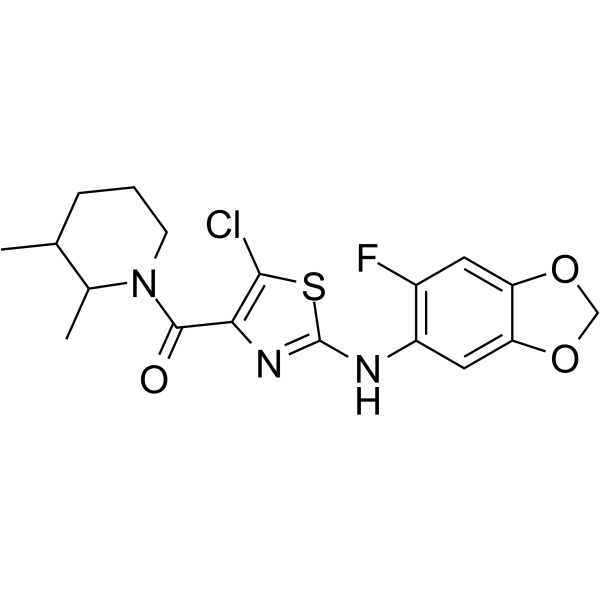
Physicochemical Properties
| Molecular Formula | C18H19CLFN3O3S |
| Molecular Weight | 411.88 |
| Exact Mass | 411.081 |
| Elemental Analysis | C, 52.49; H, 4.65; Cl, 8.61; F, 4.61; N, 10.20; O, 11.65; S, 7.78 |
| CAS # | 1366233-41-1 |
| PubChem CID | 71818573 |
| Appearance | Typically exists as solid at room temperature |
| LogP | 5.2 |
| Hydrogen Bond Donor Count | 1 |
| Hydrogen Bond Acceptor Count | 7 |
| Rotatable Bond Count | 3 |
| Heavy Atom Count | 27 |
| Complexity | 562 |
| Defined Atom Stereocenter Count | 0 |
| SMILES | C(C1=C(Cl)SC(NC2=C(F)C=C3OCOC3=C2)=N1)(N1CCCC(C)C1C)=O |
| InChi Key | GGKQWFQQUMWVOB-UHFFFAOYSA-N |
| InChi Code | InChI=1S/C18H19ClFN3O3S/c1-9-4-3-5-23(10(9)2)17(24)15-16(19)27-18(22-15)21-12-7-14-13(6-11(12)20)25-8-26-14/h6-7,9-10H,3-5,8H2,1-2H3,(H,21,22) |
| Chemical Name | [5-chloro-2-[(6-fluoro-1,3-benzodioxol-5-yl)amino]-1,3-thiazol-4-yl]-(2,3-dimethylpiperidin-1-yl)methanone |
| Synonyms | GSK2332255B; CHEMBL2418809; 1366233-41-1; GSK255B; SCHEMBL10087861; GTPL12529; BDBM50439218; |
| HS Tariff Code | 2934.99.9001 |
| Storage |
Powder-20°C 3 years 4°C 2 years In solvent -80°C 6 months -20°C 1 month |
| Shipping Condition | Room temperature (This product is stable at ambient temperature for a few days during ordinary shipping and time spent in Customs) |
Biological Activity
| Targets | rat TRPC3 (IC50 = 5 nM); rat TRPC6 (IC50 = 4 nM) |
| ln Vitro | GSK255B (0.01, 0.1, and 1 μM) inhibits the dose-dependent activation of nuclear factor of activated T cells (NFAT) by Ang II (angiotensin II) in HEK293T cells that overexpress TRPC3. In HEK293T cells producing a mutant TRPC6 channel with T70 and S322 mutated to glutamic acid (SETE), GSK255B inhibits NFAT activation by Ang II[1]. In rat newborn cardiac myocytes, GSK255B (10 μM) inhibits calcium entry that is triggered by phenylephrine (20 μM). GSK255B dose-dependent inhibition of angiotensin II or endothelin-1-induced cell hypertrophy signaling in HEK293T cells and in adult and neonatal cardiac myocytes[1]. |
| Cell Assay |
HEK293T Cell Experiments.[1] HEK293T cells were cultured to 50% confluence and then transfected with plasmid containing AT1R, NFAT-luc, and CMV-luc (internal control) as described previously. HEK293T cells do not express TRPC6 and express TRPC3 only at very low levels. For our studies, cells were transfected with WT-TRPC3, WT-TRPC6, or empty vector pcDNA to augment signaling to channel stimulation by a Gαq receptor-coupled agonist. After transfection, cultures were maintained in serum-free medium for 24 h. Cultures were then treated with Ang II with or without a TRPC3/6 inhibitor, vehicle, or inactive control for 4 h, then harvested using the Dual-Luciferase Reporter Assay System, following the manufacturer’s protocol. |
| References |
[1]. Combined TRPC3 and TRPC6 blockade by selective small-molecule or genetic deletion inhibits pathological cardiac hypertrophy. Proc Natl Acad Sci U S A. 2014 Jan 28;111(4):1551-6. |
| Additional Infomation | Chronic neurohormonal and mechanical stresses are central features of heart disease. Increasing evidence supports a role for the transient receptor potential canonical channels TRPC3 and TRPC6 in this pathophysiology. Channel expression for both is normally very low but is increased by cardiac disease, and genetic gain- or loss-of-function studies support contributions to hypertrophy and dysfunction. Selective small-molecule inhibitors remain scarce, and none target both channels, which may be useful given the high homology among them and evidence of redundant signaling. Here we tested selective TRPC3/6 antagonists (GSK2332255B and GSK2833503A; IC50, 3-21 nM against TRPC3 and TRPC6) and found dose-dependent blockade of cell hypertrophy signaling triggered by angiotensin II or endothelin-1 in HEK293T cells as well as in neonatal and adult cardiac myocytes. In vivo efficacy in mice and rats was greatly limited by rapid metabolism and high protein binding, although antifibrotic effects with pressure overload were observed. Intriguingly, although gene deletion of TRPC3 or TRPC6 alone did not protect against hypertrophy or dysfunction from pressure overload, combined deletion was protective, supporting the value of dual inhibition. Further development of this pharmaceutical class may yield a useful therapeutic agent for heart disease management.[1] |
Solubility Data
| Solubility (In Vitro) | May dissolve in DMSO (in most cases), if not, try other solvents such as H2O, Ethanol, or DMF with a minute amount of products to avoid loss of samples |
| Solubility (In Vivo) |
Note: Listed below are some common formulations that may be used to formulate products with low water solubility (e.g. < 1 mg/mL), you may test these formulations using a minute amount of products to avoid loss of samples. Injection Formulations (e.g. IP/IV/IM/SC) Injection Formulation 1: DMSO : Tween 80: Saline = 10 : 5 : 85 (i.e. 100 μL DMSO stock solution → 50 μL Tween 80 → 850 μL Saline) *Preparation of saline: Dissolve 0.9 g of sodium chloride in 100 mL ddH ₂ O to obtain a clear solution. Injection Formulation 2: DMSO : PEG300 :Tween 80 : Saline = 10 : 40 : 5 : 45 (i.e. 100 μL DMSO → 400 μLPEG300 → 50 μL Tween 80 → 450 μL Saline) Injection Formulation 3: DMSO : Corn oil = 10 : 90 (i.e. 100 μL DMSO → 900 μL Corn oil) Example: Take the Injection Formulation 3 (DMSO : Corn oil = 10 : 90) as an example, if 1 mL of 2.5 mg/mL working solution is to be prepared, you can take 100 μL 25 mg/mL DMSO stock solution and add to 900 μL corn oil, mix well to obtain a clear or suspension solution (2.5 mg/mL, ready for use in animals). Injection Formulation 4: DMSO : 20% SBE-β-CD in saline = 10 : 90 [i.e. 100 μL DMSO → 900 μL (20% SBE-β-CD in saline)] *Preparation of 20% SBE-β-CD in Saline (4°C,1 week): Dissolve 2 g SBE-β-CD in 10 mL saline to obtain a clear solution. Injection Formulation 5: 2-Hydroxypropyl-β-cyclodextrin : Saline = 50 : 50 (i.e. 500 μL 2-Hydroxypropyl-β-cyclodextrin → 500 μL Saline) Injection Formulation 6: DMSO : PEG300 : castor oil : Saline = 5 : 10 : 20 : 65 (i.e. 50 μL DMSO → 100 μLPEG300 → 200 μL castor oil → 650 μL Saline) Injection Formulation 7: Ethanol : Cremophor : Saline = 10: 10 : 80 (i.e. 100 μL Ethanol → 100 μL Cremophor → 800 μL Saline) Injection Formulation 8: Dissolve in Cremophor/Ethanol (50 : 50), then diluted by Saline Injection Formulation 9: EtOH : Corn oil = 10 : 90 (i.e. 100 μL EtOH → 900 μL Corn oil) Injection Formulation 10: EtOH : PEG300:Tween 80 : Saline = 10 : 40 : 5 : 45 (i.e. 100 μL EtOH → 400 μLPEG300 → 50 μL Tween 80 → 450 μL Saline) Oral Formulations Oral Formulation 1: Suspend in 0.5% CMC Na (carboxymethylcellulose sodium) Oral Formulation 2: Suspend in 0.5% Carboxymethyl cellulose Example: Take the Oral Formulation 1 (Suspend in 0.5% CMC Na) as an example, if 100 mL of 2.5 mg/mL working solution is to be prepared, you can first prepare 0.5% CMC Na solution by measuring 0.5 g CMC Na and dissolve it in 100 mL ddH2O to obtain a clear solution; then add 250 mg of the product to 100 mL 0.5% CMC Na solution, to make the suspension solution (2.5 mg/mL, ready for use in animals). Oral Formulation 3: Dissolved in PEG400 Oral Formulation 4: Suspend in 0.2% Carboxymethyl cellulose Oral Formulation 5: Dissolve in 0.25% Tween 80 and 0.5% Carboxymethyl cellulose Oral Formulation 6: Mixing with food powders Note: Please be aware that the above formulations are for reference only. InvivoChem strongly recommends customers to read literature methods/protocols carefully before determining which formulation you should use for in vivo studies, as different compounds have different solubility properties and have to be formulated differently. (Please use freshly prepared in vivo formulations for optimal results.) |
| Preparing Stock Solutions | 1 mg | 5 mg | 10 mg | |
| 1 mM | 2.4279 mL | 12.1395 mL | 24.2789 mL | |
| 5 mM | 0.4856 mL | 2.4279 mL | 4.8558 mL | |
| 10 mM | 0.2428 mL | 1.2139 mL | 2.4279 mL |