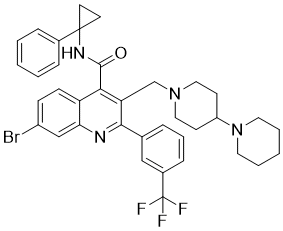
GSK2193874 (GSK-2193874) is a novel, potent, orally bioactive, and selective TRPV4 (Transient Receptor Potential Vanilloid 4) antagonist with the potential to be used for congestive heart failure. It inhibits TRPV4 with IC50 of 2 nM and 40 nM for rTRPV4 and hTRPV4. GSK2193874 was identified as a selective, orally active TRPV4 blocker that inhibits Ca(2+) influx through recombinant TRPV4 channels and native endothelial TRPV4 currents. In isolated rodent and canine lungs, TRPV4 blockade prevented the increased vascular permeability and resultant pulmonary edema associated with elevated PVP. Furthermore, in both acute and chronic HF models, GSK2193874 pretreatment inhibited the formation of pulmonary edema and enhanced arterial oxygenation. Finally, GSK2193874 treatment resolved pulmonary edema already established by myocardial infarction in mice. These findings identify a crucial role for TRPV4 in the formation of HF-induced pulmonary edema and suggest that TRPV4 blockade is a potential therapeutic strategy for HF patients.
Physicochemical Properties
| Molecular Formula | C37H38BRF3N4O |
| Molecular Weight | 691.6230 |
| Exact Mass | 690.218 |
| CAS # | 1336960-13-4 |
| PubChem CID | 53464483 |
| Appearance | White to light yellow solid powder |
| LogP | 8.819 |
| Hydrogen Bond Donor Count | 1 |
| Hydrogen Bond Acceptor Count | 7 |
| Rotatable Bond Count | 7 |
| Heavy Atom Count | 46 |
| Complexity | 1020 |
| Defined Atom Stereocenter Count | 0 |
| InChi Key | UIVOZBSCHXCGPS-UHFFFAOYSA-N |
| InChi Code | InChI=1S/C37H38BrF3N4O/c38-28-12-13-30-32(23-28)42-34(25-8-7-11-27(22-25)37(39,40)41)31(24-44-20-14-29(15-21-44)45-18-5-2-6-19-45)33(30)35(46)43-36(16-17-36)26-9-3-1-4-10-26/h1,3-4,7-13,22-23,29H,2,5-6,14-21,24H2,(H,43,46) |
| Chemical Name | 7-bromo-N-(1-phenylcyclopropyl)-3-[(4-piperidin-1-ylpiperidin-1-yl) methyl]-2-[3-(trifluoromethyl)phenyl]quinoline-4-carboxamide |
| Synonyms | GSK2193874; GSK2193874A; GSK 2193874; GSK 2193874A; GSK-2193874; GSK-2193874A; 7-bromo-N-(1-phenylcyclopropyl)-3-[(4-piperidin-1-ylpiperidin-1-yl) methyl]-2-[3-(trifluoromethyl)phenyl]quinoline-4-carboxamide; CHEMBL4073922; 3-([1,4'-Bipiperidin]-1'-ylmethyl)-7-bromo-N-(1-phenylcyclopropyl)-2-[3-(trifluoromethyl)phenyl]-4-quinolinecarboxamide; 3-([1,4'-Bipiperidin]-1'-ylmethyl)-7-bromo-N-(1-phenylcyclopropyl)-2-(3-(trifluoromethyl)phenyl)quinoline-4-carboxamide; |
| HS Tariff Code | 2934.99.9001 |
| Storage |
Powder-20°C 3 years 4°C 2 years In solvent -80°C 6 months -20°C 1 month |
| Shipping Condition | Room temperature (This product is stable at ambient temperature for a few days during ordinary shipping and time spent in Customs) |
Biological Activity
| Targets |
rTRPV4 (IC50 = 2 nM); hTRPV4 (IC50 = 40 nM)[1]
Transient Receptor Potential Vanilloid 4 (TRPV4) [1] Transient Receptor Potential Vanilloid 4 (TRPV4) [2] |
| ln Vitro |
GSK2193874 selectively targets TRPV1, TRPA1, TRPC3, TRPC6, and TRPM8 (IC50>25 μM) and targets the TRP channel [1]. GSK2193874 is an oral TRPV4 blocker that functions as a selective inhibitor of Ca2+ influx through the inhibition of both native endothelium TRPV4 currents and recombinant TRPV4 channels. GSK2193874 suppressed the activation of recombinant TRPV4 currents in whole-cell patch-clamp tests when added to external solutions at concentrations of 3 nM and above. However, GSK2193874 is ineffective up to 10 μM when delivered inside cells via inclusion in intracellular pipette solutions [2]. Acts as a potent and selective blocker of GSK2193874 towards TRPV4 cation channels, with no unexpected off-target cardiovascular liabilities addressed during development [1] - Inhibits Ca²⁺ influx through recombinant TRPV4 channels and suppresses native endothelial TRPV4 currents [2] - Prevents increased vascular permeability and subsequent pulmonary edema associated with elevated pulmonary venous pressure (PVP) in isolated rodent and canine lungs [2] |
| ln Vivo |
After evaluating GSK2193874's pharmacokinetic (PK) properties in rats and dogs, it was discovered that these animals' half-lives and oral exposures were appropriate for oral administration in chronic animal models (rat PK: iv CL=7.3 mL/min/kg, po t1/2=10 hours, %F=31; dog PK: intravenous injection CL=6.9 mL/min/kg, oral t1/2=31 hours, %F=53). Furthermore, at doses up to 30 mg/kg, GSK2193874 had no effect on rats' heart rates or blood pressure. An oral bioavailable TRPV4 inhibitor that is first-in-class, GSK2193874 has been shown to enhance lung function in a number of heart failure animals [1]. In rats, GSK2193874 exhibits good oral bioavailability (31%) and low clearance (7.3 mL/min/kg) [2]. In acute and chronic heart failure (HF) models, pretreatment with GSK2193874 inhibits the formation of pulmonary edema and enhances arterial oxygenation [2] - Effectively resolves already established pulmonary edema induced by myocardial infarction in mice [2] |
| Enzyme Assay |
Screening, calcium influx, and electrophysiology[2] TRPV4 blocker screening was performed on a fluorometric imaging plate reader (FLIPR) platform with hTRPV4-transduced HEK cells assessing the ability to inhibit TRPV4 Ca2+ influx after activation with GSK634775. Electrophysiology and other calcium influx assays were performed in HEK293, BHK, and HUVECs (Supplementary Methods). Selectivity[2] TRP selectivity assays were run on a FLIPR platform with calcium or membrane potential indicators. The following ligands were used: TRPV1, capsaicin; TRPA1, thymol; TRPC3 and TRPC6, carbachol; and TRPM8, icilin. hERG and Cav1.2 were evaluated by whole-cell voltage clamp. Details are in the Supplementary Methods Cardiac ion channel selectivity assays: [1] hERG and Cav1.2 were evaluated by whole-cell voltage clamp on PatchXpress 7000A. Nav1.5 was run using population patch clamp on IonWorks Quattro. |
| Cell Assay |
Endothelial cell integrity[2] HUVEC detachment was assessed with Diff Quik cell identification and imaged with a Sorcerer system (Optomax). HUVEC monolayer impedance was monitored with an xCELLigence system. TRPV4 FLIPR Assay: [1] HEK MSRII cells were thawed and suspended in the cell plating medium (DMEM/F12 1:1 with L-glutamine with 15 mM HEPES @ pH 7.3, 10 % FBS, 1 % Penicillin-Streptomycin solution, 1 % L-glutamine) at 15 K cells/50 µL. TRPV4 BacMam virus was added to the cells at a final concentration of 1 % and gently mixed. Cells were then plated at 15 K cells/well, allowed to stand at room temperature for 1 h and then incubated at 37 °C with 5 % CO2 for 24 to 72 h in a tissue culture incubator. Media was then removed and cells were dye loaded with 2 µM Fura-4, 0.5 mM Brilliant Black and 2.5 µM Probenecid. Plates were then run on a FLIPR Tetra 384. Blockers were added 10 min prior to TRPV4 activation with EC80 concentration of TRPV4 agonist such as GSK634775A. Data analysis was conducted following a 11 point blocker concentration curve using the Activity Base XE curve fitting module. For the detection of native endothelial TRPV4 current inhibition: Cultivate pulmonary capillary endothelial cells in appropriate culture conditions. Expose the cells to GSK2193874 at relevant concentrations. Use electrophysiological techniques to measure TRPV4-mediated currents before and after drug treatment, analyzing the inhibitory effect on current amplitude [2] - For the assessment of Ca²⁺ influx inhibition through recombinant TRPV4 channels: Transfect cells with recombinant TRPV4 expression vectors and culture until stable expression is achieved. Load the cells with a Ca²⁺-sensitive fluorescent probe. Treat the cells with GSK2193874 followed by TRPV4 activators, then monitor and quantify changes in fluorescent intensity to evaluate the inhibition of Ca²⁺ influx [2] |
| Animal Protocol |
Hemodynamic Measurement in Anesthetized Mice: [1] Male TRPV4+/+ and TRPV4-/- mice, 25–30 g and age from 10 to 12 weeks, on a BALB/c AnNCrl background strain, were utilized. Mice were anesthetized and maintained with isoflurane (1.5% in O2). The right common carotid artery and jugular vein were isolated and cannulated with polyethylene 50 tubing for continuous monitoring of blood pressure, HR, and for infusion of test drug. Drug doses were administered at an escalating dose from 3 mg/kg, 10 mg/kg, and 30 mg/kg with an infusion rate of 20 µL/min. The vehicle was a 1% dimethyl sulfoxide saline. Blood samples were collected at the end of infusion. Hemodynamic Measurement in the Anesthetized Dog: [1] Male Marshall Beagles weighing 8 to 12 kg were fasted for 18 h and then anesthetized with propofol (10 mg/kg i.v.). Femoral arteries and veins were isolated, and an arterial catheter was inserted into the left femoral artery to monitor blood pressure. Catheters were inserted into femoral veins for drug and anesthesia administration. Anesthesia was maintained with alpha chloralose (65 mg/kg i.v. + 0.5 mg/kg/min). Hemodynamic parameters were continuously recorded on CA Recorder computer software. Test compound was administered as an ascending i.v. infusion. The vehicle was a 1% dimethyl sulfoxide in saline. Blood samples were collected at the end of infusion. Osmoregulation[2] Adult male Sprague-Dawley rats (n = 7 to 8 per group) were treated with vehicle (6% Cavitron) or GSK2193874 (30 mg kg−1 day−1) via oral gavage for at least 4 days before osmotic challenges. Rats underwent acute and chronic hyper- and hypo-osmotic challenges, as described in the Supplementary Methods. Rodent radiotelemetry[2] Sprague-Dawley (control, n = 18) and spontaneously hypertensive rats (n = 11) were implanted with Data Sciences International (DSI) radiotelemetry transmitters. Rats were dosed with vehicle (6% Cavitron) or GSK2193874, and data were captured with DSI receivers and analyzed with Microsoft Excel. Diuretic studies[2] Sprague-Dawley rats were administered vehicle (0.9% NaCl, 25 ml/kg), furosemide (30 mg/kg), or hydrochlorothiazide (30 mg/kg) via oral gavage. Urine was then collected over 4 hours followed by blood sampling. Rats recovered for 4 days and then received GSK2193874 (30 mg kg−1 day−1 oral gavage) for 5 days before repeating the diuretic challenge. Rodent in vivo efficacy[2] Sprague-Dawley rats were used for in vivo testing of GSK2193874 in the presence of the TRPV4 activator GSK1016790 and for aortic banding. Mice were used for MI studies. See the Supplementary Methods for details. Isolated rodent/canine lung pulmonary edema prevention experiment: Isolate lungs from rodents or canines and establish an ex vivo perfusion system. Adjust the perfusion pressure to simulate elevated PVP. Administer GSK2193874 into the perfusion system. Continuously monitor vascular permeability and edema formation indicators (e.g., fluid accumulation, protein leakage) to assess the drug's preventive effect [2] - Acute and chronic HF models for pulmonary edema inhibition: Establish acute and chronic HF models in animals via appropriate methods (e.g., surgical or pharmacological induction). Once the models are successfully established, administer GSK2193874 orally at a therapeutic dose. Regularly measure indicators such as pulmonary edema severity (e.g., lung wet/dry weight ratio) and arterial blood oxygenation levels to evaluate the drug's inhibitory effect on edema formation [2] - Myocardial infarction-induced pulmonary edema resolution experiment: Induce myocardial infarction in mice to establish pulmonary edema models. After edema is established, administer GSK2193874 orally. Assess the resolution of pulmonary edema by measuring relevant indicators (e.g., lung edema degree, respiratory function) at specified time points [2] |
| References |
[1]. Discovery of GSK2193874: An Orally Active, Potent, and Selective Blocker of Transient Receptor Potential Vanilloid 4. ACS Med Chem Lett. 2017 Mar 20;8(5):549-554. [2]. An orally active TRPV4 channel blocker prevents and resolves pulmonary edema induced by heart failure. Sci Transl Med. 2012 Nov 7;4(159):159ra148. |
| Additional Infomation |
Transient Receptor Potential Vanilloid 4 (TRPV4) is a member of the Transient Receptor Potential (TRP) superfamily of cation channels. TRPV4 is expressed in the vascular endothelium in the lung and regulates the integrity of the alveolar septal barrier. Increased pulmonary vascular pressure evokes TRPV4-dependent pulmonary edema, and therefore, inhibition of TRPV4 represents a novel approach for the treatment of pulmonary edema associated with conditions such as congestive heart failure. Herein we report the discovery of an orally active, potent, and selective TRPV4 blocker, 3-(1,4'-bipiperidin-1'-ylmethyl)-7-bromo-N-(1-phenylcyclopropyl)-2-[3-(trifluoromethyl)phenyl]-4-quinolinecarboxamide (GSK2193874, 28) after addressing an unexpected off-target cardiovascular liability observed from in vivo studies. GSK2193874 is a selective tool for elucidating TRPV4 biology both in vitro and in vivo.[1] Pulmonary edema resulting from high pulmonary venous pressure (PVP) is a major cause of morbidity and mortality in heart failure (HF) patients, but current treatment options demonstrate substantial limitations. Recent evidence from rodent lungs suggests that PVP-induced edema is driven by activation of pulmonary capillary endothelial transient receptor potential vanilloid 4 (TRPV4) channels. To examine the therapeutic potential of this mechanism, we evaluated TRPV4 expression in human congestive HF lungs and developed small-molecule TRPV4 channel blockers for testing in animal models of HF. TRPV4 immunolabeling of human lung sections demonstrated expression of TRPV4 in the pulmonary vasculature that was enhanced in sections from HF patients compared to controls. GSK2193874 was identified as a selective, orally active TRPV4 blocker that inhibits Ca(2+) influx through recombinant TRPV4 channels and native endothelial TRPV4 currents. In isolated rodent and canine lungs, TRPV4 blockade prevented the increased vascular permeability and resultant pulmonary edema associated with elevated PVP. Furthermore, in both acute and chronic HF models, GSK2193874 pretreatment inhibited the formation of pulmonary edema and enhanced arterial oxygenation. Finally, GSK2193874 treatment resolved pulmonary edema already established by myocardial infarction in mice. These findings identify a crucial role for TRPV4 in the formation of HF-induced pulmonary edema and suggest that TRPV4 blockade is a potential therapeutic strategy for HF patients.[2] Chemical name: 3-(1,4'-bipiperidin-1'-ylmethyl)-7-bromo-N-(1-phenylcyclopropyl)-2-[3-(trifluoromethyl)phenyl]-4-quinolinecarboxamide [1] - Mechanism of action: GSK2193874 selectively blocks TRPV4 channels, which are expressed in pulmonary vascular endothelium and regulate alveolar septal barrier integrity. By inhibiting TRPV4-mediated Ca²⁺ influx, the drug prevents and resolves increased vascular permeability and pulmonary edema caused by elevated PVP in HF [1][2] - Therapeutic potential: Serves as a novel therapeutic strategy for the treatment of pulmonary edema associated with conditions such as congestive heart failure [1][2] - Expression of TRPV4 in human lungs: TRPV4 is expressed in the pulmonary vasculature of human lungs, and its expression is enhanced in lung sections from HF patients compared to healthy controls [2] |
Solubility Data
| Solubility (In Vitro) | DMSO : ~100 mg/mL (~144.59 mM) |
| Solubility (In Vivo) |
Solubility in Formulation 1: 2.5 mg/mL (3.61 mM) in 5% DMSO + 95% (20% SBE-β-CD in Saline) (add these co-solvents sequentially from left to right, and one by one), suspension solution; with sonication. Preparation of 20% SBE-β-CD in Saline (4°C,1 week): Dissolve 2 g SBE-β-CD in 10 mL saline to obtain a clear solution. Solubility in Formulation 2: ≥ 2.08 mg/mL (3.01 mM) (saturation unknown) in 10% DMSO + 40% PEG300 + 5% Tween80 + 45% Saline (add these co-solvents sequentially from left to right, and one by one), clear solution. For example, if 1 mL of working solution is to be prepared, you can add 100 μL of 20.8 mg/mL clear DMSO stock solution to 400 μL PEG300 and mix evenly; then add 50 μL Tween-80 to the above solution and mix evenly; then add 450 μL normal saline to adjust the volume to 1 mL. Preparation of saline: Dissolve 0.9 g of sodium chloride in 100 mL ddH₂ O to obtain a clear solution. Solubility in Formulation 3: ≥ 2.08 mg/mL (3.01 mM) (saturation unknown) in 10% DMSO + 90% Corn Oil (add these co-solvents sequentially from left to right, and one by one), clear solution. For example, if 1 mL of working solution is to be prepared, you can add 100 μL of 20.8 mg/mL clear DMSO stock solution to 900 μL of corn oil and mix evenly. (Please use freshly prepared in vivo formulations for optimal results.) |
| Preparing Stock Solutions | 1 mg | 5 mg | 10 mg | |
| 1 mM | 1.4459 mL | 7.2294 mL | 14.4588 mL | |
| 5 mM | 0.2892 mL | 1.4459 mL | 2.8918 mL | |
| 10 mM | 0.1446 mL | 0.7229 mL | 1.4459 mL |