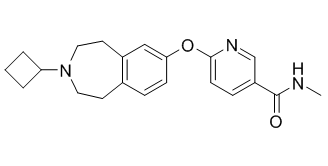
GSK189254A (also known as GSK189254) is a novel histamine H(3) receptor antagonist with high affinity for human (pK(i) = 9.59 -9.90) and rat (pK(i) = 8.51-9.17) H(3) receptors. It has the potential for the treatment of narcolepsy. GSK189254 demonstrated strong functional antagonism (pA(2) = 9.06 versus agonist-induced changes in cAMP) and inverse agonism (pIC(50) = 8.20 versus basal guanosine 5'-O-(3-[(35)S]thio)triphosphate binding) at the human recombinant H(3) receptor, demonstrating its >10,000-fold selectivity for human H(3) receptors over other targets tested. Specific binding of [(3)H]GSK189254 was shown by in vitro autoradiography in the cortex and hippocampus of rats and humans. For the symptomatic treatment of dementia in Alzheimer's disease and other cognitive disorders, GSK189254 may have therapeutic potential.
Physicochemical Properties
| Molecular Formula | C21H25N3O2 | |
| Molecular Weight | 351.44 | |
| Exact Mass | 351.194 | |
| Elemental Analysis | C, 71.77; H, 7.17; N, 11.96; O, 9.10 | |
| CAS # | 720690-73-3 | |
| Related CAS # | 945493-87-8 (HCl); 720690-73-3 | |
| PubChem CID | 9798547 | |
| Appearance | White to off-white solid powder | |
| Density | 1.2±0.1 g/cm3 | |
| Boiling Point | 545.0±50.0 °C at 760 mmHg | |
| Flash Point | 283.4±30.1 °C | |
| Vapour Pressure | 0.0±1.5 mmHg at 25°C | |
| Index of Refraction | 1.605 | |
| LogP | 3.29 | |
| Hydrogen Bond Donor Count | 1 | |
| Hydrogen Bond Acceptor Count | 4 | |
| Rotatable Bond Count | 4 | |
| Heavy Atom Count | 26 | |
| Complexity | 482 | |
| Defined Atom Stereocenter Count | 0 | |
| InChi Key | WROHEWWOCPRMIA-UHFFFAOYSA-N | |
| InChi Code | InChI=1S/C21H25N3O2/c1-22-21(25)17-6-8-20(23-14-17)26-19-7-5-15-9-11-24(18-3-2-4-18)12-10-16(15)13-19/h5-8,13-14,18H,2-4,9-12H2,1H3,(H,22,25) | |
| Chemical Name | 6-[(3-cyclobutyl-1,2,4,5-tetrahydro-3-benzazepin-7-yl)oxy]-N-methylpyridine-3-carboxamide | |
| Synonyms |
|
|
| HS Tariff Code | 2934.99.9001 | |
| Storage |
Powder-20°C 3 years 4°C 2 years In solvent -80°C 6 months -20°C 1 month |
|
| Shipping Condition | Room temperature (This product is stable at ambient temperature for a few days during ordinary shipping and time spent in Customs) |
Biological Activity
| Targets | H3, human ( pKi = 9.59-9.90 ); H3, rat ( pIC50 = 8.51-9.17 ) | |
| ln Vitro |
|
|
| ln Vivo |
|
|
| Animal Protocol | Rats: GSK189254 pharmacokinetic studies are carried out in male Sprague-Dawley rats that are conscious. GSK189254 (n=3) is infused intravenously into the animals over the course of one hour at a nominal dose level of 1 mg of free base/kg through the use of a femoral vein cannula (10 mL/h/kg). To achieve the target concentration of 0.1 mg free base/mL, GSK189254 is dissolved in 0.9% (w/v) saline and filtered through a 0.22-mm Millex-GV filter prior to administration. The same rats were given a single oral dose of GSK189254 by gastric gavage after a period of at least two days, with the aim of achieving a dose of 2 mg of free base/kg. GSK189254 is designed to have a target concentration of 0.4 mg free base/mL in 1% (w/v) aqueous methylcellulose[1]. Mice: The vehicle is made up of 0.05 mL of 0.9% NaCl and 1% methylcellulose. It dissolves GSK189254 in the vehicle solution. GSK189254 is administered acutely and repeatedly to wild-type (Ox+/+) and orexin-knockout (Ox−/−) mice to examine its effects on the sleep-wake cycle. In Ox+/+ and Ox−/− mice, GSK189254 (3 and 10 mg/kg, p.o.) is dosed at 10 h during the sleep-wake cycle. GSK189254 is administered orally at a dose of 10 mg/kg[2]. | |
| References |
[1]. GSK189254, a novel H3 receptor antagonist that binds to histamine H3 receptors in Alzheimer's disease brain and improves cognitive performance in preclinical models. J Pharmacol Exp Ther. 2007 Jun;321(3):1032-45. |
Solubility Data
| Solubility (In Vitro) |
|
|||
| Solubility (In Vivo) |
Solubility in Formulation 1: ≥ 2.5 mg/mL (7.11 mM) (saturation unknown) in 10% DMSO + 40% PEG300 + 5% Tween80 + 45% Saline (add these co-solvents sequentially from left to right, and one by one), clear solution. For example, if 1 mL of working solution is to be prepared, you can add 100 μL of 25.0 mg/mL clear DMSO stock solution to 400 μL PEG300 and mix evenly; then add 50 μL Tween-80 to the above solution and mix evenly; then add 450 μL normal saline to adjust the volume to 1 mL. Preparation of saline: Dissolve 0.9 g of sodium chloride in 100 mL ddH₂ O to obtain a clear solution. Solubility in Formulation 2: ≥ 2.5 mg/mL (7.11 mM) (saturation unknown) in 10% DMSO + 90% (20% SBE-β-CD in Saline) (add these co-solvents sequentially from left to right, and one by one), clear solution. For example, if 1 mL of working solution is to be prepared, you can add 100 μL of 25.0 mg/mL clear DMSO stock solution to 900 μL of 20% SBE-β-CD physiological saline solution and mix evenly. Preparation of 20% SBE-β-CD in Saline (4°C,1 week): Dissolve 2 g SBE-β-CD in 10 mL saline to obtain a clear solution. Solubility in Formulation 3: ≥ 2.5 mg/mL (7.11 mM) (saturation unknown) in 10% DMSO + 90% Corn Oil (add these co-solvents sequentially from left to right, and one by one), clear solution. For example, if 1 mL of working solution is to be prepared, you can add 100 μL of 25.0 mg/mL clear DMSO stock solution to 900 μL of corn oil and mix evenly. (Please use freshly prepared in vivo formulations for optimal results.) |
| Preparing Stock Solutions | 1 mg | 5 mg | 10 mg | |
| 1 mM | 2.8454 mL | 14.2272 mL | 28.4544 mL | |
| 5 mM | 0.5691 mL | 2.8454 mL | 5.6909 mL | |
| 10 mM | 0.2845 mL | 1.4227 mL | 2.8454 mL |