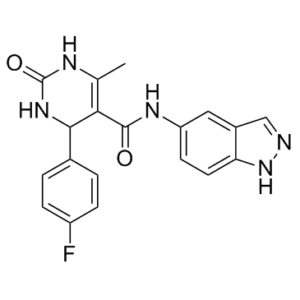
GSK180736A (GSK-180736A) is a GRK2 inhibitor that was developed as a novel and potent Rho-associated, coiled-coil-containing protein kinase (ROCK) inhibitor which binds to GRK2 (G protein-coupled receptor kinase 2) with IC50 of 0.77 μM; G protein-coupled receptors (GPCRs) are central to many physiological processes. Regulation of this superfamily of receptors is controlled by GPCR kinases (GRKs), some of which have been implicated in heart failure. GSK180736A shows ≥400-fold selectivity for GRK2 over both GRK1 and GRK5. GSK180736A is structurally similar to paroxetine. ROCK1 is a potential therapeutic target in the treatment of cardiovascular diseases such as hypertension. GSK180736A is a weak inhibitor of PKA with an IC50 of 30 μM, but highly potent against ROCK1 with IC50 of 100 nM.
Physicochemical Properties
| Molecular Formula | C19H16FN5O2 | |
| Molecular Weight | 365.361046791077 | |
| Exact Mass | 365.128 | |
| CAS # | 817194-38-0 | |
| Related CAS # |
|
|
| PubChem CID | 11233873 | |
| Appearance | Light yellow to khaki solid powder | |
| LogP | 1.7 | |
| Hydrogen Bond Donor Count | 4 | |
| Hydrogen Bond Acceptor Count | 4 | |
| Rotatable Bond Count | 3 | |
| Heavy Atom Count | 27 | |
| Complexity | 632 | |
| Defined Atom Stereocenter Count | 0 | |
| SMILES | O=C1NC(C2C=CC(F)=CC=2)C(C(NC2C=C3C(NN=C3)=CC=2)=O)=C(C)N1 |
|
| InChi Key | HEAIGWIZTYAQTC-UHFFFAOYSA-N | |
| InChi Code | InChI=1S/C19H16FN5O2/c1-10-16(17(24-19(27)22-10)11-2-4-13(20)5-3-11)18(26)23-14-6-7-15-12(8-14)9-21-25-15/h2-9,17H,1H3,(H,21,25)(H,23,26)(H2,22,24,27) | |
| Chemical Name | 4-(4-fluorophenyl)-N-(1H-indazol-5-yl)-6-methyl-2-oxo-3,4-dihydro-1H-pyrimidine-5-carboxamide | |
| Synonyms |
|
|
| HS Tariff Code | 2934.99.9001 | |
| Storage |
Powder-20°C 3 years 4°C 2 years In solvent -80°C 6 months -20°C 1 month |
|
| Shipping Condition | Room temperature (This product is stable at ambient temperature for a few days during ordinary shipping and time spent in Customs) |
Biological Activity
| Targets |
G Protein-Coupled Receptor Kinase 2 (GRK2) (Ki = 0.7 nM; IC50 = 1.3 nM for recombinant GRK2 kinase activity; >500-fold selectivity over other GRK isoforms and 200+ kinases) [1] |
| ln Vitro |
Developed as a ROCK inhibitor, GSK180736A is a structurally similar compound to paroxetine, but it has been shown to be an even more potent and selective GRK2 inhibitor, with an IC50 of 0.77 μM and more than 100-fold selectivity over other GRKs. One possible therapeutic target for the management of cardiovascular conditions like hypertension is ROCK1. GSK180736A exhibits low potency against PKA (IC50 = 30 μM) but high potency against ROCK1 (IC50 = 100 nM)[1]. GSK180736A potently inhibited recombinant human GRK2 kinase activity in a dose-dependent manner, with 98% inhibition at 10 nM [1] - GSK180736A showed high selectivity for GRK2: IC50 > 1 μM for GRK1, GRK4, GRK5, GRK6, and other kinases (e.g., PKA, PKC, CDK1), confirming >500-fold selectivity [1] - GSK180736A (5 nM) inhibited GRK2-mediated phosphorylation of β2-adrenergic receptor (β2AR) in HEK293 cells by 75%, as detected by phospho-specific Western blot [1] - GSK180736A (1-10 nM) dose-dependently enhanced isoproterenol-induced cAMP accumulation in HEK293 cells expressing β2AR (3.2-fold increase at 10 nM), reversing GRK2-mediated receptor desensitization [1] - GSK180736A (≤100 nM) did not affect viability of HEK293, HeLa, or primary cardiomyocytes, with cell viability >90% after 72 hours [1] |
| ln Vivo | GSK180736A is a compound structurally similar to paroxetine that is developed as a ROCK inhibitor, is shown to be an even more potent and selective inhibitor of GRK2 with an IC50 of 0.77 μM and more than 100-fold selectivity over other GRKs. ROCK1 is a potential therapeutic target in the treatment of cardiovascular diseases such as hypertension. GSK180736A is a weak inhibitor of PKA with an IC50 of 30 μM, but highly potent against ROCK1 (IC50=100 NM). |
| Enzyme Assay |
Recombinant human GRK2 was incubated with ATP (10 μM) and synthetic peptide substrate (β2AR-derived) in reaction buffer (pH 7.4). Serial concentrations of GSK180736A (0.01-100 nM) were added, and the mixture was incubated at 30°C for 60 minutes. Phosphorylated peptide was detected using a fluorescence-based kinase assay kit, and IC50/Ki values were calculated by nonlinear regression [1] - Surface Plasmon Resonance (SPR) assay: Recombinant GRK2 was immobilized on a sensor chip. GSK180736A (0.1-20 nM) was injected over the chip at 25°C, and binding affinity (Ki) was determined by analyzing sensorgrams of resonance signal changes [1] - Kinase selectivity panel assay: GSK180736A (1 μM) was tested against a panel of 200+ kinases (including GRK isoforms, serine/threonine kinases, tyrosine kinases). Kinase activity was measured using specific substrates, and selectivity was determined as the ratio of IC50 for off-target kinases to IC50 for GRK2 [1] |
| Cell Assay |
HEK293 cells stably expressing human β2AR were cultured in DMEM medium supplemented with fetal bovine serum. Cells were pretreated with GSK180736A (0.1-10 nM) for 1 hour, then stimulated with isoproterenol (1 μM) for 30 minutes. cAMP accumulation was quantified using a cyclic AMP ELISA kit [1] - β2AR phosphorylation assay: HEK293-β2AR cells were treated with GSK180736A (5 nM) for 1 hour, followed by isoproterenol (1 μM) stimulation for 15 minutes. Total protein was extracted, and Western blot was performed with phospho-β2AR (Ser345/346) antibody to detect GRK2-mediated phosphorylation [1] - Cell viability assay: Primary cardiomyocytes and HEK293 cells were seeded in 96-well plates, treated with GSK180736A (0.01-100 nM) for 72 hours. Cell viability was assessed by MTT assay [1] |
| Animal Protocol |
NA NA |
| ADME/Pharmacokinetics |
Plasma protein binding rate of GSK180736A was 94% in human plasma and 92% in rat plasma [1] - Metabolism studies in human liver microsomes showed GSK180736A was metabolized primarily via CYP3A4-mediated oxidation, with a half-life of 3.8 hours in microsomal incubation [1] |
| Toxicity/Toxicokinetics |
GSK180736A (≤100 nM) showed no cytotoxicity to primary cardiomyocytes, HEK293, or HeLa cells, with no induction of apoptotic cell death (apoptotic rate <5%) [1] - Acute toxicity in mice: Single intraperitoneal injection of GSK180736A up to 100 mg/kg did not cause mortality or significant weight loss [1] |
| References |
[1]. Structure-Based Design, Synthesis, and Biological Evaluation of Highly Selective and Potent G Protein-Coupled Receptor Kinase 2 Inhibitors. J Med Chem. 2016 Apr 28;59(8):3793-807. |
| Additional Infomation |
GSK180736A is a highly selective, potent small-molecule inhibitor of GRK2, designed via structure-based drug design targeting the GRK2 ATP-binding pocket [1] - Its mechanism of action involves competitive binding to GRK2’s ATP site, inhibiting GRK2-mediated GPCR phosphorylation and desensitization [1] - GSK180736A is widely used as a research tool to study GRK2 function in GPCR signaling pathways, cardiovascular diseases, and inflammatory responses [1] - The drug exhibits favorable physicochemical properties, including good aqueous solubility (85 μg/mL) and stability in simulated gastric and intestinal fluids [1] |
Solubility Data
| Solubility (In Vitro) |
|
|||
| Solubility (In Vivo) |
Solubility in Formulation 1: ≥ 2.5 mg/mL (6.84 mM) (saturation unknown) in 10% DMSO + 40% PEG300 + 5% Tween80 + 45% Saline (add these co-solvents sequentially from left to right, and one by one), clear solution. For example, if 1 mL of working solution is to be prepared, you can add 100 μL of 25.0 mg/mL clear DMSO stock solution to 400 μL PEG300 and mix evenly; then add 50 μL Tween-80 to the above solution and mix evenly; then add 450 μL normal saline to adjust the volume to 1 mL. Preparation of saline: Dissolve 0.9 g of sodium chloride in 100 mL ddH₂ O to obtain a clear solution. Solubility in Formulation 2: ≥ 2.5 mg/mL (6.84 mM) (saturation unknown) in 10% DMSO + 90% (20% SBE-β-CD in Saline) (add these co-solvents sequentially from left to right, and one by one), clear solution. For example, if 1 mL of working solution is to be prepared, you can add 100 μL of 25.0 mg/mL clear DMSO stock solution to 900 μL of 20% SBE-β-CD physiological saline solution and mix evenly. Preparation of 20% SBE-β-CD in Saline (4°C,1 week): Dissolve 2 g SBE-β-CD in 10 mL saline to obtain a clear solution. Solubility in Formulation 3: ≥ 2.5 mg/mL (6.84 mM) (saturation unknown) in 10% DMSO + 90% Corn Oil (add these co-solvents sequentially from left to right, and one by one), clear solution. For example, if 1 mL of working solution is to be prepared, you can add 100 μL of 25.0 mg/mL clear DMSO stock solution to 900 μL of corn oil and mix evenly. (Please use freshly prepared in vivo formulations for optimal results.) |
| Preparing Stock Solutions | 1 mg | 5 mg | 10 mg | |
| 1 mM | 2.7370 mL | 13.6851 mL | 27.3703 mL | |
| 5 mM | 0.5474 mL | 2.7370 mL | 5.4741 mL | |
| 10 mM | 0.2737 mL | 1.3685 mL | 2.7370 mL |