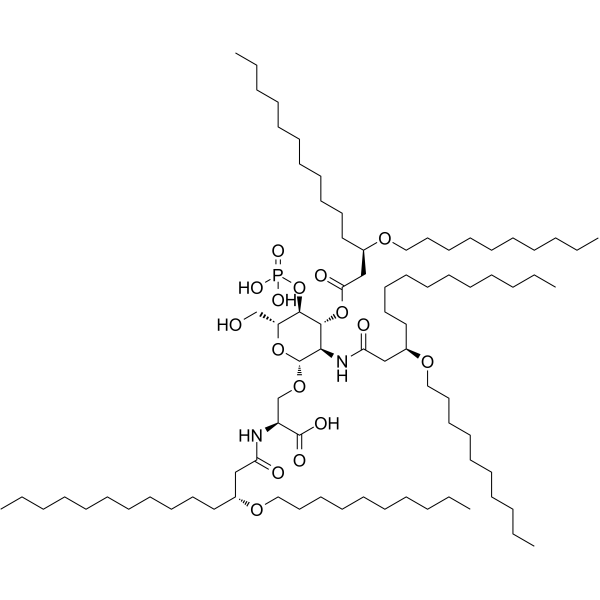
GSK1795091 (CRX-601; GSK-1795091) is a novel and potent Toll-like receptor 4 (TLR4) agonist with antitumor activity. TLR4 is a member of the TLR family tha plays a key role in the activation of innate immunity against pathogens. As an immunologic stimulator, it can be used as a vaccine adjuvant to enhance both mucosal and systemic immunity to influenza virus vaccines. GSK1795091 is being studies in clinical trials for the treatment of cancer. GSK1795091 binds to and activates TLR4, thereby stimulating dendritic cells (DCs), monocytes and macrophages. This activation results in the production of pro-inflammatory cytokines, including interferon gamma (IFN-g), tumor necrosis factor-alpha (TNF-a) and the interleukins (IL), IL-1 beta, -6 and -12. This may induce a T helper cell-1 (Th1) immune response and, upon co-administration of a vaccine containing tumor-associated antigens (TAAs), activates a cytotoxic T-lymphocyte (CTL) response against tumor cells expressing those TAAs.
Physicochemical Properties
| Molecular Formula | C81H157N2O16P |
| Molecular Weight | 1446.09086871147 |
| Exact Mass | 1445.127 |
| CAS # | 1233589-81-5 |
| PubChem CID | 25127152 |
| Appearance | Typically exists as solid at room temperature |
| LogP | 25.6 |
| Hydrogen Bond Donor Count | 6 |
| Hydrogen Bond Acceptor Count | 16 |
| Rotatable Bond Count | 77 |
| Heavy Atom Count | 100 |
| Complexity | 1920 |
| Defined Atom Stereocenter Count | 9 |
| SMILES | CCCCCCCCCCC[C@H](CC(=O)N[C@@H]1[C@H]([C@@H]([C@H](O[C@H]1OC[C@@H](C(=O)O)NC(=O)C[C@@H](CCCCCCCCCCC)OCCCCCCCCCC)CO)OP(=O)(O)O)OC(=O)C[C@@H](CCCCCCCCCCC)OCCCCCCCCCC)OCCCCCCCCCC |
| InChi Key | ICLAYQQKWJGHBV-XJZMHMBSSA-N |
| InChi Code | InChI=1S/C81H157N2O16P/c1-7-13-19-25-31-37-40-46-52-58-69(93-61-55-49-43-34-28-22-16-10-4)64-74(85)82-72(80(88)89)68-96-81-77(83-75(86)65-70(59-53-47-41-38-32-26-20-14-8-2)94-62-56-50-44-35-29-23-17-11-5)79(78(73(67-84)97-81)99-100(90,91)92)98-76(87)66-71(60-54-48-42-39-33-27-21-15-9-3)95-63-57-51-45-36-30-24-18-12-6/h69-73,77-79,81,84H,7-68H2,1-6H3,(H,82,85)(H,83,86)(H,88,89)(H2,90,91,92)/t69-,70-,71-,72+,73-,77-,78-,79-,81-/m1/s1 |
| Chemical Name | (2S)-2-[[(3R)-3-decoxytetradecanoyl]amino]-3-[(2R,3R,4R,5S,6R)-3-[[(3R)-3-decoxytetradecanoyl]amino]-4-[(3R)-3-decoxytetradecanoyl]oxy-6-(hydroxymethyl)-5-phosphonooxyoxan-2-yl]oxypropanoic acid |
| Synonyms | GSK 1795091 GSK-1795091 GSK1795091 |
| HS Tariff Code | 2934.99.9001 |
| Storage |
Powder-20°C 3 years 4°C 2 years In solvent -80°C 6 months -20°C 1 month |
| Shipping Condition | Room temperature (This product is stable at ambient temperature for a few days during ordinary shipping and time spent in Customs) |
Biological Activity
| ln Vivo | In order to elicit significant mucosal and systemic immune responses, GSK1795091 (CRX-601), an intranasal medication at 0.1 μg/mouse, is employed as an adjuvant in conjunction with vaccine effectiveness (H3N2) induction [1]. In mouse tumor models, GSK1795091 (25 μg/mouse; intravenously; each; once weekly for three times) slows growth and results in long-term tumors [3]. |
| Animal Protocol |
Animal/Disease Models: Female balb/c (Bagg ALBino) mouse primed with H3N2 [1] Doses: 0.1 μg/mouse Route of Administration: Intranasal administration Experimental Results: As an adjuvant combined with detergent cleaved influenza antigen (H3N2), it can produce Robust local and systemic immunity against co-administered influenza antigens, while demonstrating high efficacy against two heterotypic influenza challenges. Mice receiving the adjuvanted vaccine had Dramatically higher IgA titers than unadjuvanted (vehicle) controls in an adjuvant dose-dependent manner. Adjuvanted vaccines promote antigen-specific IgG and IgA antibody responses and the generation of multifunctional antigen-specific Th17 cells. |
| References |
[1]. Safety, Pharmacokinetics, and Pharmacodynamics of the TLR4 Agonist GSK1795091 in Healthy Individuals: Results from a Randomized, Double-blind, Placebo-controlled, Ascending Dose Study. Clin Ther. 2020;42(8):1519-1534.e33. [2]. Maroof A, et.al. Intranasal vaccination promotes detrimental Th17-mediated immunity against influenza infection. PLoS Pathog. 2014 Jan;10(1):e1003875. [3]. OX40 agonists for cancer treatment: a patent review. Expert Opin Ther Pat. 2021 Jan;31(1):81-90. |
| Additional Infomation | TLR4 Agonist GSK1795091 is a toll-like receptor 4 (TLR4) agonist, with potential immunoadjuvant activity. Upon administration, GSK1795091 binds to and activates TLR4, thereby stimulating dendritic cells (DCs), monocytes and macrophages. This activation results in the production of pro-inflammatory cytokines, including interferon gamma (IFN-g), tumor necrosis factor-alpha (TNF-a) and the interleukins (IL), IL-1 beta, -6 and -12. This may induce a T helper cell-1 (Th1) immune response and, upon co-administration of a vaccine containing tumor-associated antigens (TAAs), activates a cytotoxic T-lymphocyte (CTL) response against tumor cells expressing those TAAs. TLR4, a member of the TLR family, plays a key role in the activation of innate immunity. |
Solubility Data
| Solubility (In Vitro) | May dissolve in DMSO (in most cases), if not, try other solvents such as H2O, Ethanol, or DMF with a minute amount of products to avoid loss of samples |
| Solubility (In Vivo) |
Note: Listed below are some common formulations that may be used to formulate products with low water solubility (e.g. < 1 mg/mL), you may test these formulations using a minute amount of products to avoid loss of samples. Injection Formulations (e.g. IP/IV/IM/SC) Injection Formulation 1: DMSO : Tween 80: Saline = 10 : 5 : 85 (i.e. 100 μL DMSO stock solution → 50 μL Tween 80 → 850 μL Saline) *Preparation of saline: Dissolve 0.9 g of sodium chloride in 100 mL ddH ₂ O to obtain a clear solution. Injection Formulation 2: DMSO : PEG300 :Tween 80 : Saline = 10 : 40 : 5 : 45 (i.e. 100 μL DMSO → 400 μLPEG300 → 50 μL Tween 80 → 450 μL Saline) Injection Formulation 3: DMSO : Corn oil = 10 : 90 (i.e. 100 μL DMSO → 900 μL Corn oil) Example: Take the Injection Formulation 3 (DMSO : Corn oil = 10 : 90) as an example, if 1 mL of 2.5 mg/mL working solution is to be prepared, you can take 100 μL 25 mg/mL DMSO stock solution and add to 900 μL corn oil, mix well to obtain a clear or suspension solution (2.5 mg/mL, ready for use in animals). Injection Formulation 4: DMSO : 20% SBE-β-CD in saline = 10 : 90 [i.e. 100 μL DMSO → 900 μL (20% SBE-β-CD in saline)] *Preparation of 20% SBE-β-CD in Saline (4°C,1 week): Dissolve 2 g SBE-β-CD in 10 mL saline to obtain a clear solution. Injection Formulation 5: 2-Hydroxypropyl-β-cyclodextrin : Saline = 50 : 50 (i.e. 500 μL 2-Hydroxypropyl-β-cyclodextrin → 500 μL Saline) Injection Formulation 6: DMSO : PEG300 : castor oil : Saline = 5 : 10 : 20 : 65 (i.e. 50 μL DMSO → 100 μLPEG300 → 200 μL castor oil → 650 μL Saline) Injection Formulation 7: Ethanol : Cremophor : Saline = 10: 10 : 80 (i.e. 100 μL Ethanol → 100 μL Cremophor → 800 μL Saline) Injection Formulation 8: Dissolve in Cremophor/Ethanol (50 : 50), then diluted by Saline Injection Formulation 9: EtOH : Corn oil = 10 : 90 (i.e. 100 μL EtOH → 900 μL Corn oil) Injection Formulation 10: EtOH : PEG300:Tween 80 : Saline = 10 : 40 : 5 : 45 (i.e. 100 μL EtOH → 400 μLPEG300 → 50 μL Tween 80 → 450 μL Saline) Oral Formulations Oral Formulation 1: Suspend in 0.5% CMC Na (carboxymethylcellulose sodium) Oral Formulation 2: Suspend in 0.5% Carboxymethyl cellulose Example: Take the Oral Formulation 1 (Suspend in 0.5% CMC Na) as an example, if 100 mL of 2.5 mg/mL working solution is to be prepared, you can first prepare 0.5% CMC Na solution by measuring 0.5 g CMC Na and dissolve it in 100 mL ddH2O to obtain a clear solution; then add 250 mg of the product to 100 mL 0.5% CMC Na solution, to make the suspension solution (2.5 mg/mL, ready for use in animals). Oral Formulation 3: Dissolved in PEG400 Oral Formulation 4: Suspend in 0.2% Carboxymethyl cellulose Oral Formulation 5: Dissolve in 0.25% Tween 80 and 0.5% Carboxymethyl cellulose Oral Formulation 6: Mixing with food powders Note: Please be aware that the above formulations are for reference only. InvivoChem strongly recommends customers to read literature methods/protocols carefully before determining which formulation you should use for in vivo studies, as different compounds have different solubility properties and have to be formulated differently. (Please use freshly prepared in vivo formulations for optimal results.) |
| Preparing Stock Solutions | 1 mg | 5 mg | 10 mg | |
| 1 mM | 0.6915 mL | 3.4576 mL | 6.9152 mL | |
| 5 mM | 0.1383 mL | 0.6915 mL | 1.3830 mL | |
| 10 mM | 0.0692 mL | 0.3458 mL | 0.6915 mL |