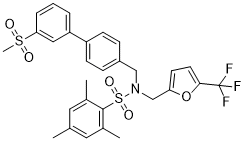
GSK2033 is a novel, potent and cell-active LXR (liver X receptor) antagonist with pIC50s of 7 and 7.4 for LXRα or LXRβ. It enhances T-cell proliferation and blocks T 0901317-antiproliferative activity on T-cells and is cell permeable. GSK2033 displays systemic exposure. Although GSK2033 performed as expected in cell-based models as a LXR inverse agonist, it displayed unexpected activity in the mouse NAFLD model. The expression of lipogenic enzyme genes such as fatty acid synthase and sterol regulatory binding protein 1c were induced rather than suppressed and no effect on hepatic steatosis was found. Further characterization of the specificity of GSK2033 revealed that it displayed a significant degree of promiscuity, targeting a number of other nuclear receptors that could clearly alter hepatic gene expression.
Physicochemical Properties
| Molecular Formula | C29H28NO5F3S2 |
| Molecular Weight | 591.662 |
| Exact Mass | 591.136 |
| Elemental Analysis | C, 58.87; H, 4.77; F, 9.63; N, 2.37; O, 13.52; S, 10.84 |
| CAS # | 1221277-90-2 |
| PubChem CID | 46203250 |
| Appearance | White to off-white solid powder |
| Density | 1.3±0.1 g/cm3 |
| Boiling Point | 734.7±70.0 °C at 760 mmHg |
| Flash Point | 398.1±35.7 °C |
| Vapour Pressure | 0.0±2.4 mmHg at 25°C |
| Index of Refraction | 1.572 |
| LogP | 6.62 |
| Hydrogen Bond Donor Count | 0 |
| Hydrogen Bond Acceptor Count | 9 |
| Rotatable Bond Count | 8 |
| Heavy Atom Count | 40 |
| Complexity | 1040 |
| Defined Atom Stereocenter Count | 0 |
| SMILES | O=S(C1=C(C)C=C(C)C=C1C)(N(CC2=CC=C(C3=CC=CC(S(=O)(C)=O)=C3)C=C2)CC4=CC=C(C(F)(F)F)O4)=O |
| InChi Key | PSOXOVKYGWBTPB-UHFFFAOYSA-N |
| InChi Code | InChI=1S/C29H28F3NO5S2/c1-19-14-20(2)28(21(3)15-19)40(36,37)33(18-25-12-13-27(38-25)29(30,31)32)17-22-8-10-23(11-9-22)24-6-5-7-26(16-24)39(4,34)35/h5-16H,17-18H2,1-4H3 |
| Chemical Name | 2,4,6-Trimethyl-N-[[3'-(methylsulfonyl)[1,1'-biphenyl]-4-yl]methyl]-N-[[5-(trifluoromethyl)-2-furanyl]methyl]benzenesulfonamide |
| Synonyms | GSK-2033; GSK2033; GSK 2033. |
| HS Tariff Code | 2934.99.9001 |
| Storage |
Powder-20°C 3 years 4°C 2 years In solvent -80°C 6 months -20°C 1 month |
| Shipping Condition | Room temperature (This product is stable at ambient temperature for a few days during ordinary shipping and time spent in Customs) |
Biological Activity
| Targets |
Liver X Receptor α (LXRα) (IC₅₀ = 0.04 μM) [1] Liver X Receptor β (LXRβ) (IC₅₀ = 0.05 μM) [1] |
| ln Vitro |
GSK2033 is an LXR antagonist having pIC50s of 7.4 for LXRβ and 7.4 for LXRβ, respectively. In the full-length LXRα or full-length LXRβ co-transfection experiments, GSK2033 dose-dependently suppressed basal transcription with IC50s of 17 nM and 9 nM, respectively. GSK2033 exhibits dose-dependent inhibition of ABCA1-driven luciferase reporter gene transcription, with an IC50 of 52 nM for LXRα and 10 nM for LXRβ. Additionally, GSK2033 suppresses SREBP1 and fatty acid synthase (FASN) expression [2]. As a potent tertiary sulfonamide GSK-2033, it acts as a selective antagonist of LXRα and LXRβ, with IC₅₀ values of 0.04 μM and 0.05 μM respectively in a cell-based reporter gene assay [1] - Inhibits LXR-mediated transcriptional activation induced by the LXR agonist T0901317 in a concentration-dependent manner, without significant agonistic activity on LXRα/β itself [1] |
| ln Vivo |
The one-month GSK2033 therapy showed no discernible impact on the levels of liver triglycerides. The administration of GSK2033 had no effect on plasma triglyceride levels [2]. In a mouse model of high-fat diet (HFD)-induced fatty liver disease, oral administration of GSK-2033 (30 mg/kg/day for 4 weeks) does not affect body weight gain but significantly reduces hepatic steatosis, as evidenced by decreased liver triglyceride (TG) content and improved liver histopathological changes (reduced lipid droplet accumulation) [2] - Downregulates the expression of LXR target genes involved in lipid metabolism in the liver, including SREBP-1c, FASN, and ACC1, which are key regulators of de novo lipogenesis [2] - Exhibits promiscuous activity: unexpectedly increases the expression of ABCA1 (an LXR target gene involved in cholesterol efflux) in the liver, which is inconsistent with typical LXR antagonist effects [2] - Does not significantly alter serum lipid profiles (total cholesterol, triglycerides, HDL-C, LDL-C) compared to the HFD control group [2] |
| Enzyme Assay |
LXRα/β transcriptional activity inhibition assay (reporter gene assay): Culture cells stably transfected with LXR-responsive luciferase reporter plasmid and LXRα/β expression plasmids. Preincubate the cells with serial dilutions of GSK-2033 for 1 hour, then add the LXR agonist T0901317 to activate LXR signaling. After continued incubation for 24 hours, lyse the cells and measure luciferase activity. Calculate the IC₅₀ values by analyzing the inhibition rate of luciferase activity relative to the agonist-only control group [1] |
| Cell Assay |
LXR-mediated gene expression inhibition assay: Culture hepatoma cells or primary hepatocytes in appropriate medium. Treat the cells with GSK-2033 at different concentrations in the presence or absence of T0901317. After incubation for 24-48 hours, extract total RNA from the cells, perform reverse transcription to cDNA, and use quantitative PCR to detect the expression levels of LXR target genes (e.g., ABCA1, SREBP-1c). Analyze the effect of GSK-2033 on LXR-mediated gene transcription [1] |
| Animal Protocol |
HFD-induced fatty liver disease mouse model experiment: Use male C57BL/6 mice, randomly divided into three groups: normal diet (ND) control group, HFD control group, and GSK-2033 treatment group (n = 8-10 per group). Feed the HFD group and treatment group with a high-fat diet (60% fat content) for 4 weeks to induce fatty liver, while the ND group is fed a normal diet. From the 5th week, administer GSK-2033 (dissolved in an appropriate vehicle) to the treatment group by oral gavage at a dose of 30 mg/kg once daily, and the ND and HFD groups receive the same volume of vehicle. Continue the high-fat diet during the treatment period. After 4 weeks of treatment, sacrifice the mice, collect serum and liver tissue samples for biochemical analysis (serum lipids, liver triglycerides) and histopathological examination (HE staining, oil red O staining) [2] |
| References |
[1]. Discovery of tertiary sulfonamides as potent liver X receptor antagonists. J Med Chem. 2010 Apr 22;53(8):3412-6. [2]. Promiscuous activity of the LXR antagonist GSK2033 in a mouse model of fatty liver disease. Biochem Biophys Res Commun. 2016 Oct 21;479(3):424-428. |
| Additional Infomation |
GSK-2033 is a member of the tertiary sulfonamide class, identified as a potent LXR antagonist through high-throughput screening and structure-activity relationship optimization [1] - The primary mechanism of action of GSK-2033 is to bind to LXRα/β and block agonist-induced LXR activation, thereby inhibiting the transcription of LXR target genes involved in lipid metabolism [1] - The promiscuous activity of GSK-2033 (upregulating ABCA1 expression) suggests potential complexity in its in vivo mechanism, which may limit its application as a selective LXR antagonist for fatty liver disease treatment [2] |
Solubility Data
| Solubility (In Vitro) | DMSO : ~30 mg/mL (~50.70 mM) |
| Solubility (In Vivo) |
Solubility in Formulation 1: 3 mg/mL (5.07 mM) in 10% DMSO + 40% PEG300 + 5% Tween80 + 45% Saline (add these co-solvents sequentially from left to right, and one by one), suspension solution; with sonication. For example, if 1 mL of working solution is to be prepared, you can add 100 μL of 30.0 mg/mL clear DMSO stock solution to 400 μL PEG300 and mix evenly; then add 50 μL Tween-80 to the above solution and mix evenly; then add 450 μL normal saline to adjust the volume to 1 mL. Preparation of saline: Dissolve 0.9 g of sodium chloride in 100 mL ddH₂ O to obtain a clear solution. Solubility in Formulation 2: 3 mg/mL (5.07 mM) in 10% DMSO + 90% Corn Oil (add these co-solvents sequentially from left to right, and one by one), suspension solution; with ultrasonication. For example, if 1 mL of working solution is to be prepared, you can add 100 μL of 30.0 mg/mL clear DMSO stock solution to 900 μL of corn oil and mix evenly. (Please use freshly prepared in vivo formulations for optimal results.) |
| Preparing Stock Solutions | 1 mg | 5 mg | 10 mg | |
| 1 mM | 1.6902 mL | 8.4508 mL | 16.9016 mL | |
| 5 mM | 0.3380 mL | 1.6902 mL | 3.3803 mL | |
| 10 mM | 0.1690 mL | 0.8451 mL | 1.6902 mL |