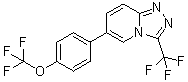
GS967 (also known as GS-458967) is a novel, potent, and selective sodium channel inhibitor exhibiting potent antiarrhythmic effects in various in vitro and in vivo models. It inhibit cardiac late sodium current (late INa ) with IC50 values of 0.13 and 0.21 μM for ventricular myocytes and isolated hearts, respectively. The antiarrhythmic mechanism of GS967 has been attributed to preferential suppression of late sodium current. GS967 (10, 100, 300 nM) completely attenuates the effect of ATX-II (10 nM) to increase action potential duration (APD) and APD variability in ventricular myocytes, with an apparent IC50 value of ∼10 nM and decreased the beat-to-beat variability of APD. GS967 selectively suppressed late I(Na) and prevented and/or reduced the incidence of experimentally induced arrhythmias in rabbit myocytes and hearts.
Physicochemical Properties
| Molecular Formula | C14H7F6N3O | |
| Molecular Weight | 347.22 | |
| Exact Mass | 347.049 | |
| CAS # | 1262618-39-2 | |
| Related CAS # |
|
|
| PubChem CID | 58118983 | |
| Appearance | White to off-white solid powder | |
| Density | 1.5±0.1 g/cm3 | |
| Index of Refraction | 1.539 | |
| LogP | 4.56 | |
| Hydrogen Bond Donor Count | 0 | |
| Hydrogen Bond Acceptor Count | 9 | |
| Rotatable Bond Count | 2 | |
| Heavy Atom Count | 24 | |
| Complexity | 435 | |
| Defined Atom Stereocenter Count | 0 | |
| InChi Key | FEVBKJITJDHASC-UHFFFAOYSA-N | |
| InChi Code | InChI=1S/C14H7F6N3O/c15-13(16,17)12-22-21-11-6-3-9(7-23(11)12)8-1-4-10(5-2-8)24-14(18,19)20/h1-7H | |
| Chemical Name | 6-[4-(trifluoromethoxy)phenyl]-3-(trifluoromethyl)-[1,2,4]triazolo[4,3-a]pyridine | |
| Synonyms |
|
|
| HS Tariff Code | 2934.99.9001 | |
| Storage |
Powder-20°C 3 years 4°C 2 years In solvent -80°C 6 months -20°C 1 month |
|
| Shipping Condition | Room temperature (This product is stable at ambient temperature for a few days during ordinary shipping and time spent in Customs) |
Biological Activity
| Targets |
GS967 targets cardiac late sodium current (INa,L) mediated by voltage-gated sodium channel Nav1.5 (IC50 = 0.3 μM for human Nav1.5 INa,L; IC50 > 30 μM for peak sodium current [INa,P] of Nav1.5) [3] GS967 exhibits high selectivity for INa,L over INa,P (selectivity ratio > 100-fold) [1][3][4] |
| ln Vitro |
The effects of ATX-II (10 nM) on increasing action potential duration (APD) and APD variability in ventricular myocytes are completely attenuated by GS967 (10, 100, and 300 nM), with an apparent IC50 value of ~10 nM. It also reduces the step-by-step variability of APD sex[1]. In HEK293 cells stably expressing human Nav1.5, GS967 (0.01-10 μM) dose-dependently inhibited INa,L with an IC50 of 0.3 μM, exerting a use-dependent block (greater inhibition at higher stimulation frequencies: 3 Hz vs. 0.5 Hz). At 10 μM, it inhibited INa,L by ~90% but had minimal effect on INa,P (<10% inhibition) [3] - In isolated rabbit ventricular myocytes, GS967 (0.1-10 μM) concentration-dependently suppressed INa,L (IC50 = 0.5 μM) without altering INa,P or resting membrane potential. Under simulated ischemia (low glucose, hypoxia), it shortened action potential duration (APD90) by ~25% (1 μM) and reduced the incidence of early afterdepolarizations (EADs) from 68% to 12% [1] - In primary rat cardiomyocytes subjected to ischemia-reperfusion (I/R) injury, GS967 (1 μM) pre-treatment or delayed treatment (1 hour post-reperfusion) reversed Nav1.5 downregulation: western blot showed Nav1.5 protein levels increased by ~60% and ~55%, respectively, compared to I/R alone; real-time PCR revealed SCN5A mRNA levels were upregulated by ~45% (pre-treatment) [2] - In isolated canine atrial myocytes, GS967 (0.3 μM) inhibited INa,L by ~75% and reduced ischemia-induced repolarization alternans (Repol Alternans) amplitude by ~60%, a key arrhythmogenic substrate [4] |
| ln Vivo |
The proarrhythmogenic effects of the IKr inhibitor E-4031 and the INa late enhancer ATX-II are inhibited and reversed by GS967. GS967 inhibits ischemia-induced arrhythmias and considerably reduces the arrhythmogenic effects of methoxamine-chlorfenium [1]. Usage-dependent blockade (UDB) is consistent with GS967's frequency-dependent reduction of INaP. Compared to ranolazine (16 μM) and lidocaine (17 μM) (IC50=0.07 μM), GS967 induces INaP UDB more potently. Research has shown that GS967 affects the classic long QT syndrome mutation (delKPQ) in the same way [2]. GS967 inhibits the increases in left atrial and left ventricular alternans that are brought on by ischemia. GS967 decreases the increases in repolarization and depolarization heterogeneity brought on by ischemia. GS967 slightly reduces contractility during ischemia, consistent with late INa inhibition, but does not change heart rate, arterial blood pressure, PR and QT intervals, or QRS duration [3]. In rats subjected to 30-minute coronary artery ligation followed by 2-hour reperfusion, intravenous administration of GS967 (0.3 mg/kg, 1 mg/kg) 5 minutes before reperfusion dose-dependently suppressed ventricular arrhythmias: high-dose treatment reduced the incidence of ventricular tachycardia (VT) from 83% to 25% and ventricular fibrillation (VF) from 58% to 8%, and shortened total arrhythmia duration from 42 ± 8 minutes to 7 ± 3 minutes [1] - In rats with 45-minute myocardial ischemia and 24-hour reperfusion, intraperitoneal GS967 (1 mg/kg) pre-treatment (30 minutes before ischemia) or delayed treatment (1 hour post-reperfusion) both reduced VT/VF incidence (pre-treatment: 30% vs. 75% in model group; delayed treatment: 35% vs. 75%) and reversed Nav1.5 downregulation in ischemic myocardium [2] - In dogs with 1-hour circumflex coronary artery ligation and 2-hour reperfusion, intravenous GS967 (0.1 mg/kg, 0.3 mg/kg) dose-dependently reduced atrial and ventricular Repol Alternans (maximal reduction of ~70% at 0.3 mg/kg) and decreased ECG heterogeneity, a predictor of arrhythmia risk [4] |
| Enzyme Assay |
Human Nav1.5 INa,L inhibition assay: HEK293 cells stably expressing human Nav1.5 were seeded on glass coverslips. Whole-cell patch clamp recordings were performed using intracellular and extracellular solutions optimized for sodium current detection. GS967 (0.01-10 μM) was applied to the bath solution, and INa,L was evoked by a depolarizing protocol (e.g., holding potential -80 mV, stepping to -20 mV for 500 ms, followed by repolarization to -60 mV). Current amplitude was recorded at different stimulation frequencies (0.5 Hz, 3 Hz) to assess use dependence. IC50 values were calculated from dose-response curves of INa,L inhibition [3] - Rabbit ventricular myocyte INa,L and action potential assay: Isolated rabbit ventricular myocytes were enzymatically dissociated and plated on coverslips. Patch clamp recordings were conducted to measure INa,L (using ramp pulses) and action potential duration (APD90) under normal and simulated ischemia conditions (glucose-free, hypoxic buffer). GS967 (0.1-10 μM) was added, and changes in INa,L amplitude and APD90 were quantified to evaluate anti-arrhythmic potential [1] |
| Cell Assay |
Primary rat cardiomyocyte I/R model assay: Primary rat cardiomyocytes were isolated and cultured in 6-well plates. Cells were divided into control, I/R, GS967 pre-treatment (1 μM, 30 minutes before I/R), and delayed treatment (1 μM, 1 hour post-reperfusion) groups. I/R was induced by incubating cells in glucose-free hypoxic buffer for 4 hours followed by normoxic buffer for 24 hours. Western blot was performed to detect Nav1.5 protein expression (primary antibody against Nav1.5, secondary antibody conjugated to horseradish peroxidase; GAPDH as loading control). Real-time PCR was used to quantify SCN5A mRNA levels [2] - Canine atrial myocyte Repol Alternans assay: Isolated canine atrial myocytes were subjected to simulated ischemia (hypoxic buffer for 1 hour). GS967 (0.3 μM) was added to the bath solution, and Repol Alternans was induced by pacing at increasing frequencies (1-3 Hz). Action potential duration was recorded using patch clamp, and alternans amplitude was calculated to assess the drug's effect on arrhythmogenic substrates [4] |
| Animal Protocol |
60 μg/kg bolus, followed by a 16 μg/kg/min infusion Rats with Ventricular tachycardia or fibrillation induced either by local aconitine injection (50 μg) in the left ventricular muscle of adult male rats or by arterial perfusion of 0.1 mM hydrogen peroxide in aged male rats. Rat myocardial ischemia-reperfusion (I/R) arrhythmia model: Male Sprague-Dawley rats (250-300 g) were anesthetized and mechanically ventilated. The left anterior descending coronary artery was ligated for 30 minutes, then reperfused for 2 hours. GS967 was dissolved in normal saline and administered intravenously at 0.3 mg/kg or 1 mg/kg 5 minutes before reperfusion; the control group received normal saline. ECG was continuously recorded to analyze the incidence, duration, and severity of VT/VF (arrhythmia scoring based on Lambeth Conventions) [1] - Rat I/R model with delayed treatment: Male Wistar rats (220-280 g) were anesthetized, and the left coronary artery was ligated for 45 minutes followed by 24-hour reperfusion. Rats were randomly divided into sham, model, GS967 pre-treatment (1 mg/kg, intraperitoneal injection 30 minutes before ischemia), and delayed treatment (1 mg/kg, intraperitoneal injection 1 hour post-reperfusion) groups. GS967 was dissolved in 5% DMSO + 95% normal saline. ECG was recorded during reperfusion, and myocardial tissues were collected for western blot and PCR analysis [2] - Canine I/R Repol Alternans model: Male mongrel dogs (15-20 kg) were anesthetized and instrumented with ECG electrodes and intracardiac catheters. The circumflex coronary artery was ligated for 1 hour, then reperfused for 2 hours. GS967 was dissolved in normal saline and administered intravenously at 0.1 mg/kg or 0.3 mg/kg 10 minutes before reperfusion.ECG and intracardiac electrograms were recorded to measure Repol Alternans amplitude and ECG heterogeneity [4] |
| References |
[1]. A novel, potent, and selective inhibitor of cardiac late sodium current suppresses experimental arrhythmias. J Pharmacol Exp Ther. 2013 Jan;344(1):23-32. [2]. Pre- and Delayed Treatments With Ranolazine Ameliorate Ventricular Arrhythmias and Nav1.5 Downregulation in Ischemic/Reperfused Rat Hearts. J Cardiovasc Pharmacol. 2016 Oct;68(4):269-279. [3]. Use-Dependent Block of Human Cardiac Sodium Channels by GS967. Mol Pharmacol. 2016 Jul;90(1):52-60. [4]. Selective late sodium current blockade with GS-458967 markedly reduces ischemia-induced atrial and ventricular repolarization alternans and ECG heterogeneity. Heart Rhythm. 2014 Oct;11(10):1827-35. |
| Additional Infomation |
GS967 is a novel, potent, and highly selective inhibitor of cardiac late sodium current (INa,L) [1][3][4] - The therapeutic mechanism of GS967 involves selective blockade of Nav1.5-mediated INa,L, reducing intracellular sodium overload during ischemia, thereby attenuating calcium overload (via Na+/Ca2+ exchanger), inhibiting arrhythmogenic substrates (e.g., EADs, Repol Alternans), and suppressing atrial/ventricular arrhythmias [1][2][3][4] - GS967 exhibits use-dependent inhibition of INa,L, which enhances its efficacy in pathological conditions (e.g., high heart rate during ischemia) while minimizing effects on normal cardiac function [3] - Preclinical data demonstrate that GS967 effectively suppresses ischemia-induced arrhythmias in vitro and in vivo, with both pre-treatment and delayed treatment showing efficacy, supporting its potential for treating acute myocardial infarction-related arrhythmias [1][2][4] |
Solubility Data
| Solubility (In Vitro) |
|
|||
| Solubility (In Vivo) |
Solubility in Formulation 1: 2.5 mg/mL (7.20 mM) in 10% DMSO + 40% PEG300 + 5% Tween80 + 45% Saline (add these co-solvents sequentially from left to right, and one by one), suspension solution; with sonication. For example, if 1 mL of working solution is to be prepared, you can add 100 μL of 25.0 mg/mL clear DMSO stock solution to 400 μL PEG300 and mix evenly; then add 50 μL Tween-80 to the above solution and mix evenly; then add 450 μL normal saline to adjust the volume to 1 mL. Preparation of saline: Dissolve 0.9 g of sodium chloride in 100 mL ddH₂ O to obtain a clear solution. Solubility in Formulation 2: ≥ 2.5 mg/mL (7.20 mM) (saturation unknown) in 10% DMSO + 90% Corn Oil (add these co-solvents sequentially from left to right, and one by one), clear solution. For example, if 1 mL of working solution is to be prepared, you can add 100 μL of 25.0 mg/mL clear DMSO stock solution to 900 μL of corn oil and mix evenly. (Please use freshly prepared in vivo formulations for optimal results.) |
| Preparing Stock Solutions | 1 mg | 5 mg | 10 mg | |
| 1 mM | 2.8800 mL | 14.4001 mL | 28.8002 mL | |
| 5 mM | 0.5760 mL | 2.8800 mL | 5.7600 mL | |
| 10 mM | 0.2880 mL | 1.4400 mL | 2.8800 mL |