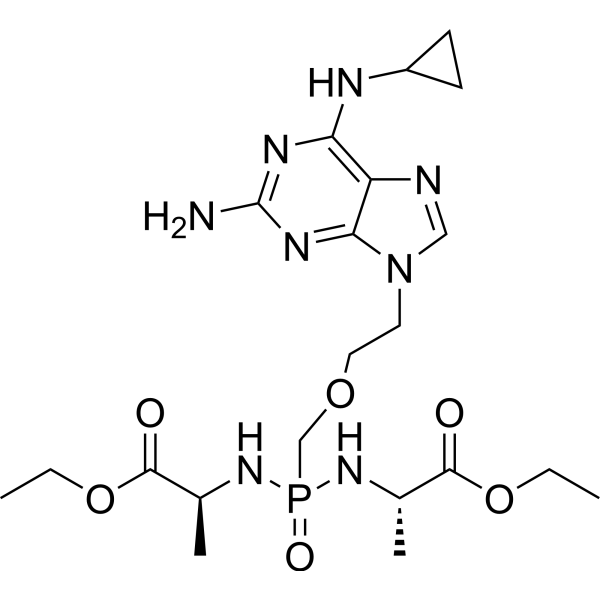
Physicochemical Properties
| Molecular Formula | C21H35N8O6P |
| Molecular Weight | 526.53 |
| Exact Mass | 526.242 |
| CAS # | 859209-74-8 |
| Related CAS # | Rabacfosadine succinate;1431856-99-3 |
| PubChem CID | 16047979 |
| Appearance | Light yellow to yellow solid powder |
| LogP | 2.017 |
| Hydrogen Bond Donor Count | 4 |
| Hydrogen Bond Acceptor Count | 13 |
| Rotatable Bond Count | 17 |
| Heavy Atom Count | 36 |
| Complexity | 760 |
| Defined Atom Stereocenter Count | 2 |
| SMILES | CCOC(=O)[C@H](C)NP(=O)(COCCN1C=NC2=C(N=C(N=C21)N)NC3CC3)N[C@@H](C)C(=O)OCC |
| InChi Key | ANSPEDQTHURSFQ-KBPBESRZSA-N |
| InChi Code | InChI=1S/C21H35N8O6P/c1-5-34-19(30)13(3)27-36(32,28-14(4)20(31)35-6-2)12-33-10-9-29-11-23-16-17(24-15-7-8-15)25-21(22)26-18(16)29/h11,13-15H,5-10,12H2,1-4H3,(H2,27,28,32)(H3,22,24,25,26)/t13-,14-/m0/s1 |
| Chemical Name | ethyl (2S)-2-[[2-[2-amino-6-(cyclopropylamino)purin-9-yl]ethoxymethyl-[[(2S)-1-ethoxy-1-oxopropan-2-yl]amino]phosphoryl]amino]propanoate |
| Synonyms | GS-9219; GS9219; GS 9219 |
| HS Tariff Code | 2934.99.9001 |
| Storage |
Powder-20°C 3 years 4°C 2 years In solvent -80°C 6 months -20°C 1 month |
| Shipping Condition | Room temperature (This product is stable at ambient temperature for a few days during ordinary shipping and time spent in Customs) |
Biological Activity
| ln Vitro | Rabacfosadine (GS-9219) is hydrolyzed, deaminated, and phosphorylated by enzymes in lymphocytes to produce its active metabolite, 9-(2-phosphonomethoxyethyl)guanine (PMEG) diphosphate. When it comes to hematopoietic tumor cell lines and activated lymphocytes, GS-9219 exhibits strong antiproliferative activity. It was investigated if labaksodine could stop hematopoietic tumor cells and activated lymphocytes from proliferating. According to BrdUrd incorporation, rabascofosadine inhibits the proliferation of mitogen-stimulated T and B lymphocytes with EC50 values of 135 and 42 nM, respectively. Instead of using the BrdUrd assay, the metabolism-based sodium XTT assay was used to assess rabakvorsadine in these populations in order to compare the activity of GS-9219 in dividing and non-dividing cells. The XTT assay results revealed a 127-fold difference in the rabafoxadine EC50 values between proliferating cells (EC50=135 nM) and quiescent cells (EC50=17.2 μM). Based on these findings, rabaxadine is highly selective for lymphoblastoid cells that are actively replicating [1]. |
| ln Vivo | In dogs with lymphoma, rabaksodine (RAB) exhibits strong single-agent efficacy and functions differently from doxorubicin (DOX). multicenter prospective clinical trial with open label. Dogs were given doxorubicin (30 mg/m2 IV, weeks 3, 9, 15) and labavoxadine (1.0 mg/kg IV, weeks 0, 6, 12) alternately. Each month, dogs in complete remission (CR) had evaluations. Every 21 days, comprehensive assessments of the clinicopathology, response, and adverse events (AEs) were carried out. In 46 dogs who received at least one dosage of each medication, acute adverse events (AEs) that happened within 21 days following the first administration of each medicine were compared between labavoxadine and doxorubicin [2]. |
| References |
[1]. GS-9219--a novel acyclic nucleotide analogue with potent antineoplastic activity in dogs with spontaneous non-Hodgkin's lymphoma. Clin Cancer Res. 2008 May 1;14(9):2824-32. [2]. Alternating Rabacfosadine/Doxorubicin: Efficacy and Tolerability in Na?ve Canine Multicentric Lymphoma. J Vet Intern Med. 2017 May;31(3):872-878. |
| Additional Infomation |
Rabacfosadine has been used in trials studying the treatment of Multiple Myeloma, Non-Hodgkin's Lymphoma, and Chronic Lymphocytic Leukemia. Rabacfosadine is an acyclic nucleotide phosphonate prodrug and polymerase inhibitor that can potentially be used for its antineoplastic activity in the treatment of lymphoma in dogs. Upon administration, rabacfosadine is hydrolyzed intracellularly to 9-(2-phosphonylmethoxyethyl)-N6-cyclopropyl-2, 6-diaminopurine (cPrPMEDAP) and subsequently deaminated to 9-(2-phosphonylmethoxyethyl) guanine (PMEG) and phosphorylated to PMEG diphosphate (PMEGpp). PMEGpp binds to and inhibits DNA polymerases. This inhibits DNA synthesis, resulting in S phase arrest and induction of apoptosis. See also: Rabacfosadine Succinate (active moiety of). |
Solubility Data
| Solubility (In Vitro) | DMSO : ~100 mg/mL (~189.92 mM) |
| Solubility (In Vivo) |
Solubility in Formulation 1: ≥ 2.5 mg/mL (4.75 mM) (saturation unknown) in 10% DMSO + 40% PEG300 + 5% Tween80 + 45% Saline (add these co-solvents sequentially from left to right, and one by one), clear solution. For example, if 1 mL of working solution is to be prepared, you can add 100 μL of 25.0 mg/mL clear DMSO stock solution to 400 μL PEG300 and mix evenly; then add 50 μL Tween-80 to the above solution and mix evenly; then add 450 μL normal saline to adjust the volume to 1 mL. Preparation of saline: Dissolve 0.9 g of sodium chloride in 100 mL ddH₂ O to obtain a clear solution. Solubility in Formulation 2: ≥ 2.5 mg/mL (4.75 mM) (saturation unknown) in 10% DMSO + 90% (20% SBE-β-CD in Saline) (add these co-solvents sequentially from left to right, and one by one), clear solution. For example, if 1 mL of working solution is to be prepared, you can add 100 μL of 25.0 mg/mL clear DMSO stock solution to 900 μL of 20% SBE-β-CD physiological saline solution and mix evenly. Preparation of 20% SBE-β-CD in Saline (4°C,1 week): Dissolve 2 g SBE-β-CD in 10 mL saline to obtain a clear solution. Solubility in Formulation 3: ≥ 2.5 mg/mL (4.75 mM) (saturation unknown) in 10% DMSO + 90% Corn Oil (add these co-solvents sequentially from left to right, and one by one), clear solution. For example, if 1 mL of working solution is to be prepared, you can add 100 μL of 25.0 mg/mL clear DMSO stock solution to 900 μL of corn oil and mix evenly. (Please use freshly prepared in vivo formulations for optimal results.) |
| Preparing Stock Solutions | 1 mg | 5 mg | 10 mg | |
| 1 mM | 1.8992 mL | 9.4961 mL | 18.9923 mL | |
| 5 mM | 0.3798 mL | 1.8992 mL | 3.7985 mL | |
| 10 mM | 0.1899 mL | 0.9496 mL | 1.8992 mL |