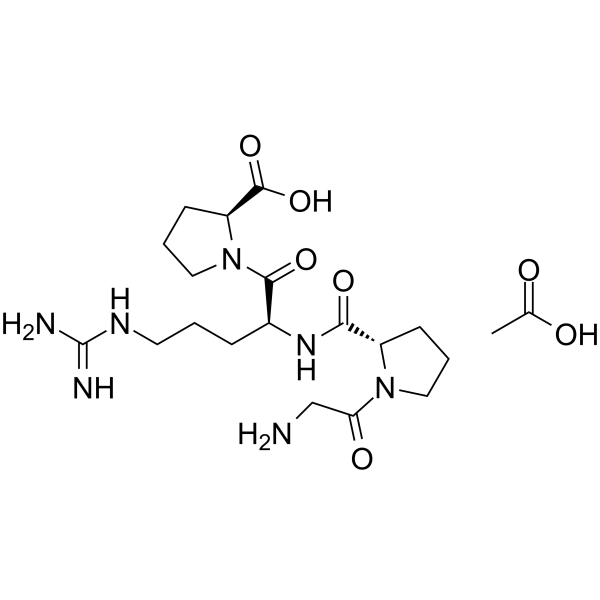
Physicochemical Properties
| Molecular Formula | C20H35N7O7 |
| Molecular Weight | 485.5346 |
| Exact Mass | 485.259 |
| CAS # | 157009-81-9 |
| Related CAS # | GPRP;67869-62-9 |
| PubChem CID | 118986652 |
| Appearance | White to off-white solid powder |
| Hydrogen Bond Donor Count | 6 |
| Hydrogen Bond Acceptor Count | 9 |
| Rotatable Bond Count | 9 |
| Heavy Atom Count | 34 |
| Complexity | 725 |
| Defined Atom Stereocenter Count | 3 |
| SMILES | CC(=O)O.C1C[C@H](N(C1)C(=O)CN)C(=O)N[C@@H](CCCN=C(N)N)C(=O)N2CCC[C@H]2C(=O)O |
| InChi Key | ZYTSTPIIKNCGRE-QKWXXBCPSA-N |
| InChi Code | InChI=1S/C18H31N7O5.C2H4O2/c19-10-14(26)24-8-2-5-12(24)15(27)23-11(4-1-7-22-18(20)21)16(28)25-9-3-6-13(25)17(29)30;1-2(3)4/h11-13H,1-10,19H2,(H,23,27)(H,29,30)(H4,20,21,22);1H3,(H,3,4)/t11-,12-,13-;/m0./s1 |
| Chemical Name | acetic acid;(2S)-1-[(2S)-2-[[(2S)-1-(2-aminoacetyl)pyrrolidine-2-carbonyl]amino]-5-(diaminomethylideneamino)pentanoyl]pyrrolidine-2-carboxylic acid |
| HS Tariff Code | 2934.99.9001 |
| Storage |
Powder-20°C 3 years 4°C 2 years In solvent -80°C 6 months -20°C 1 month Note: Please store this product in a sealed and protected environment, avoid exposure to moisture. |
| Shipping Condition | Room temperature (This product is stable at ambient temperature for a few days during ordinary shipping and time spent in Customs) |
Biological Activity
| Targets | GPRP acetate (0, 2 and 4 mM) stimulates oxidant enzyme production [1]. |
| ln Vitro |
GPRP acetate (0, 2 and 4 mM) stimulates oxidant enzyme production [1]. GPRP inhibits ADP-induced platelet aggregation in platelet-rich plasma (PRP).[1] GPRP inhibits fibrinogen polymerization by binding to fibrinogen polymerization sites and modifying glutamine residues in the α- and γ-chains of fibrinogen.[1] In PRP activated via intrinsic pathway, GPRP (2 mM and 4 mM) leads to higher peak levels of free thrombin and larger area under the thrombin generation curve compared to control without GPRP.[1] In the presence of 4 mM GPRP, peak thrombin and area under the curve were 30–40% higher than in absence of GPRP.[1] |
| ln Vivo | By promoting weight loss and engraftment, GPRP acetate (100 mg/kg; intraperitoneally, once daily for 10 days) dramatically lowers glucose enzyme sodium sulfate (DSS)-induced inflammation [3]. |
| Enzyme Assay |
Thrombin generation was measured in platelet-rich plasma (PRP) activated with Actin FSL and CaCl₂. Aliquots were taken at 15-second intervals and mixed with substrate solution containing S-2238. Reaction was stopped with acetic acid, and absorbance was measured at 405 nm. Thrombin activity was expressed as equivalent amount of thrombin, including α₂-macroglobulin–thrombin complex.[1] |
| Cell Assay |
Platelet-rich plasma (PRP) was prepared from whole blood collected in citrate from healthy volunteers. PRP platelet count was adjusted to 250,000/µL using autologous platelet-poor plasma. PRP was incubated with or without GPRP for 60 seconds before activation with Actin FSL and CaCl₂.[1] |
| Animal Protocol |
Animal/Disease Models: C57BL/6 mice dextran sodium sulfate (DSS)-induced colitis [3] Doses: 100 mg/kg Route of Administration: intraperitoneal (ip) injection; 100 mg/kg, one time/day for 10 days Experimental Results: Significant Dramatically inhibited weight loss in colitis mice, diminished DSS-induced mortality and colon length shortening, and diminished tissue damage and inflammatory cell infiltration. Mice with colitis have diminished levels of inflammatory cytokines. |
| References |
[1]. Gly-pro-arg-pro (GPRP) enhances free thrombin. Thromb Res. 1995 Jun 15;78(6):547-50. [2]. Fibrin Polymerization. 1. Alkylating peptide inhibitors of fibrin polymerization. J Med Chem. 1981 Mar; 24(3): 322-7. [3]. Fibrinogen/AKT/Microfilament Axis Promotes Colitis by Enhancing Vascular Permeability. Cell Mol Gastroenterol Hepatol. 2021;11(3):683-696. |
| Additional Infomation |
GPRP is a fibrinogen-related peptide under preclinical investigation as an antithrombotic agent.[1] It inhibits fibrinogen-dependent platelet aggregation and fibrin polymerization.[1] By inhibiting fibrin formation, GPRP reduces adsorption of free thrombin onto fibrin (antithrombin I action), resulting in higher free thrombin levels post-activation.[1] This may limit its potential clinical benefit as an antithrombotic agent despite inhibiting platelet aggregation.[1] |
Solubility Data
| Solubility (In Vitro) | H2O : ~125 mg/mL (~268.93 mM) |
| Solubility (In Vivo) |
Solubility in Formulation 1: 100 mg/mL (215.14 mM) in PBS (add these co-solvents sequentially from left to right, and one by one), clear solution; with sonication. (Please use freshly prepared in vivo formulations for optimal results.) |
| Preparing Stock Solutions | 1 mg | 5 mg | 10 mg | |
| 1 mM | 2.0596 mL | 10.2980 mL | 20.5960 mL | |
| 5 mM | 0.4119 mL | 2.0596 mL | 4.1192 mL | |
| 10 mM | 0.2060 mL | 1.0298 mL | 2.0596 mL |