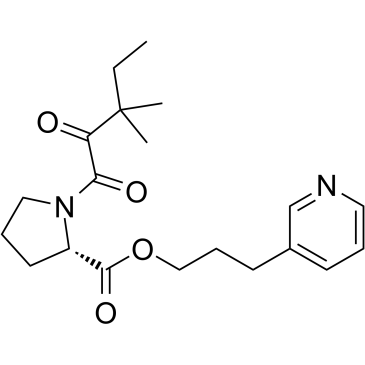
GPI-1046 (GPI1046) is an immunophilin ligand that can reduce ethanol consumption in part through activation of GLT1 in alcohol-preferring rats. GPI-1046 shows neuroprotective effects in neurodegenerative disease models. However, GPI-1046 does not have regenerative effects in MPTP-treated primates and suggest that there may be species differences with respect to the trophic effects of GPI-1046 on nigrostriatal DA neurons.
Physicochemical Properties
| Molecular Formula | C20H28N2O4 |
| Molecular Weight | 360.44732 |
| Exact Mass | 360.204 |
| CAS # | 186452-09-5 |
| PubChem CID | 445501 |
| Appearance | Colorless to light yellow liquid |
| Density | 1.1±0.1 g/cm3 |
| Boiling Point | 501.5±60.0 °C at 760 mmHg |
| Flash Point | 257.1±32.9 °C |
| Vapour Pressure | 0.0±1.3 mmHg at 25°C |
| Index of Refraction | 1.529 |
| LogP | 1.54 |
| Hydrogen Bond Donor Count | 0 |
| Hydrogen Bond Acceptor Count | 5 |
| Rotatable Bond Count | 9 |
| Heavy Atom Count | 26 |
| Complexity | 518 |
| Defined Atom Stereocenter Count | 1 |
| SMILES | CCC(C)(C)C(=O)C(=O)N1CCC[C@H]1C(=O)OCCCC2=CN=CC=C2 |
| InChi Key | OQAHHWOPVDDWHD-INIZCTEOSA-N |
| InChi Code | InChI=1S/C20H28N2O4/c1-4-20(2,3)17(23)18(24)22-12-6-10-16(22)19(25)26-13-7-9-15-8-5-11-21-14-15/h5,8,11,14,16H,4,6-7,9-10,12-13H2,1-3H3/t16-/m0/s1 |
| Chemical Name | 3-pyridin-3-ylpropyl (2S)-1-(3,3-dimethyl-2-oxopentanoyl)pyrrolidine-2-carboxylate |
| HS Tariff Code | 2934.99.9001 |
| Storage |
Powder-20°C 3 years 4°C 2 years In solvent -80°C 6 months -20°C 1 month Note: This product requires protection from light (avoid light exposure) during transportation and storage. |
| Shipping Condition | Room temperature (This product is stable at ambient temperature for a few days during ordinary shipping and time spent in Customs) |
Biological Activity
| ln Vitro |
The neuroprotective effect of GPI-1046 might be in part due to the upregulation of GLT1 level. Treatment with GPI-1046 upregulated GLT1 level but not GLAST in spinal cord culture. The upregulation of GLT1 level was associated with an increase in glutamate uptake, which was attenuated by the selective GLT1 inhibitor dihydrokainate, indicating a direct activation of GLT1 action. [1] GPI-1046 may exert neuroprotective effects through the activation of striatal glutathione (GSH) levels, mediated by the activation of GSH synthesis. [1] GPI-1046 has been shown to attenuate inositol triphosphate (IP3) and ryanodine-sensitive endoplasmic reticulum (ER) calcium release in vitro. [1] |
| ln Vivo |
Administration of GPI-1046 (10 and 20 mg/kg, i.p.) significantly reduced ethanol intake in male alcohol-preferring (P) rats in a dose-dependent manner, starting 48 hours after the first treatment and persisting through the post-treatment period. The higher dose (20 mg/kg) reduced ethanol intake from an average of 7 g/kg/day to about 2 g/kg/day (~70% reduction). [1] GPI-1046 treatment (10 and 20 mg/kg, i.p.) significantly increased water intake in P rats compared to the vehicle-treated group. [1] GPI-1046 treatment did not affect the body weight of the animals. [1] GPI-1046 treatment (20 mg/kg, i.p.) did not affect sucrose (10%) intake in male P rats, suggesting specificity for reducing ethanol intake rather than a general suppression of appetitive drinking behavior. [1] GPI-1046 treatment (10 and 20 mg/kg, i.p.) significantly increased GLT1 protein expression in the prefrontal cortex (PFC) of P rats compared to the ethanol-naïve vehicle group. The 20 mg/kg dose also increased GLT1 in PFC compared to a water-naïve control group. [1] GPI-1046 treatment (10 and 20 mg/kg, i.p.) significantly increased GLT1 protein expression in the nucleus accumbens core (NAc-core) of P rats compared to the ethanol-naïve vehicle group. The 20 mg/kg dose produced a greater increase than the 10 mg/kg dose and also compared to the water-naïve control group. Chronic ethanol consumption (in the ethanol-naïve vehicle group) was found to downregulate GLT1 expression in the NAc-core compared to the water-naïve group. [1] Oral administration of GPI-1046 revealed dramatic upregulation of GLT1 level in adult mice. [1] In a model of ischemia, GPI-1046 decreased infarct volume and induced neuroprotection, mediated through the attenuation of increased rotamase activity and modulation of proteins like FKBP12, caspase-8, and caspase-3. [1] GPI-1046 restored long-term potentiation of corticostriatal synaptic transmission in 6-hydroxydopamine-lesioned animals. [1] GPI-1046 has been found to increase the level of glial cell line-derived neurotrophic factor (GDNF) in the mouse brain. [1] |
| Animal Protocol |
Male alcohol-preferring (P) rats were given concurrent free-choice access to 15% ethanol, 30% ethanol, water, and food for five weeks to establish stable ethanol consumption. [1] On Week 6, animals received intraperitoneal (i.p.) injections once daily for five consecutive days. Treatment groups received GPI-1046 at 10 mg/kg or 20 mg/kg, dissolved in a vehicle containing 2% dimethylsulfoxide (DMSO). Control groups received the vehicle (2% DMSO) only. One control group had access only to water and food (water-naïve), while another had access to ethanol, water, and food (ethanol-naïve). [1] Ethanol intake, water intake, and body weight were measured daily for eight days, starting on the first day of injections. [1] For sucrose intake testing, a separate group of P rats had continuous access to 10% sucrose for 5 weeks. They then received i.p. injections of either vehicle or GPI-1046 (20 mg/kg) for five consecutive days, with intake measured over eight days. [1] Three days after the last injection, animals were euthanized. The brains were removed, and the prefrontal cortex (PFC) and nucleus accumbens core (NAc-core) were dissected using stereotaxic coordinates for subsequent Western blot analysis of GLT1 expression. [1] |
| References |
[1]. Neuroimmunophilin GPI-1046 reduces ethanol consumption in part through activation of GLT1 in alcohol-preferring rats. Neuroscience. 2012 Dec 27;227:327-35. [2]. The immunophilin ligand GPI-1046 does not have neuroregenerative effects in MPTP-treated monkeys. Exp Neurol. 2002 Dec;178(2):236-42. [3]. Neurologic Complications of HIV Disease and Their Treatment. Top HIV Med. Apr-May 2007;15(2):32-9. |
| Additional Infomation |
GPI-1046 (3-(3-pyridyl)-1-propyl (2S)-1-(3,3-dimethyl-1,2-dioxopentyl)-2-pyrrolidinecarboxylate) is a neuroimmunophilin ligand and an analog of FK506 (tacrolimus). Unlike FK506, it does not have immunosuppressive or antibiotic action. [1] It is investigated for its neuroprotective properties and its ability to upregulate the glutamate transporter GLT1. [1] The study suggests that GPI-1046 reduces ethanol consumption, at least in part, through the upregulation of GLT1 in key brain reward regions (PFC and NAc-core), leading to increased glutamate clearance. [1] The reduction in ethanol intake persisted for several days after the last dose, suggesting a lasting effect possibly related to GLT1 upregulation or other pharmacological mechanisms. [1] The authors propose GPI-1046 as a potential therapeutic compound for the treatment of alcohol dependence. [1] |
Solubility Data
| Solubility (In Vitro) | DMSO : ≥ 100 mg/mL (~277.43 mM) |
| Solubility (In Vivo) |
Solubility in Formulation 1: ≥ 1 mg/mL (2.77 mM) (saturation unknown) in 10% DMSO + 40% PEG300 + 5% Tween80 + 45% Saline (add these co-solvents sequentially from left to right, and one by one), clear solution. For example, if 1 mL of working solution is to be prepared, you can add 100 μL of 10.0 mg/mL clear DMSO stock solution to 400 μL of PEG300 and mix evenly; then add 50 μL of Tween-80 to the above solution and mix evenly; then add 450 μL of normal saline to adjust the volume to 1 mL. Preparation of saline: Dissolve 0.9 g of sodium chloride in 100 mL ddH₂ O to obtain a clear solution. Solubility in Formulation 2: ≥ 1 mg/mL (2.77 mM) (saturation unknown) in 10% DMSO + 90% (20% SBE-β-CD in Saline) (add these co-solvents sequentially from left to right, and one by one), clear solution. For example, if 1 mL of working solution is to be prepared, you can add 100 μL of 10.0 mg/mL clear DMSO stock solution to 900 μL of 20% SBE-β-CD physiological saline solution and mix evenly. Preparation of 20% SBE-β-CD in Saline (4°C,1 week): Dissolve 2 g SBE-β-CD in 10 mL saline to obtain a clear solution. Solubility in Formulation 3: ≥ 1 mg/mL (2.77 mM) (saturation unknown) in 10% DMSO + 90% Corn Oil (add these co-solvents sequentially from left to right, and one by one), clear solution. For example, if 1 mL of working solution is to be prepared, you can add 100 μL of 10.0 mg/mL clear DMSO stock solution to 900 μL of corn oil and mix evenly. (Please use freshly prepared in vivo formulations for optimal results.) |
| Preparing Stock Solutions | 1 mg | 5 mg | 10 mg | |
| 1 mM | 2.7743 mL | 13.8715 mL | 27.7431 mL | |
| 5 mM | 0.5549 mL | 2.7743 mL | 5.5486 mL | |
| 10 mM | 0.2774 mL | 1.3872 mL | 2.7743 mL |