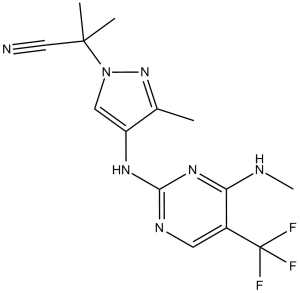
GNE-0877 (GNE 0877; GNE0877) is a novel, highly potent and selective leucine-rich repeat kinase 2 (LRRK2) inhibitor with important biological activity. It inhibits LRRK2 with a Ki of 0.7 nM. GNE-0877 showed significantly enhanced LRRK2 cellular potency (3 nM) and low turnover in human liver microsomes and hepatocytes with no evidence of glucuronidation. Invitrogen kinase-selectivity profiling (188 kinases) of GNE-0877 at 0.1 μM resulted in only four kinases showing greater than 50% inhibition and suggested that GNE-0877 is a highly selective LRRK2 inhibitor. Furthermore, GNE-0877 possessed a 212-fold biochemical-selectivity index over TTK (Ki = 150 nM).
Physicochemical Properties
| Molecular Formula | C14H16N7F3 |
| Molecular Weight | 339.31894 |
| Exact Mass | 339.141 |
| CAS # | 1374828-69-9 |
| PubChem CID | 69093374 |
| Appearance | White to yellow solid powder |
| Density | 1.4±0.1 g/cm3 |
| Boiling Point | 506.3±60.0 °C at 760 mmHg |
| Flash Point | 260.0±32.9 °C |
| Vapour Pressure | 0.0±1.3 mmHg at 25°C |
| Index of Refraction | 1.584 |
| LogP | 1.51 |
| Hydrogen Bond Donor Count | 2 |
| Hydrogen Bond Acceptor Count | 9 |
| Rotatable Bond Count | 4 |
| Heavy Atom Count | 24 |
| Complexity | 487 |
| Defined Atom Stereocenter Count | 0 |
| InChi Key | ZPPUMAMZIMPJGP-UHFFFAOYSA-N |
| InChi Code | InChI=1S/C14H16F3N7/c1-8-10(6-24(23-8)13(2,3)7-18)21-12-20-5-9(14(15,16)17)11(19-4)22-12/h5-6H,1-4H3,(H2,19,20,21,22) |
| Chemical Name | 2-methyl-2-(3-methyl-4-((4-(methylamino)-5-(trifluoromethyl)pyrimidin-2-yl)amino)-1H-pyrazol-1-yl)propanenitrile . |
| Synonyms | GNE 0877; GNE-0877; GNE0877; |
| HS Tariff Code | 2934.99.9001 |
| Storage |
Powder-20°C 3 years 4°C 2 years In solvent -80°C 6 months -20°C 1 month |
| Shipping Condition | Room temperature (This product is stable at ambient temperature for a few days during ordinary shipping and time spent in Customs) |
Biological Activity
| ln Vitro | GNE0877 (1 μM; 10–30 min) exhibits good hepatocyte and human liver microsome cellular potency[1]. |
| ln Vivo | The LRRK2 Ser1292 autophosphorylation is inhibited by GNE0877 (10 and 50 mg/kg; ip once)[1]. |
| Cell Assay |
Cell Viability Assay[1] Cell Types: Human liver microsomes and hepatocytes Tested Concentrations: 1 μM Incubation Duration: 10, 20 and 30 min Experimental Results: Exibited low turnover and good in vitro stability in human liver microsomes and hepatocytes with no glucuronidation. |
| Animal Protocol |
Animal/Disease Models: BAC transgenic mice expressing human LRRK2 protein with the G2019S Parkinson's disease mutation[1] Doses: 10 and 50 mg/kg Route of Administration: intraperitoneal (ip)injection; 10 and 50 mg/kg once Experimental Results: Tration-dependently inhibited Ser1292 autophosphorylation with an IC50 of 3 nM. |
| References |
[1]. Discovery of highly potent, selective, and brain-penetrant aminopyrazole leucine-rich repeat kinase 2 (LRRK2) small molecule inhibitors. J Med Chem. 2014 Feb 13;57(3):921-36. |
Solubility Data
| Solubility (In Vitro) | DMSO : ~250 mg/mL (~736.77 mM) |
| Solubility (In Vivo) |
Solubility in Formulation 1: ≥ 2.08 mg/mL (6.13 mM) (saturation unknown) in 10% DMSO + 90% (20% SBE-β-CD in Saline) (add these co-solvents sequentially from left to right, and one by one), clear solution. For example, if 1 mL of working solution is to be prepared, you can add 100 μL of 20.8 mg/mL clear DMSO stock solution to 900 μL of 20% SBE-β-CD physiological saline solution and mix evenly. Preparation of 20% SBE-β-CD in Saline (4°C,1 week): Dissolve 2 g SBE-β-CD in 10 mL saline to obtain a clear solution. Solubility in Formulation 2: ≥ 2.08 mg/mL (6.13 mM) (saturation unknown) in 10% DMSO + 90% Corn Oil (add these co-solvents sequentially from left to right, and one by one), clear solution. For example, if 1 mL of working solution is to be prepared, you can add 100 μL of 20.8 mg/mL clear DMSO stock solution to 900 μL of corn oil and mix evenly. (Please use freshly prepared in vivo formulations for optimal results.) |
| Preparing Stock Solutions | 1 mg | 5 mg | 10 mg | |
| 1 mM | 2.9471 mL | 14.7354 mL | 29.4707 mL | |
| 5 mM | 0.5894 mL | 2.9471 mL | 5.8941 mL | |
| 10 mM | 0.2947 mL | 1.4735 mL | 2.9471 mL |