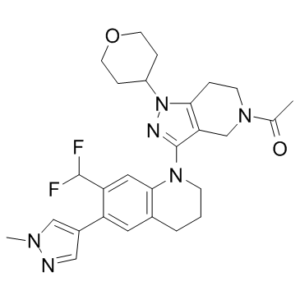
GNE-049 is a novel, highly potent and selective CBP/p300 bromodomain inhibitor with an IC50 of 1.1 nM in TR-FRET assay. GNE-049 also inhibits BRET and BRD4(1) with IC50s of 12 nM and 4200 nM, respectively. Inhibition of the bromodomain of the transcriptional regulator CBP/P300 is an especially interesting new therapeutic approach in oncology. It was discovered based on the in vivo chemical tool 1 (GNE-272) for the bromodomain of CBP that was moderately potent and selective over BRD4(1). In pursuit of a more potent and selective CBP inhibitor, we used structure-based design. Constraining the aniline of 1 into a tetrahydroquinoline motif maintained potency and increased selectivity 2-fold. Structure-activity relationship studies coupled with further structure-based design targeting the LPF shelf, BC loop, and KAc regions allowed us to significantly increase potency and selectivity, resulting in the identification of non-CNS penetrant 19 (GNE-781, TR-FRET IC50 = 0.94 nM, BRET IC50 = 6.2 nM; BRD4(1) IC50 = 5100 nΜ) that maintained good in vivo PK properties in multiple species. GNE-049 displays antitumor activity in an AML tumor model and was also shown to decrease Foxp3 transcript levels in a dose dependent manner.
Physicochemical Properties
| Molecular Formula | C27H32F2N6O2 |
| Molecular Weight | 510.5788 |
| Exact Mass | 510.255 |
| CAS # | 1936421-41-8 |
| PubChem CID | 121373418 |
| Appearance | Light yellow to yellow solid powder |
| LogP | 2.9 |
| Hydrogen Bond Donor Count | 0 |
| Hydrogen Bond Acceptor Count | 7 |
| Rotatable Bond Count | 4 |
| Heavy Atom Count | 37 |
| Complexity | 816 |
| Defined Atom Stereocenter Count | 0 |
| SMILES | FC([H])(C1=C(C2C([H])=NN(C([H])([H])[H])C=2[H])C([H])=C2C([H])([H])C([H])([H])C([H])([H])N(C2=C1[H])C1C2C([H])([H])N(C(C([H])([H])[H])=O)C([H])([H])C([H])([H])C=2N(C2([H])C([H])([H])C([H])([H])OC([H])([H])C2([H])[H])N=1)F |
| InChi Key | FLTYKXCCCAPRLV-UHFFFAOYSA-N |
| InChi Code | InChI=1S/C26H30F2N6O2/c1-16(35)32-8-5-23-22(14-32)26(30-34(23)19-6-9-36-15-19)33-7-3-4-17-10-20(18-12-29-31(2)13-18)21(25(27)28)11-24(17)33/h10-13,19,25H,3-9,14-15H2,1-2H3 |
| Chemical Name | 1-[3-[7-(difluoromethyl)-6-(1-methylpyrazol-4-yl)-3,4-dihydro-2H-quinolin-1-yl]-1-tetrahydrofuran-3-yl-6,7-dihydro-4H-pyrazolo[4,3-c]pyridin-5-yl]ethanone |
| Synonyms | GNE-049; GNE 049; GNE049. |
| HS Tariff Code | 2934.99.9001 |
| Storage |
Powder-20°C 3 years 4°C 2 years In solvent -80°C 6 months -20°C 1 month Note: Please store this product in a sealed and protected environment (e.g. under nitrogen), avoid exposure to moisture. |
| Shipping Condition | Room temperature (This product is stable at ambient temperature for a few days during ordinary shipping and time spent in Customs) |
Biological Activity
| ln Vitro | GNE-049 was chosen for additional examination due to its ideal combination of cellular potency, selectivity, and liver microsomal (LM) stability. GNE-049 performs well in orthogonal assessments of target engagement and demonstrates great potency in BRET cell tests. Among them, GNE-049 has an EC50 of 14 nM and can suppress MYC (MV4-11 cell line) expression[1]. |
| ln Vivo | GNE-049 has PK that is acceptable in dogs, monkeys, rats, and mice. Potency experiments with respect to specific bromodomains show that GNE-049 exhibits a strong degree of selectivity for CBP/P300 and, crucially, a 3820-fold increase in selectivity over BRD4 (1). In a single-dose (30–250 mg/kg QD) toxicokinetic study conducted on rats, GNE-049 was further assessed. Rats given a dosage of 250 mg/kg showed adverse effects on the central nervous system (CNS), such as vocalization and noticeable hyperactivity. Moreover, the ratio of the unbound drug concentration in the brain to the unbound drug concentration in plasma (Kp,uu) three hours after the injection was found to be 0.43 at the 250 mg/kg dose level, suggesting that GNE-049 is entering the brain. central nervous system and could be a factor in the toxicity that has been reported [1]. |
| References |
[1]. GNE-781, A Highly Advanced Potent and Selective Bromodomain Inhibitor of Cyclic Adenosine Monophosphate Response Element Binding Protein, Binding Protein (CBP). J Med Chem. 2017 Nov 22;60(22):9162-9183. |
Solubility Data
| Solubility (In Vitro) | DMSO : ~100 mg/mL (~195.86 mM) |
| Solubility (In Vivo) |
Solubility in Formulation 1: ≥ 2.5 mg/mL (4.90 mM) (saturation unknown) in 10% DMSO + 40% PEG300 + 5% Tween80 + 45% Saline (add these co-solvents sequentially from left to right, and one by one), clear solution. For example, if 1 mL of working solution is to be prepared, you can add 100 μL of 25.0 mg/mL clear DMSO stock solution to 400 μL PEG300 and mix evenly; then add 50 μL Tween-80 to the above solution and mix evenly; then add 450 μL normal saline to adjust the volume to 1 mL. Preparation of saline: Dissolve 0.9 g of sodium chloride in 100 mL ddH₂ O to obtain a clear solution. Solubility in Formulation 2: ≥ 2.5 mg/mL (4.90 mM) (saturation unknown) in 10% DMSO + 90% Corn Oil (add these co-solvents sequentially from left to right, and one by one), clear solution. For example, if 1 mL of working solution is to be prepared, you can add 100 μL of 25.0 mg/mL clear DMSO stock solution to 900 μL of corn oil and mix evenly. (Please use freshly prepared in vivo formulations for optimal results.) |
| Preparing Stock Solutions | 1 mg | 5 mg | 10 mg | |
| 1 mM | 1.9586 mL | 9.7928 mL | 19.5856 mL | |
| 5 mM | 0.3917 mL | 1.9586 mL | 3.9171 mL | |
| 10 mM | 0.1959 mL | 0.9793 mL | 1.9586 mL |