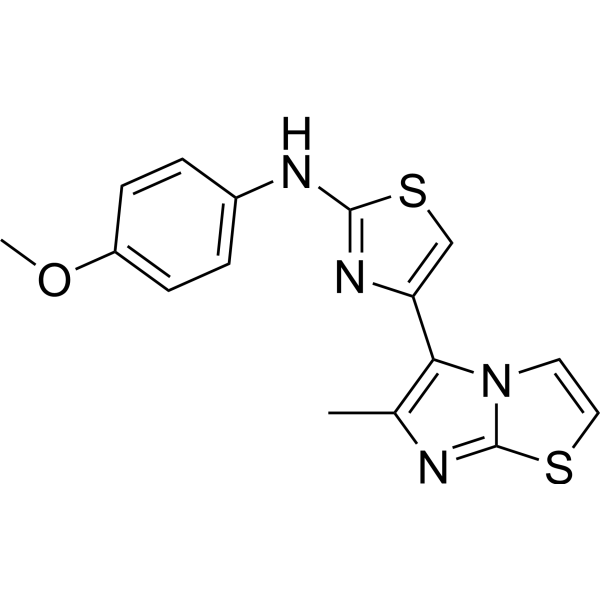
Physicochemical Properties
| Molecular Formula | C16H14N4OS2 |
| Molecular Weight | 342.44 |
| Exact Mass | 342.06 |
| CAS # | 315703-81-2 |
| PubChem CID | 2877425 |
| Appearance | Light brown to brown solid powder |
| LogP | 4.8 |
| Hydrogen Bond Donor Count | 1 |
| Hydrogen Bond Acceptor Count | 6 |
| Rotatable Bond Count | 4 |
| Heavy Atom Count | 23 |
| Complexity | 408 |
| Defined Atom Stereocenter Count | 0 |
| InChi Key | YYYAGFCFCHCRAN-UHFFFAOYSA-N |
| InChi Code | InChI=1S/C16H14N4OS2/c1-10-14(20-7-8-22-16(20)17-10)13-9-23-15(19-13)18-11-3-5-12(21-2)6-4-11/h3-9H,1-2H3,(H,18,19) |
| Chemical Name | N-(4-methoxyphenyl)-4-(6-methylimidazo[2,1-b][1,3]thiazol-5-yl)-1,3-thiazol-2-amine |
| HS Tariff Code | 2934.99.9001 |
| Storage |
Powder-20°C 3 years 4°C 2 years In solvent -80°C 6 months -20°C 1 month Note: This product requires protection from light (avoid light exposure) during transportation and storage. |
| Shipping Condition | Room temperature (This product is stable at ambient temperature for a few days during ordinary shipping and time spent in Customs) |
Biological Activity
| References |
[1].Potent Small-Molecule Inhibitors Targeting Acetylated Microtubules as Anticancer Agents Against Triple-Negative Breast Cancer. Biomedicines. 2020 Sep 9;8(9):338. |
Solubility Data
| Solubility (In Vitro) | DMSO :~12.5 mg/mL (~36.50 mM; with sonication (<60°C)) |
| Solubility (In Vivo) |
Solubility in Formulation 1: ≥ 1.25 mg/mL (3.65 mM) (saturation unknown) in 10% DMSO + 40% PEG300 + 5% Tween-80 + 45% Saline (add these co-solvents sequentially from left to right, and one by one),clear solution. For example, if 1 mL of working solution is to be prepared,you can add 100 μL of 12.5 mg/mL clear DMSO stock solution and add it to 400 μL PEG300 and mix well. Then add 50 μL Tween-80 to the above system and mix well. Then continue to add 450 μL of physiological saline to make up to 1 mL. Preparation of saline: Dissolve 0.9 g of sodium chloride in 100 mL ddH₂ O to obtain a clear solution. Solubility in Formulation 2: ≥ 1.25 mg/mL (3.65 mM) (saturation unknown) in 10% DMSO + 90% (20% SBE-β-CD in Saline) (add these co-solvents sequentially from left to right, and one by one),clear solution. For example, if 1 mL of working solution is to be prepared,you can add 100 μL of 12.5 mg/mL clear DMSO stock solution and add it to 900 μL of 20% SBE-β-CD in saline and mix well. Preparation of 20% SBE-β-CD in Saline (4°C,1 week): Dissolve 2 g SBE-β-CD in 10 mL saline to obtain a clear solution. Solubility in Formulation 3: 1.25 mg/mL (3.65 mM) in 10% DMSO + 90% Corn Oil (add these co-solvents sequentially from left to right, and one by one),suspension solution; with ultrasonication. For example, if 1 mL of working solution is to be prepared,you can add 100 μL of 12.5 mg/mL clear DMSO stock solution and add it to 900 μL corn oil and mix well. (Please use freshly prepared in vivo formulations for optimal results.) |
| Preparing Stock Solutions | 1 mg | 5 mg | 10 mg | |
| 1 mM | 2.9202 mL | 14.6011 mL | 29.2022 mL | |
| 5 mM | 0.5840 mL | 2.9202 mL | 5.8404 mL | |
| 10 mM | 0.2920 mL | 1.4601 mL | 2.9202 mL |