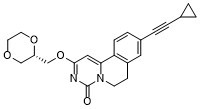
GLPG1205 is novel, specific, orally bioactive and negative allosteric GPR84 antagonist with a favorable PK/PD profiles. GLPG1205 has anti-inflammatory activity and is used for the treatment of pulmonary fibrosis. GLPG1205 reduced disease activity index score and neutrophil infiltration in a mouse dextran sodium sulfate-induced chronic inflammatory bowel disease model, with efficacy similar to positive-control compound sulfasalazine. The drug discovery steps leading to GLPG1205 identification, currently under phase II clinical investigation, are described herein.
Physicochemical Properties
| Molecular Formula | C22H22N2O4 |
| Molecular Weight | 378.421085834503 |
| Exact Mass | 378.157 |
| CAS # | 1445847-37-9 |
| PubChem CID | 71616860 |
| Appearance | Light yellow to yellow solid powder |
| LogP | 2.4 |
| Hydrogen Bond Donor Count | 0 |
| Hydrogen Bond Acceptor Count | 4 |
| Rotatable Bond Count | 4 |
| Heavy Atom Count | 28 |
| Complexity | 757 |
| Defined Atom Stereocenter Count | 1 |
| SMILES | O1CCOC[C@H]1COC1C=C2C3C=CC(C#CC4CC4)=CC=3CCN2C(N=1)=O |
| InChi Key | IRBAWVGZNJIROV-SFHVURJKSA-N |
| InChi Code | InChI=1S/C22H22N2O4/c25-22-23-21(28-14-18-13-26-9-10-27-18)12-20-19-6-5-16(4-3-15-1-2-15)11-17(19)7-8-24(20)22/h5-6,11-12,15,18H,1-2,7-10,13-14H2/t18-/m0/s1 |
| Chemical Name | (S)-2-((1,4-dioxan-2-yl)methoxy)-9-(cyclopropylethynyl)-6,7-dihydro-4H-pyrimido[6,1-a]isoquinolin-4-one |
| Synonyms | GLPG1205 GLPG 1205 GLPG-1205 |
| HS Tariff Code | 2934.99.9001 |
| Storage |
Powder-20°C 3 years 4°C 2 years In solvent -80°C 6 months -20°C 1 month |
| Shipping Condition | Room temperature (This product is stable at ambient temperature for a few days during ordinary shipping and time spent in Customs) |
Biological Activity
| ln Vitro | Neutrophils that are stimulated by ZQ16 to produce [Ca2+]i respond entirely to GLPG1205 (0.5 μM) [1]. The ROS response caused by GPR84 agonist is totally blocked by GLPG1205 (1 μM) when applied for 5 minutes [1]. ZQ16-induced ROS can be successfully countered by GLPG1205, as demonstrated by its IC50 value of 15 nM in TNF-primed neutrophils[1]. |
| ln Vivo | In a model of idiopathic pulmonary fibrosis, GLPG1250 (orally given; 30 mg/kg; twice daily) dramatically decreased Ashcroft scores commencing 7 days after challenge and continuing for 2 weeks [3]. ? In mice, GLPG1250 (given orally at a dose of 30 mg/kg once day) dramatically decreased lung deposition beginning eighteen weeks after radiation. Moreover, GLPG1250 prevents lung bronchial epithelial cells and parenchymal macrophages from increasing MnSOD in a radiation model [3]. ? GLPG1205 dose-dependently decreased colonic MPO levels, neutrophil influx, disease activity, and histopathological activity in a mouse model of IBD [4]. |
| References |
[1]. Similarities and differences between the responses induced in human phagocytes through activation of the medium chain fatty acid receptor GPR84 and the short chain fatty acid receptor FFA2R. Biochim Biophys Acta Mol Cell Res. 2018 May;1865(5):695-708. [2]. Human safety, pharmacokinetics and pharmacodynamics of the GPR84 antagonist GLPG1205, a potential new approach to treat IBD. [3]. Characterization of GLPG1205 in Mouse Fibrosis Models: A Potent and Selective Antagonist of GPR84 for Treatment of Idiopathic Pulmonary Fibrosis. American Journal of Respiratory and Critical Care Medicine 2019;199:A1046. [4]. Human safety, pharmacokinetics and pharmacodynamics. |
| Additional Infomation | GLPG-1205 is under investigation in clinical trial NCT03725852 (A Clinical Study to Test How Effective and Safe GLPG1205 is for Patients With Idiopathic Pulmonary Fibrosis (IPF)). |
Solubility Data
| Solubility (In Vitro) | DMSO : ~250 mg/mL (~660.64 mM) |
| Solubility (In Vivo) |
Solubility in Formulation 1: 6.25 mg/mL (16.52 mM) in 10% DMSO + 40% PEG300 + 5% Tween80 + 45% Saline (add these co-solvents sequentially from left to right, and one by one), suspension solution; with sonication. For example, if 1 mL of working solution is to be prepared, you can add 100 μL of 62.5 mg/mL clear DMSO stock solution to 400 μL PEG300 and mix evenly; then add 50 μL Tween-80 to the above solution and mix evenly; then add 450 μL normal saline to adjust the volume to 1 mL. Preparation of saline: Dissolve 0.9 g of sodium chloride in 100 mL ddH₂ O to obtain a clear solution. Solubility in Formulation 2: ≥ 6.25 mg/mL (16.52 mM) (saturation unknown) in 10% DMSO + 90% Corn Oil (add these co-solvents sequentially from left to right, and one by one), clear solution. For example, if 1 mL of working solution is to be prepared, you can add 100 μL of 62.5 mg/mL clear DMSO stock solution to 900 μL corn oil and mix evenly. Solubility in Formulation 3: 5 mg/mL (13.21 mM) in 0.5% CMC-Na/saline water (add these co-solvents sequentially from left to right, and one by one), suspension solution; with ultrasonication. Preparation of saline: Dissolve 0.9 g of sodium chloride in 100 mL ddH₂ O to obtain a clear solution. (Please use freshly prepared in vivo formulations for optimal results.) |
| Preparing Stock Solutions | 1 mg | 5 mg | 10 mg | |
| 1 mM | 2.6426 mL | 13.2128 mL | 26.4257 mL | |
| 5 mM | 0.5285 mL | 2.6426 mL | 5.2851 mL | |
| 10 mM | 0.2643 mL | 1.3213 mL | 2.6426 mL |