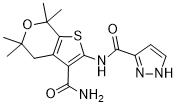
GLPG1837 (also known as ABBV-974) is a novel, potent and reversible CFTR (cystic fibrosis transmembrane conductance regulator) potentiator with EC50s of 3 nM and 339 nM for F508del and G551D CFTR, respectively. Cystic fibrosis (CF) is caused by mutations in the gene for the cystic fibrosis transmembrane conductance regulator (CFTR). With the discovery of Ivacaftor and Orkambi, it has been shown that CFTR function can be partially restored by administering one or more small molecules. These molecules aim at either enhancing the amount of CFTR on the cell surface (correctors) or at improving the gating function of the CFTR channel (potentiators).
Physicochemical Properties
| Molecular Formula | C16H20N4O3S |
| Molecular Weight | 348.420001983643 |
| Exact Mass | 348.125 |
| CAS # | 1654725-02-6 |
| PubChem CID | 117857370 |
| Appearance | Light yellow to yellow solid powder |
| LogP | 1.8 |
| Hydrogen Bond Donor Count | 3 |
| Hydrogen Bond Acceptor Count | 5 |
| Rotatable Bond Count | 3 |
| Heavy Atom Count | 24 |
| Complexity | 539 |
| Defined Atom Stereocenter Count | 0 |
| SMILES | S1C(=C(C(N)=O)C2=C1C(C)(C)OC(C)(C)C2)NC(C1=CC=NN1)=O |
| InChi Key | GHTGYZMBQPXTCQ-UHFFFAOYSA-N |
| InChi Code | InChI=1S/C16H20N4O3S/c1-15(2)7-8-10(12(17)21)14(24-11(8)16(3,4)23-15)19-13(22)9-5-6-18-20-9/h5-6H,7H2,1-4H3,(H2,17,21)(H,18,20)(H,19,22) |
| Chemical Name | N-(3-carbamoyl-5,5,7,7-tetramethyl-4,7-dihydro-5H-thieno[2,3-c]pyran-2-yl)-1H-pyrazole-3-carboxamide |
| Synonyms | ABBV-974; ABBV 974; ABBV974; GLPG-1837; GLPG 1837; GLPG1837; |
| HS Tariff Code | 2934.99.9001 |
| Storage |
Powder-20°C 3 years 4°C 2 years In solvent -80°C 6 months -20°C 1 month |
| Shipping Condition | Room temperature (This product is stable at ambient temperature for a few days during ordinary shipping and time spent in Customs) |
Biological Activity
| Targets | GLPG1837 is a strong CFTR enhancer, having EC50s for F508del and G551D CFTR of 3 nM and 339 nM, respectively. GLPG1837, with a potency of 181 nM, enhances the conductivity of the G551D CFTR channel [1]. A reversible CFTR enhancer, GLPG1837 appears to have an affinity in the region of 0.2–2 µM [2]. |
| ln Vitro |
GLPG1837 is a strong CFTR enhancer, having EC50s for F508del and G551D CFTR of 3 nM and 339 nM, respectively. GLPG1837, with a potency of 181 nM, enhances the conductivity of the G551D CFTR channel [1]. A reversible CFTR enhancer, GLPG1837 appears to have an affinity in the region of 0.2–2 µM [2]. In YFP halide assay, GLPG1837 (compound 13) showed EC50 = 3 nM and 105% activation on F508del CFTR, and EC50 = 339 nM and 103% activation on G551D CFTR. In transepithelial clamp circuit (TECC) assay using primary human bronchial epithelial (HBE) cells from G551D/F508del patients, GLPG1837 induced nearly 200% higher CFTR current compared to Ivacaftor, with an EC50 of 181 nM. On other class III/IV CFTR mutants (G178R, S549N, R117H), GLPG1837 showed higher potency and efficacy compared to Ivacaftor in YFP halide assay. [1] |
| Cell Assay |
YFP Halide Assay: CFBE41o- cells (bronchial epithelial cell line from CF patient) overexpressing F508del CFTR and YFP were cultured, incubated at 27°C to increase CFTR membrane expression. Cells were treated with forskolin and potentiator for 10 min, then NaI buffer was added. Fluorescence quenching was measured, and percent activation was calculated as 1−(F/F0). HEK293 cells transfected with mutant CFTR (G551D, G178R, S549N, R117H) and YFP were used similarly. Activity was expressed as percent activation relative to control. [1] Transepithelial Clamp Circuit (TECC) Assay: Primary human bronchial epithelial cells from G551D/F508del patients were mounted in TECC instrument, bathed in NaCl-Ringer solution. Apical amiloride (100 μM) and basolateral/apical forskolin (10 μM) were applied. Compounds were added to both sides, and transepithelial potential (PD) and resistance (R) were recorded every 2 min for 20 min. Short-circuit current (Ieq) was calculated using Ohm’s law. EC50 was determined from dose–response curves. [1] |
| Animal Protocol |
Pharmacokinetic studies were conducted in rats and dogs. For rat PK, GLPG1837 was administered intravenously at 1 mg/kg and orally at 5 mg/kg. For dog PK, intravenous dose was 1 mg/kg and oral dose was 5 mg/kg. Blood samples were collected at time points, and plasma concentrations were measured to calculate PK parameters. [1] |
| ADME/Pharmacokinetics |
In vitro ADME: Clint,unb (microsomes) = 1.7 L/h/kg (rat), 1.1 L/h/kg (human); Clint,unb (hepatocytes) = 5.7 L/h/kg (rat), 1.8 L/h/kg (human). Permeability (MDCK A→B) = 11 × 10⁻⁶ cm/s, efflux ratio = 2.6. Thermodynamic solubility: 8.6 μM at pH 7.4, 11 μM at pH 3.0. No significant CYP inhibition (IC50 > 100 μM for 1A2, 2C19, 2C9, 2D6, 3A4). hERG inhibition (manual patch clamp): IC50 > 33 μM. Rat PK (IV 1 mg/kg): Cl = 1.92 L/h/kg, Cl,unb = 24 L/h/kg, Vd = 4.8 L/kg, T1/2 = 1.84 h, oral bioavailability = 67% (5 mg/kg). Dog PK (IV 1 mg/kg): Cl = 0.32 L/h/kg, Cl,unb = 6.4 L/h/kg, Vd = 1.4 L/kg, T1/2 = 3.0 h, oral bioavailability >100% (5 mg/kg). [1] |
| References |
[1]. Discovery of N-(3-Carbamoyl-5,5,7,7-tetramethyl-5,7-dihydro-4H-thieno[2,3-c]pyran-2-yl)-lH-pyrazole-5-carboxamide (GLPG1837), a Novel Potentiator Which Can Open Class III Mutant Cystic Fibrosis Transmembrane Conductance Regulator (. [2]. A common mechanism for CFTR potentiators. J Gen Physiol. 2017 Dec 4;149(12):1105-1118. |
| Additional Infomation |
GLPG1837 is a novel CFTR potentiator discovered from a tetramethyl-THP scaffold. It shows improved potency and efficacy compared to Ivacaftor, especially on class III gating mutants like G551D. The compound has low solubility but good permeability due to intramolecular hydrogen bonding, which reduces effective polar surface area. A phosphate prodrug (compound 29) was developed to improve solubility and exposure at higher doses. GLPG1837 entered clinical phase I and phase II studies (SAPHIRA I and II) for cystic fibrosis. [1] |
Solubility Data
| Solubility (In Vitro) | DMSO : ≥ 250 mg/mL (~717.52 mM) |
| Solubility (In Vivo) |
Note: Listed below are some common formulations that may be used to formulate products with low water solubility (e.g. < 1 mg/mL), you may test these formulations using a minute amount of products to avoid loss of samples. Injection Formulations (e.g. IP/IV/IM/SC) Injection Formulation 1: DMSO : Tween 80: Saline = 10 : 5 : 85 (i.e. 100 μL DMSO stock solution → 50 μL Tween 80 → 850 μL Saline) *Preparation of saline: Dissolve 0.9 g of sodium chloride in 100 mL ddH ₂ O to obtain a clear solution. Injection Formulation 2: DMSO : PEG300 :Tween 80 : Saline = 10 : 40 : 5 : 45 (i.e. 100 μL DMSO → 400 μLPEG300 → 50 μL Tween 80 → 450 μL Saline) Injection Formulation 3: DMSO : Corn oil = 10 : 90 (i.e. 100 μL DMSO → 900 μL Corn oil) Example: Take the Injection Formulation 3 (DMSO : Corn oil = 10 : 90) as an example, if 1 mL of 2.5 mg/mL working solution is to be prepared, you can take 100 μL 25 mg/mL DMSO stock solution and add to 900 μL corn oil, mix well to obtain a clear or suspension solution (2.5 mg/mL, ready for use in animals). Injection Formulation 4: DMSO : 20% SBE-β-CD in saline = 10 : 90 [i.e. 100 μL DMSO → 900 μL (20% SBE-β-CD in saline)] *Preparation of 20% SBE-β-CD in Saline (4°C,1 week): Dissolve 2 g SBE-β-CD in 10 mL saline to obtain a clear solution. Injection Formulation 5: 2-Hydroxypropyl-β-cyclodextrin : Saline = 50 : 50 (i.e. 500 μL 2-Hydroxypropyl-β-cyclodextrin → 500 μL Saline) Injection Formulation 6: DMSO : PEG300 : castor oil : Saline = 5 : 10 : 20 : 65 (i.e. 50 μL DMSO → 100 μLPEG300 → 200 μL castor oil → 650 μL Saline) Injection Formulation 7: Ethanol : Cremophor : Saline = 10: 10 : 80 (i.e. 100 μL Ethanol → 100 μL Cremophor → 800 μL Saline) Injection Formulation 8: Dissolve in Cremophor/Ethanol (50 : 50), then diluted by Saline Injection Formulation 9: EtOH : Corn oil = 10 : 90 (i.e. 100 μL EtOH → 900 μL Corn oil) Injection Formulation 10: EtOH : PEG300:Tween 80 : Saline = 10 : 40 : 5 : 45 (i.e. 100 μL EtOH → 400 μLPEG300 → 50 μL Tween 80 → 450 μL Saline) Oral Formulations Oral Formulation 1: Suspend in 0.5% CMC Na (carboxymethylcellulose sodium) Oral Formulation 2: Suspend in 0.5% Carboxymethyl cellulose Example: Take the Oral Formulation 1 (Suspend in 0.5% CMC Na) as an example, if 100 mL of 2.5 mg/mL working solution is to be prepared, you can first prepare 0.5% CMC Na solution by measuring 0.5 g CMC Na and dissolve it in 100 mL ddH2O to obtain a clear solution; then add 250 mg of the product to 100 mL 0.5% CMC Na solution, to make the suspension solution (2.5 mg/mL, ready for use in animals). Oral Formulation 3: Dissolved in PEG400 Oral Formulation 4: Suspend in 0.2% Carboxymethyl cellulose Oral Formulation 5: Dissolve in 0.25% Tween 80 and 0.5% Carboxymethyl cellulose Oral Formulation 6: Mixing with food powders Note: Please be aware that the above formulations are for reference only. InvivoChem strongly recommends customers to read literature methods/protocols carefully before determining which formulation you should use for in vivo studies, as different compounds have different solubility properties and have to be formulated differently. (Please use freshly prepared in vivo formulations for optimal results.) |
| Preparing Stock Solutions | 1 mg | 5 mg | 10 mg | |
| 1 mM | 2.8701 mL | 14.3505 mL | 28.7010 mL | |
| 5 mM | 0.5740 mL | 2.8701 mL | 5.7402 mL | |
| 10 mM | 0.2870 mL | 1.4350 mL | 2.8701 mL |