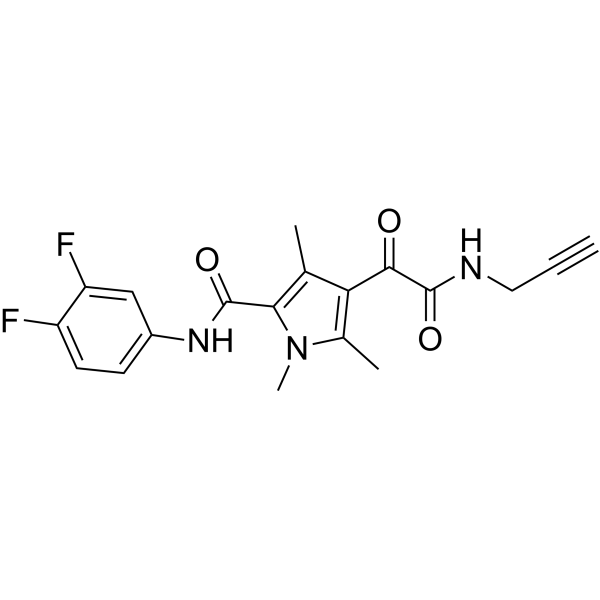
Physicochemical Properties
| Molecular Formula | C19H17F2N3O3 |
| Molecular Weight | 373.35339140892 |
| Exact Mass | 373.123 |
| CAS # | 2133017-36-2 |
| PubChem CID | 130408536 |
| Appearance | Light yellow to brown solid powder |
| LogP | 2.1 |
| Hydrogen Bond Donor Count | 2 |
| Hydrogen Bond Acceptor Count | 5 |
| Rotatable Bond Count | 5 |
| Heavy Atom Count | 27 |
| Complexity | 647 |
| Defined Atom Stereocenter Count | 0 |
| SMILES | FC1=C(C=CC(=C1)NC(C1=C(C)C(C(C(NCC#C)=O)=O)=C(C)N1C)=O)F |
| InChi Key | SQOFSIXYJGPNKV-UHFFFAOYSA-N |
| InChi Code | InChI=1S/C19H17F2N3O3/c1-5-8-22-19(27)17(25)15-10(2)16(24(4)11(15)3)18(26)23-12-6-7-13(20)14(21)9-12/h1,6-7,9H,8H2,2-4H3,(H,22,27)(H,23,26) |
| Chemical Name | N-(3,4-difluorophenyl)-1,3,5-trimethyl-4-[2-oxo-2-(prop-2-ynylamino)acetyl]pyrrole-2-carboxamide |
| HS Tariff Code | 2934.99.9001 |
| Storage |
Powder-20°C 3 years 4°C 2 years In solvent -80°C 6 months -20°C 1 month |
| Shipping Condition | Room temperature (This product is stable at ambient temperature for a few days during ordinary shipping and time spent in Customs) |
Biological Activity
| Targets |
- Hepatitis B Virus (HBV) core protein (capsid protein): GLP-26 is an HBV capsid assembly modulator (CAM) that inhibits HBV capsid assembly with an EC₅₀ of 0.4 μM (in HBV replication inhibition assay) and induces formation of aberrant capsids with an AC₅₀ (concentration causing 50% aberrant capsid formation) of 0.3 μM [1] |
| ln Vitro |
In HepNTCP-DL transfected with wild-type HBV, GLP-26 (0.7-1.7 μM; 3-day cells) lowers HBeAg with an EC50 of 0.7 μM [2]. 1. HBV capsid assembly modulation: GLP-26 dose-dependently inhibits proper HBV capsid assembly and promotes formation of non-infectious, aberrant capsids. At 1 μM, it reduces correctly assembled capsids by 82% and increases aberrant capsids by 78% compared to vehicle control. The effect is specific to HBV core protein, with no impact on other viral proteins (e.g., HBsAg) [1] 2. HBV replication inhibition: In HepG2.2.15 cells (HBV-replicating hepatoma cells), GLP-26 inhibits HBV DNA replication with EC₅₀ = 0.4 μM. At 2 μM, it reduces intracellular HBV pgRNA levels by 65% and secreted HBV DNA by 75% [1] 3. Selectivity: GLP-26 (10 μM) shows no significant cytotoxicity in HepG2 cells (cell viability ≥90% vs. control) and no inhibitory activity against other viruses (HCV, HIV-1) [1] |
| Enzyme Assay |
1. HBV capsid assembly assay: Recombinant HBV core protein was incubated with serial concentrations of GLP-26 (0.01–10 μM) in assembly buffer containing ATP and Mg²⁺ at 37°C for 4 hours. Properly assembled capsids and aberrant capsids were separated by native agarose gel electrophoresis. Band intensities were quantified by densitometry to calculate inhibition rate of proper assembly and induction rate of aberrant assembly, and EC₅₀/AC₅₀ values were derived [1] |
| Cell Assay |
Cell Viability Assay[2] Cell Types: HepNTCP-DL cells Tested Concentrations: 0.7-1.7 μM Incubation Duration: 3 days Experimental Results: The secreted HBeAg in HepNTCP-DL cells was diminished. 1. HBV replication inhibition assay: HepG2.2.15 cells were seeded in 24-well plates and treated with GLP-26 (0.05–10 μM) for 72 hours. Intracellular HBV pgRNA was extracted and quantified by qPCR, and secreted HBV DNA in culture supernatants was purified and measured by real-time PCR. Cell viability was assessed in parallel using a cell proliferation assay kit to exclude cytotoxicity interference [1] |
| References |
[1]. Recent advances in the development of HBV capsid assembly modulators. Curr Opin Chem Biol. 2019 Jun;50:73-79. |
| Additional Infomation |
1. GLP-26 belongs to the class of HBV capsid assembly modulators (CAMs) with a quinoline-derived scaffold [1] 2. Its mechanism of action involves binding to the HBV core protein dimer interface, disrupting proper capsid polymerization and promoting formation of non-functional, aberrant capsids, thereby blocking HBV replication at the capsid assembly step [1] 3. GLP-26 shows potent in vitro anti-HBV activity and high selectivity, making it a promising candidate for the development of anti-HBV therapeutics [1] 4. The literature [1] is a review focusing on HBV CAM development and does not provide in vivo data, ADME/pharmacokinetics, or toxicity information for GLP-26 [1] |
Solubility Data
| Solubility (In Vitro) | DMSO : ~125 mg/mL (~334.81 mM) |
| Solubility (In Vivo) |
Solubility in Formulation 1: ≥ 2.08 mg/mL (5.57 mM) (saturation unknown) in 10% DMSO + 40% PEG300 + 5% Tween80 + 45% Saline (add these co-solvents sequentially from left to right, and one by one), clear solution. For example, if 1 mL of working solution is to be prepared, you can add 100 μL of 20.8 mg/mL clear DMSO stock solution to 400 μL PEG300 and mix evenly; then add 50 μL Tween-80 to the above solution and mix evenly; then add 450 μL normal saline to adjust the volume to 1 mL. Preparation of saline: Dissolve 0.9 g of sodium chloride in 100 mL ddH₂ O to obtain a clear solution. Solubility in Formulation 2: ≥ 2.08 mg/mL (5.57 mM) (saturation unknown) in 10% DMSO + 90% Corn Oil (add these co-solvents sequentially from left to right, and one by one), clear solution. For example, if 1 mL of working solution is to be prepared, you can add 100 μL of 20.8 mg/mL clear DMSO stock solution to 900 μL of corn oil and mix evenly. (Please use freshly prepared in vivo formulations for optimal results.) |
| Preparing Stock Solutions | 1 mg | 5 mg | 10 mg | |
| 1 mM | 2.6785 mL | 13.3923 mL | 26.7845 mL | |
| 5 mM | 0.5357 mL | 2.6785 mL | 5.3569 mL | |
| 10 mM | 0.2678 mL | 1.3392 mL | 2.6785 mL |