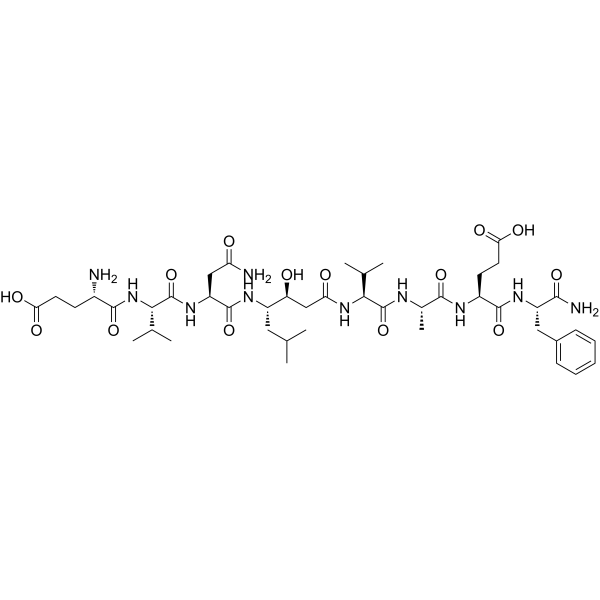
Physicochemical Properties
| Molecular Formula | C44H70N10O14 |
| Molecular Weight | 963.09 |
| Exact Mass | 962.50729 |
| CAS # | 552337-94-7 |
| PubChem CID | 44565392 |
| Sequence | H-Glu-Val-Asn-Sta-Val-Ala-Glu-Phe-NH2; Glu-Val-Asn-{Statine}-Val-Ala-Glu-Phe-NH2; (N-(L-alpha-glutamyl-L-valyl-L-asparagyl)-(3S,4S)-4-amino-3-hydroxy-6-methylheptanoyl)-L-valyl-L-alanyl-L-alpha-glutamyl-L-phenylalaninamide |
| SequenceShortening | EVNXVAEF; EVN-{Statine}-VAEF-NH2 |
| Appearance | Typically exists as solid at room temperature |
| LogP | -3.8 |
| Hydrogen Bond Donor Count | 13 |
| Hydrogen Bond Acceptor Count | 15 |
| Rotatable Bond Count | 31 |
| Heavy Atom Count | 68 |
| Complexity | 1770 |
| Defined Atom Stereocenter Count | 9 |
| SMILES | C[C@@H](C(=O)N[C@@H](CCC(=O)O)C(=O)N[C@@H](CC1=CC=CC=C1)C(=O)N)NC(=O)[C@H](C(C)C)NC(=O)C[C@@H]([C@H](CC(C)C)NC(=O)[C@H](CC(=O)N)NC(=O)[C@H](C(C)C)NC(=O)[C@H](CCC(=O)O)N)O |
| InChi Key | UEVJWCGGKBQXDV-TVZWHCCBSA-N |
| InChi Code | InChI=1S/C44H70N10O14/c1-21(2)17-28(50-42(66)30(19-32(46)56)52-44(68)37(23(5)6)54-40(64)26(45)13-15-34(58)59)31(55)20-33(57)53-36(22(3)4)43(67)48-24(7)39(63)49-27(14-16-35(60)61)41(65)51-29(38(47)62)18-25-11-9-8-10-12-25/h8-12,21-24,26-31,36-37,55H,13-20,45H2,1-7H3,(H2,46,56)(H2,47,62)(H,48,67)(H,49,63)(H,50,66)(H,51,65)(H,52,68)(H,53,57)(H,54,64)(H,58,59)(H,60,61)/t24-,26-,27-,28-,29-,30-,31-,36-,37-/m0/s1 |
| Chemical Name | (4S)-4-amino-5-[[(2S)-1-[[(2S)-4-amino-1-[[(3S,4S)-1-[[(2S)-1-[[(2S)-1-[[(2S)-1-[[(2S)-1-amino-1-oxo-3-phenylpropan-2-yl]amino]-4-carboxy-1-oxobutan-2-yl]amino]-1-oxopropan-2-yl]amino]-3-methyl-1-oxobutan-2-yl]amino]-3-hydroxy-6-methyl-1-oxoheptan-4-yl]amino]-1,4-dioxobutan-2-yl]amino]-3-methyl-1-oxobutan-2-yl]amino]-5-oxopentanoic acid |
| Synonyms | GL189; CHEMBL464758; GL-189; CHEMBL-464758; |
| HS Tariff Code | 2934.99.9001 |
| Storage |
Powder-20°C 3 years 4°C 2 years In solvent -80°C 6 months -20°C 1 month |
| Shipping Condition | Room temperature (This product is stable at ambient temperature for a few days during ordinary shipping and time spent in Customs) |
Biological Activity
| Targets | β-secretase |
| ln Vitro | β-Secretase, an enzyme participating in amyloid β-peptide generation, is thought to be involved in the pathogenesis of Alzheimer's disease. We examined the effects of β-secretase inhibitors such as N-benzyloxycarbonyl-Val-Leu-leucinal (Z-VLL-CHO) and H-EVNstatineVAEF-NH2 (GL-189) on glutamate-induced retinal ganglion cell (RGC) death in vitro. In cultures of purified RGCs from neonatal rats, 2-day exposure to 25 μM glutamate induced RGC death, and Z-VLL-CHO (100 nM) and GL-189 (1 μM) had neuroprotective effects. We also found out that Z-VLL-CHO showed a neuroprotective effect on retinal damage induced by optic nerve crush in vivo. Thus, β-secretase could be a potential target for therapy of neurodegenerative retinal diseases [1]. |
| Cell Assay |
Cultures were pre-incubated with vehicle (0.1% dimethyl sulfoxide; DMSO), N-benzyloxycarbonyl-Val-Leu-leucinal (Z-VLL-CHO), H-EVNstatineVAEF-NH2 (GL-189), or DNQX for 24 h, then exposed to 25 μM glutamate for 2 days with or without the above agents at 37 °C under an atmosphere of 5% CO2 and 95% air. After glutamate-exposure, cell viabilities were determined using 1 μM Calcein-AM, as described previously with a minor modification. In the present study, a surviving RGC was defined as a cell with a Calcein-AM-stained cell body and a process extending at least one cell-diameter from the cell body. The numbers of surviving RGCs in 5 microscope fields (200×) of each RGCs-seeded-coverslip were counted. The first field selected was in the center of the coverslip, and the other fields were adjacent to the first field in all four directions. In cultures of purified RGCs, 2-day exposure to 25 μM glutamate reduced RGCs viability to about 70% of control. Prior and concomitant treatment with Z-VLL-CHO (Fig. 1A–C and Fig. 2) or GL-189 (Fig. 2) inhibited the RGC death in a concentration-dependent manner, statistical significance being reached at 100 nM or 1 μM, respectively. DNQX (10 μM) also significantly inhibited glutamate-induced RGC death, as previously reported [1]. |
| References |
[1]. Neuroprotective effects of beta-secretase inhibitors against rat retinal ganglion cell death. Neurosci Lett. 2004 Nov 3;370(1):61-4. |
| Additional Infomation | Effects of Z-VLL-CHO and GL-189 on gluatamate-induced neurotoxicity in rat retinal ganglion cells (RGCs). RGCs were purified from 7-day-old rats by means of a two-step panning method. Cultures were exposed to 25 μM glutamate for 2 days. Vehicle, Z-VLL-CHO (10, 100 nM), GL-189 (0.1, 1 μM), or 10 μM DNQX was present for 24 h before and throughout this glutamate treatment. [1] |
Solubility Data
| Solubility (In Vitro) | May dissolve in DMSO (in most cases), if not, try other solvents such as H2O, Ethanol, or DMF with a minute amount of products to avoid loss of samples |
| Solubility (In Vivo) |
Note: Listed below are some common formulations that may be used to formulate products with low water solubility (e.g. < 1 mg/mL), you may test these formulations using a minute amount of products to avoid loss of samples. Injection Formulations (e.g. IP/IV/IM/SC) Injection Formulation 1: DMSO : Tween 80: Saline = 10 : 5 : 85 (i.e. 100 μL DMSO stock solution → 50 μL Tween 80 → 850 μL Saline) *Preparation of saline: Dissolve 0.9 g of sodium chloride in 100 mL ddH ₂ O to obtain a clear solution. Injection Formulation 2: DMSO : PEG300 :Tween 80 : Saline = 10 : 40 : 5 : 45 (i.e. 100 μL DMSO → 400 μLPEG300 → 50 μL Tween 80 → 450 μL Saline) Injection Formulation 3: DMSO : Corn oil = 10 : 90 (i.e. 100 μL DMSO → 900 μL Corn oil) Example: Take the Injection Formulation 3 (DMSO : Corn oil = 10 : 90) as an example, if 1 mL of 2.5 mg/mL working solution is to be prepared, you can take 100 μL 25 mg/mL DMSO stock solution and add to 900 μL corn oil, mix well to obtain a clear or suspension solution (2.5 mg/mL, ready for use in animals). Injection Formulation 4: DMSO : 20% SBE-β-CD in saline = 10 : 90 [i.e. 100 μL DMSO → 900 μL (20% SBE-β-CD in saline)] *Preparation of 20% SBE-β-CD in Saline (4°C,1 week): Dissolve 2 g SBE-β-CD in 10 mL saline to obtain a clear solution. Injection Formulation 5: 2-Hydroxypropyl-β-cyclodextrin : Saline = 50 : 50 (i.e. 500 μL 2-Hydroxypropyl-β-cyclodextrin → 500 μL Saline) Injection Formulation 6: DMSO : PEG300 : castor oil : Saline = 5 : 10 : 20 : 65 (i.e. 50 μL DMSO → 100 μLPEG300 → 200 μL castor oil → 650 μL Saline) Injection Formulation 7: Ethanol : Cremophor : Saline = 10: 10 : 80 (i.e. 100 μL Ethanol → 100 μL Cremophor → 800 μL Saline) Injection Formulation 8: Dissolve in Cremophor/Ethanol (50 : 50), then diluted by Saline Injection Formulation 9: EtOH : Corn oil = 10 : 90 (i.e. 100 μL EtOH → 900 μL Corn oil) Injection Formulation 10: EtOH : PEG300:Tween 80 : Saline = 10 : 40 : 5 : 45 (i.e. 100 μL EtOH → 400 μLPEG300 → 50 μL Tween 80 → 450 μL Saline) Oral Formulations Oral Formulation 1: Suspend in 0.5% CMC Na (carboxymethylcellulose sodium) Oral Formulation 2: Suspend in 0.5% Carboxymethyl cellulose Example: Take the Oral Formulation 1 (Suspend in 0.5% CMC Na) as an example, if 100 mL of 2.5 mg/mL working solution is to be prepared, you can first prepare 0.5% CMC Na solution by measuring 0.5 g CMC Na and dissolve it in 100 mL ddH2O to obtain a clear solution; then add 250 mg of the product to 100 mL 0.5% CMC Na solution, to make the suspension solution (2.5 mg/mL, ready for use in animals). Oral Formulation 3: Dissolved in PEG400 Oral Formulation 4: Suspend in 0.2% Carboxymethyl cellulose Oral Formulation 5: Dissolve in 0.25% Tween 80 and 0.5% Carboxymethyl cellulose Oral Formulation 6: Mixing with food powders Note: Please be aware that the above formulations are for reference only. InvivoChem strongly recommends customers to read literature methods/protocols carefully before determining which formulation you should use for in vivo studies, as different compounds have different solubility properties and have to be formulated differently. (Please use freshly prepared in vivo formulations for optimal results.) |
| Preparing Stock Solutions | 1 mg | 5 mg | 10 mg | |
| 1 mM | 1.0383 mL | 5.1916 mL | 10.3832 mL | |
| 5 mM | 0.2077 mL | 1.0383 mL | 2.0766 mL | |
| 10 mM | 0.1038 mL | 0.5192 mL | 1.0383 mL |