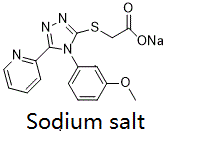
Physicochemical Properties
| Molecular Formula | C16H15N4NAO3S |
| Molecular Weight | 366.370072603226 |
| Exact Mass | 364.06 |
| Elemental Analysis | C, 52.74; H, 3.60; N, 15.38; Na, 6.31; O, 13.17; S, 8.80 |
| CAS # | 1459687-96-7 |
| Related CAS # | GJ103;1459687-89-8 |
| PubChem CID | 71748052 |
| Appearance | Solid powder |
| Hydrogen Bond Donor Count | 0 |
| Hydrogen Bond Acceptor Count | 7 |
| Rotatable Bond Count | 6 |
| Heavy Atom Count | 25 |
| Complexity | 434 |
| Defined Atom Stereocenter Count | 0 |
| InChi Key | PTFQBXAUOWUATD-UHFFFAOYSA-M |
| InChi Code | InChI=1S/C16H14N4O3S.Na/c1-23-12-6-4-5-11(9-12)20-15(13-7-2-3-8-17-13)18-19-16(20)24-10-14(21)22;/h2-9H,10H2,1H3,(H,21,22);/q;+1/p-1 |
| Chemical Name | sodium;2-[[4-(3-methoxyphenyl)-5-pyridin-2-yl-1,2,4-triazol-3-yl]sulfanyl]acetate |
| Synonyms | GJ-103 sodium; |
| HS Tariff Code | 2934.99.9001 |
| Storage |
Powder-20°C 3 years 4°C 2 years In solvent -80°C 6 months -20°C 1 month Note: Please store this product in a sealed and protected environment, avoid exposure to moisture. |
| Shipping Condition | Room temperature (This product is stable at ambient temperature for a few days during ordinary shipping and time spent in Customs) |
Biological Activity
| Targets | GJ103 (10-30 μM; 4 days) sodium promotes ATM folding activity in AT153LA cells with homozygous TGA mutations and homozygous TAA mutations [1]. GJ103 salt showed no appreciable active cytotoxicity on AT cells at doses as high as 300 µM [1]. |
| ln Vitro |
GJ103 (10-30 μM; 4 days) sodium promotes ATM folding activity in AT153LA cells with homozygous TGA mutations and homozygous TAA mutations [1]. GJ103 salt showed no appreciable active cytotoxicity on AT cells at doses as high as 300 µM [1]. GJ103 (an analog of GJ072) demonstrated read-through activity in A-T lymphoblastoid cell lines carrying homozygous nonsense mutations in the ATM gene. It induced ATM kinase activity, shown by increased ATMpSer1981 autophosphorylation and SMC1pSer966 transphosphorylation measured by flow cytometry (∆FI), and promoted ATMpSer1981 foci formation after irradiation (IRIF). The activity was observed in cells with TGA, TAG, and TAA stop codons at concentrations of 10 and 30 µmol/L. [1] GJ103 also induced detectable full-length ATM protein in A-T cells as measured by ATM-ELISA. [1] GJ103 and other GJ072 analogs did not show obvious cytotoxicity in A-T cells at concentrations up to 300 µmol/L. [1] |
| Cell Assay |
ATM kinase activity was assessed using flow cytometry for ATMpSer1981 and SMC1pSer966 phosphorylation. Cells were treated with compounds for 4 days, irradiated with 10 Gy, fixed, permeabilized, and stained with primary antibodies followed by fluorescent secondary antibodies. Fluorescence intensity was measured by flow cytometry. [1] ATMpSer1981 nuclear foci formation (IRIF) was evaluated by immunofluorescence. After 4-day compound treatment, cells were irradiated with 2 Gy, fixed, permeabilized, blocked, and incubated with anti-ATMpSer1981 antibody followed by FITC-conjugated secondary antibody. Foci were visualized and quantified microscopically. [1] Full-length ATM protein levels were measured by ATM-ELISA using nuclear extracts from compound-treated cells. [1] Cytotoxicity was assessed by XTT assay after compound treatment, measuring absorbance at 480 nm. [1] |
| References |
[1]. A new series of small molecular weight compounds induce read through of all three types of nonsense mutations in the ATM gene. Mol Ther. 2013 Sep;21(9):1653-60. |
| Additional Infomation |
GJ103 is a water-soluble salt form of the GJ072 analog, designed to facilitate in vivo administration. [1] It belongs to a series of small molecular read-through (SMRT) compounds that induce read-through of premature stop codons, potentially offering a therapeutic strategy for genetic disorders caused by nonsense mutations such as ataxia-telangiectasia (A-T). [1] The compound is active against all three types of nonsense mutations (TGA, TAG, TAA), which is considered advantageous for translational potential. [1] |
Solubility Data
| Solubility (In Vitro) |
DMSO : ~50 mg/mL (~137.23 mM) H2O : ≥ 10 mg/mL (~27.45 mM) |
| Solubility (In Vivo) |
Solubility in Formulation 1: ≥ 2.5 mg/mL (6.86 mM) (saturation unknown) in 10% DMSO + 40% PEG300 + 5% Tween80 + 45% Saline (add these co-solvents sequentially from left to right, and one by one), clear solution. For example, if 1 mL of working solution is to be prepared, you can add 100 μL of 25.0 mg/mL clear DMSO stock solution to 400 μL PEG300 and mix evenly; then add 50 μL Tween-80 to the above solution and mix evenly; then add 450 μL normal saline to adjust the volume to 1 mL. Preparation of saline: Dissolve 0.9 g of sodium chloride in 100 mL ddH₂ O to obtain a clear solution. Solubility in Formulation 2: ≥ 2.5 mg/mL (6.86 mM) (saturation unknown) in 10% DMSO + 90% (20% SBE-β-CD in Saline) (add these co-solvents sequentially from left to right, and one by one), clear solution. For example, if 1 mL of working solution is to be prepared, you can add 100 μL of 25.0 mg/mL clear DMSO stock solution to 900 μL of 20% SBE-β-CD physiological saline solution and mix evenly. Preparation of 20% SBE-β-CD in Saline (4°C,1 week): Dissolve 2 g SBE-β-CD in 10 mL saline to obtain a clear solution. Solubility in Formulation 3: ≥ 2.5 mg/mL (6.86 mM) (saturation unknown) in 10% DMSO + 90% Corn Oil (add these co-solvents sequentially from left to right, and one by one), clear solution. For example, if 1 mL of working solution is to be prepared, you can add 100 μL of 25.0 mg/mL clear DMSO stock solution to 900 μL of corn oil and mix evenly. (Please use freshly prepared in vivo formulations for optimal results.) |
| Preparing Stock Solutions | 1 mg | 5 mg | 10 mg | |
| 1 mM | 2.7295 mL | 13.6474 mL | 27.2948 mL | |
| 5 mM | 0.5459 mL | 2.7295 mL | 5.4590 mL | |
| 10 mM | 0.2729 mL | 1.3647 mL | 2.7295 mL |