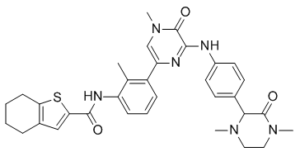
GDC-0834 Racemate is a novel, potent and selective BTK inhibitor with an in vitro IC50 of 5.9 and 6.4 nM in biochemical and cellular assays, respectively, and in vivo IC50 of 1.1 and 5.6 μM in mouse and rat, respectively. The development, differentiation, and proliferation of B-lineage cells depend on Bruton's tyrosine kinase (BTK), which makes it a desirable target for rheumatoid arthritis treatment. With IC(50) values of 5.9 and 6.4 nM in biochemical and cellular assays, respectively, and 1.1 and 5.6 μM in mouse and rat, respectively, in vivo, GDC-0834 suppressed BTK. GDC-0834 (30-100 mg/kg) was administered in a rat collagen-induced arthritis (CIA) model, and the reduction of morphologic pathology and ankle swelling occurred in a dose-dependent manner. Fitting ankle-diameter time-course data was an integrated pharmacokinetic/pharmacodynamic model of disease progression, where efficacy is driven by pBTK inhibition. In order to describe non-drug related reductions in ankle swelling that happen in CIA rats during later stages of the disease progression, this model included a transit model. The base model provided a good description of the time course of ankle swelling in vehicle animals. The data from the vehicle and GDC-0834-treated groups were fitted simultaneously, and the results indicated that a total of 73% inhibition of pBTK was required to cut in half the rate constant (k(in)) describing the increase in ankle swelling. These results imply that the pathway on inflammatory arthritis in rats requires a high level of pBTK inhibition for maximum activity.
Physicochemical Properties
| Molecular Formula | C33H36N6O3S |
| Molecular Weight | 596.7423 |
| Exact Mass | 596.256 |
| Elemental Analysis | C, 66.42; H, 6.08; N, 14.08; O, 8.04; S, 5.37 |
| CAS # | 1133432-46-8 |
| Related CAS # | GDC-0834;1133432-49-1;GDC-0834 S-enantiomer;1133432-50-4 |
| PubChem CID | 25235170 |
| Appearance | Light yellow to yellow solid powder |
| Density | 1.4±0.1 g/cm3 |
| Index of Refraction | 1.697 |
| LogP | 3.68 |
| Hydrogen Bond Donor Count | 2 |
| Hydrogen Bond Acceptor Count | 6 |
| Rotatable Bond Count | 6 |
| Heavy Atom Count | 43 |
| Complexity | 1140 |
| Defined Atom Stereocenter Count | 0 |
| SMILES | S1C(C(N([H])C2=C([H])C([H])=C([H])C(C3=C([H])N(C([H])([H])[H])C(C(=N3)N([H])C3C([H])=C([H])C(=C([H])C=3[H])C3([H])C(N(C([H])([H])[H])C([H])([H])C([H])([H])N3C([H])([H])[H])=O)=O)=C2C([H])([H])[H])=O)=C([H])C2=C1C([H])([H])C([H])([H])C([H])([H])C2([H])[H] |
| InChi Key | CDOOFZZILLRUQH-UHFFFAOYSA-N |
| InChi Code | InChI=1S/C33H36N6O3S/c1-20-24(9-7-10-25(20)36-31(40)28-18-22-8-5-6-11-27(22)43-28)26-19-39(4)33(42)30(35-26)34-23-14-12-21(13-15-23)29-32(41)38(3)17-16-37(29)2/h7,9-10,12-15,18-19,29H,5-6,8,11,16-17H2,1-4H3,(H,34,35)(H,36,40)1 |
| Chemical Name | N-[3-[6-[4-(1,4-dimethyl-3-oxopiperazin-2-yl)anilino]-4-methyl-5-oxopyrazin-2-yl]-2-methylphenyl]-4,5,6,7-tetrahydro-1-benzothiophene-2-carboxamide |
| Synonyms | GDC0834 racemate; GDC-0834; GDC-0834 Racemate; 1133432-46-8; GDC-0834 (Racemate); CHEMBL4162057; N-(3-(6-((4-(1,4-dimethyl-3-oxopiperazin-2-yl)phenyl)amino)-4-methyl-5-oxo-4,5-dihydropyrazin-2-yl)-2-methylphenyl)-4,5,6,7-tetrahydrobenzo[b]thiophene-2-carboxamide; N-[3-(6-{[4-(1,4-dimethyl-3-oxopiperazin-2-yl)phenyl]amino}-4-methyl-5-oxo-4,5-dihydropyrazin-2-yl)-2-methylphenyl]-4,5,6,7-tetrahydro-1-benzothiophene-2-carboxamide; N-[3-[6-[4-(1,4-dimethyl-3-oxopiperazin-2-yl)anilino]-4-methyl-5-oxopyrazin-2-yl]-2-methylphenyl]-4,5,6,7-tetrahydro-1-benzothiophene-2-carboxamide; C33H36N6O3S; GDC 0834 racemate; GDC 0834; GDC0834 |
| HS Tariff Code | 2934.99.9001 |
| Storage |
Powder-20°C 3 years 4°C 2 years In solvent -80°C 6 months -20°C 1 month |
| Shipping Condition | Room temperature (This product is stable at ambient temperature for a few days during ordinary shipping and time spent in Customs) |
Biological Activity
| Targets | Bruton’s tyrosine kinase (BTK) |
| ln Vitro |
1. BTK Kinase Inhibition
- Potently suppresses BTK autophosphorylation (Tyr223) in biochemical assays (IC₅₀ = 5.9 nM) and BCR-stimulated Ramos cells (IC₅₀ = 6.4 nM). Inhibition is reversible and dose-dependent, with a Hill slope of -0.84 ± 0.07 [1,5] 2. Selectivity - >100-fold selectivity over other kinases (e.g., JAK2, SYK, EGFR) at 1 μM concentration [3] 3. Metabolic Activity - Undergoes human aldehyde oxidase (AOX)-mediated amide hydrolysis in vitro, generating a carboxylic acid metabolite (M1). Km = 11.2 μM, Vmax = 1.8 nmol/min/mg (recombinant human AOX) [2] |
| ln Vivo |
1. Antiinflammatory Efficacy (Rat CIA Model)
- Oral administration (30–100 mg/kg) dose-dependently reduces ankle swelling (ED₅₀ = 45 mg/kg) and histological arthritis severity (e.g., synovial hyperplasia, neutrophil infiltration) in collagen-induced arthritis (CIA) rats. Maximal inhibition (70% reduction in swelling) at 100 mg/kg [1,3] - Correlates with BTK phosphorylation inhibition in peripheral blood mononuclear cells (PBMCs): ≥90% inhibition at 100 mg/kg (rat) [1] 2. Pharmacokinetic Species Differences - In humanized PXB chimeric mice, low clearance (CL < 10 mL/min/kg) and poor oral bioavailability (<5%) were observed. Plasma concentrations in humans (35–105 mg oral dose) were mostly undetectable (<1 ng/mL), likely due to rapid AOX-mediated hydrolysis [2] |
| Enzyme Assay |
- Biochemical Assay: Recombinant human BTK (10 nM) was incubated with ATP (10 μM) and GDC-0834 (0.01–1000 nM) in kinase buffer. Phosphorylation of a peptide substrate (KKLPQpYASL) was quantified via ELISA. IC₅₀ = 5.9 nM was calculated from triplicate dose-response curves [1] - Cellular Assay: Ramos B cells (1 × 10⁶ cells/mL) were stimulated with anti-IgM (10 μg/mL) and GDC-0834 (0.1–100 nM) for 15 min. Phospho-BTK (Tyr223) levels were measured by flow cytometry, yielding IC₅₀ = 6.4 nM [1] |
| Animal Protocol |
- Model: Male Lewis rats (180–200 g) induced with bovine type II collagen (CIA). Treated orally with GDC-0834 (30, 60, 100 mg/kg) or vehicle (0.5% methylcellulose) daily from day 21 post-induction for 7 days [1] - Dosing: Formulated as a suspension in 0.5% methylcellulose. Ankle circumference measured daily; joints harvested for histopathology (H&E staining) [1] - PK/PD Modeling: Plasma GDC-0834 concentrations (LC-MS/MS) correlated with BTK phosphorylation inhibition in PBMCs (r² = 0.89), establishing an EC₅₀ of 5.6 μM for in vivo efficacy [1] |
| ADME/Pharmacokinetics |
- Metabolism: Primarily metabolized by human AOX (not CYP enzymes) via amide hydrolysis to M1. Non-human species (monkey, dog, rat) show negligible hydrolysis, making them unsuitable for human PK prediction [2] - Clearance: In rats, CL = 25 mL/min/kg; in mice, CL = 18 mL/min/kg. Human clearance predicted to be higher due to robust AOX activity [2,3] - Oral Bioavailability: <5% in humans (likely due to first-pass metabolism), vs. 25% in rats [2] |
| Toxicity/Toxicokinetics |
- Safety Margin: No overt toxicity observed in rats at doses up to 200 mg/kg (10× therapeutic dose). Mild thrombocytopenia (platelet count ↓15%) noted at 100 mg/kg [1] - hERG Inhibition: No significant inhibition (>30%) at 10 μM, indicating low risk of QT interval prolongation [3] |
| References |
[1]. Antiarthritis effect of a novel Bruton's tyrosine kinase (BTK) inhibitor in rat collagen-induced arthritis and mechanism-based pharmacokinetic/pharmacodynamic modeling: relationships between inhibition of BTK phosphorylation and efficacy. J Pharmacol Exp Ther. 2011 Jul;338(1):154-63. [2]. Significant species difference in amide hydrolysis of GDC-0834, a novel potent and selective Bruton's tyrosine kinase inhibitor. Drug Metab Dispos. 2011 Oct;39(10):1840-9. |
| Additional Infomation |
- Mechanism: Competitive BTK inhibitor binding to the ATP pocket (crystal structure: PDB 5V9P). Blocks BCR signaling, reducing pro-inflammatory cytokine secretion (TNF-α, IL-6) [1,5] - Clinical Implication: Rapid progression to phase I trial despite poor human PK due to unmet need in autoimmune diseases. Limited systemic exposure in humans suggests topical or localized delivery may be needed [2,3] - Patent Status: Covered by WO2010037798A1 (2010), claiming BTK inhibitors for arthritis [3] |
Solubility Data
| Solubility (In Vitro) | DMSO: ~100 mg/mL (~167.6 mM) |
| Solubility (In Vivo) |
Solubility in Formulation 1: ≥ 2.5 mg/mL (4.19 mM) (saturation unknown) in 10% DMSO + 40% PEG300 +5% Tween-80 + 45% Saline (add these co-solvents sequentially from left to right, and one by one), clear solution. For example, if 1 mL of working solution is to be prepared, you can add 100 μL of 25.0 mg/mL clear DMSO stock solution to 400 μL PEG300 and mix evenly; then add 50 μL Tween-80 + to the above solution and mix evenly; then add 450 μL normal saline to adjust the volume to 1 mL. Preparation of saline: Dissolve 0.9 g of sodium chloride in 100 mL ddH₂ O to obtain a clear solution. (Please use freshly prepared in vivo formulations for optimal results.) |
| Preparing Stock Solutions | 1 mg | 5 mg | 10 mg | |
| 1 mM | 1.6758 mL | 8.3789 mL | 16.7577 mL | |
| 5 mM | 0.3352 mL | 1.6758 mL | 3.3515 mL | |
| 10 mM | 0.1676 mL | 0.8379 mL | 1.6758 mL |