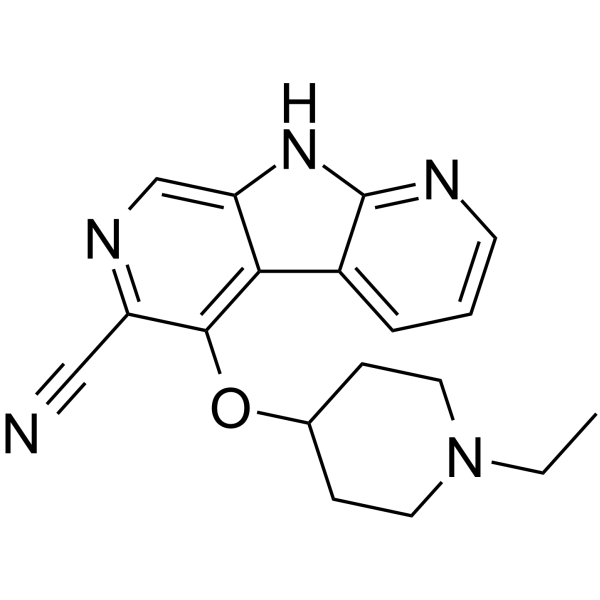
Physicochemical Properties
| Molecular Formula | C18H19N5O |
| Molecular Weight | 321.384 |
| Exact Mass | 321.158 |
| CAS # | 1200129-48-1 |
| PubChem CID | 58266779 |
| Appearance | Off-white to brown solid powder |
| Density | 1.3±0.1 g/cm3 |
| Boiling Point | 589.2±50.0 °C at 760 mmHg |
| Flash Point | 310.2±30.1 °C |
| Vapour Pressure | 0.0±1.7 mmHg at 25°C |
| Index of Refraction | 1.686 |
| LogP | 3.82 |
| Hydrogen Bond Donor Count | 1 |
| Hydrogen Bond Acceptor Count | 5 |
| Rotatable Bond Count | 3 |
| Heavy Atom Count | 24 |
| Complexity | 483 |
| Defined Atom Stereocenter Count | 0 |
| InChi Key | XEZLBMHDUXSICI-UHFFFAOYSA-N |
| InChi Code | InChI=1S/C18H19N5O/c1-2-23-8-5-12(6-9-23)24-17-14(10-19)21-11-15-16(17)13-4-3-7-20-18(13)22-15/h3-4,7,11-12H,2,5-6,8-9H2,1H3,(H,20,22) |
| Chemical Name | 3-(1-ethylpiperidin-4-yl)oxy-5,8,10-triazatricyclo[7.4.0.02,7]trideca-1(9),2,4,6,10,12-hexaene-4-carbonitrile |
| Synonyms | GDC 0425; GDC-0425; GDC0425 |
| HS Tariff Code | 2934.99.9001 |
| Storage |
Powder-20°C 3 years 4°C 2 years In solvent -80°C 6 months -20°C 1 month |
| Shipping Condition | Room temperature (This product is stable at ambient temperature for a few days during ordinary shipping and time spent in Customs) |
Biological Activity
| ln Vitro | Cells are considerably shielded from the decreased viability following GDC-0425 treatment by inhibiting MEK with medication inhibitors or RNAi-mediated gene silencing [3]. Chk1 becomes hyperphosphorylated after being treated with GDC-0425 (3 μM) for 24 hours [3]. |
| ln Vivo | Tumor development was partially inhibited by GDC-0425. In every model that was investigated, the gemcitabine/GDC-0425 combination produced a significant tumor regression [3]. |
| Cell Assay |
Cell Viability Assay[3] Cell Types: Chk1 Positive Breast Cancer Cell Line Tested Concentrations: 0.001, 0.01, 0.1, 1, 10 mM Incubation Duration: 72 hrs (hours) Experimental Results: diminished cell proliferation. Cell viability assay[3] Cell Types: U-2 OS Cell Tested Concentrations: 3 μM Incubation Duration: 24 hrs (hours) Experimental Results: Causes hyperphosphorylation of Chk1. |
| Animal Protocol |
Animal/Disease Models: NCr nude mice bearing osteosarcoma and triple-negative breast cancer model xenografts (143B PML BK TK, HCC1806 and HCC70 cell lines) [3] Doses: For 4-arm study, mice were treated with vehicle, gemcitabine 120 mg /kg, GDC-0425 75 mg/kg alone, or gemcitabine and GDC-0425 in combination for 15 days. For the 6-arm study in the HCC1806 and HCC70 models, mice were treated with vehicle alone, gemcitabine 120 mg/kg, GDC-0425 50 mg/kg, GDC-0425 75 mg/kg, or the combination of gemcitabine and GDC-0425. Route of Administration: Gemcitabine is administered orally 24, 48, and 72 hrs (hrs (hours)) after intraperitoneal (ip) injection. Experimental Results: Treatment with gemcitabine or GDC-0425 alone partially inhibited tumor growth. Notably, the gemcitabine/GDC-0425 combination resulted in significant tumor regression in all models tested. |
| References |
[1]. A supported liquid extraction LC-MS/MS method for determination of concentrations of GDC-0425, a small molecule Checkpoint kinase 1 inhibitor, in human plasma. Biomed Chromatogr. 2016 Dec;30(12):1984-1991. [2]. Phase I Study of GDC-0425, a Checkpoint Kinase 1 Inhibitor, in Combination with Gemcitabine in Patients with Refractory Solid Tumors. Clin Cancer Res. 2017 May 15;23(10):2423-2432. [3]. Ras-MEK Signaling Mediates a Critical Chk1-Dependent DNA Damage Response in Cancer Cells. Mol Cancer Ther. 2017 Apr;16(4):694-704. |
| Additional Infomation |
GDC-0425 is under investigation in clinical trial NCT01359696 (A Study Evaluating the Safety, Tolerability, and Pharmacokinetics of GDC-0425 Administered With and Without Gemcitabine in Patients With Refractory Solid Tumors or Lymphoma). Chk1 Inhibitor GDC-0425 is an orally bioavailable inhibitor of checkpoint kinase 1 (chk1), with potential antineoplastic and chemosensitization activities. Upon oral administration, chk1 inhibitor GDC-0425 selectively binds to chk1, thereby preventing activity of chk1 and abrogating the repair of damaged DNA. This may lead to an accumulation of damaged DNA, inhibition of cell cycle arrest, and induction of apoptosis. GDC-0425 may potentiate the cytotoxicity of DNA-damaging agents and reverse tumor cell resistance to chemotherapeutic agents. Chk1, an ATP-dependent serine/threonine kinase, mediates cell cycle checkpoint control, is essential for DNA repair, and plays a key role in resistance to chemotherapeutic agents. |
Solubility Data
| Solubility (In Vitro) | H2O : ~25 mg/mL (~77.79 mM) |
| Solubility (In Vivo) |
Note: Listed below are some common formulations that may be used to formulate products with low water solubility (e.g. < 1 mg/mL), you may test these formulations using a minute amount of products to avoid loss of samples. Injection Formulations (e.g. IP/IV/IM/SC) Injection Formulation 1: DMSO : Tween 80: Saline = 10 : 5 : 85 (i.e. 100 μL DMSO stock solution → 50 μL Tween 80 → 850 μL Saline) *Preparation of saline: Dissolve 0.9 g of sodium chloride in 100 mL ddH ₂ O to obtain a clear solution. Injection Formulation 2: DMSO : PEG300 :Tween 80 : Saline = 10 : 40 : 5 : 45 (i.e. 100 μL DMSO → 400 μLPEG300 → 50 μL Tween 80 → 450 μL Saline) Injection Formulation 3: DMSO : Corn oil = 10 : 90 (i.e. 100 μL DMSO → 900 μL Corn oil) Example: Take the Injection Formulation 3 (DMSO : Corn oil = 10 : 90) as an example, if 1 mL of 2.5 mg/mL working solution is to be prepared, you can take 100 μL 25 mg/mL DMSO stock solution and add to 900 μL corn oil, mix well to obtain a clear or suspension solution (2.5 mg/mL, ready for use in animals). Injection Formulation 4: DMSO : 20% SBE-β-CD in saline = 10 : 90 [i.e. 100 μL DMSO → 900 μL (20% SBE-β-CD in saline)] *Preparation of 20% SBE-β-CD in Saline (4°C,1 week): Dissolve 2 g SBE-β-CD in 10 mL saline to obtain a clear solution. Injection Formulation 5: 2-Hydroxypropyl-β-cyclodextrin : Saline = 50 : 50 (i.e. 500 μL 2-Hydroxypropyl-β-cyclodextrin → 500 μL Saline) Injection Formulation 6: DMSO : PEG300 : castor oil : Saline = 5 : 10 : 20 : 65 (i.e. 50 μL DMSO → 100 μLPEG300 → 200 μL castor oil → 650 μL Saline) Injection Formulation 7: Ethanol : Cremophor : Saline = 10: 10 : 80 (i.e. 100 μL Ethanol → 100 μL Cremophor → 800 μL Saline) Injection Formulation 8: Dissolve in Cremophor/Ethanol (50 : 50), then diluted by Saline Injection Formulation 9: EtOH : Corn oil = 10 : 90 (i.e. 100 μL EtOH → 900 μL Corn oil) Injection Formulation 10: EtOH : PEG300:Tween 80 : Saline = 10 : 40 : 5 : 45 (i.e. 100 μL EtOH → 400 μLPEG300 → 50 μL Tween 80 → 450 μL Saline) Oral Formulations Oral Formulation 1: Suspend in 0.5% CMC Na (carboxymethylcellulose sodium) Oral Formulation 2: Suspend in 0.5% Carboxymethyl cellulose Example: Take the Oral Formulation 1 (Suspend in 0.5% CMC Na) as an example, if 100 mL of 2.5 mg/mL working solution is to be prepared, you can first prepare 0.5% CMC Na solution by measuring 0.5 g CMC Na and dissolve it in 100 mL ddH2O to obtain a clear solution; then add 250 mg of the product to 100 mL 0.5% CMC Na solution, to make the suspension solution (2.5 mg/mL, ready for use in animals). Oral Formulation 3: Dissolved in PEG400 Oral Formulation 4: Suspend in 0.2% Carboxymethyl cellulose Oral Formulation 5: Dissolve in 0.25% Tween 80 and 0.5% Carboxymethyl cellulose Oral Formulation 6: Mixing with food powders Note: Please be aware that the above formulations are for reference only. InvivoChem strongly recommends customers to read literature methods/protocols carefully before determining which formulation you should use for in vivo studies, as different compounds have different solubility properties and have to be formulated differently. (Please use freshly prepared in vivo formulations for optimal results.) |
| Preparing Stock Solutions | 1 mg | 5 mg | 10 mg | |
| 1 mM | 3.1116 mL | 15.5579 mL | 31.1158 mL | |
| 5 mM | 0.6223 mL | 3.1116 mL | 6.2232 mL | |
| 10 mM | 0.3112 mL | 1.5558 mL | 3.1116 mL |