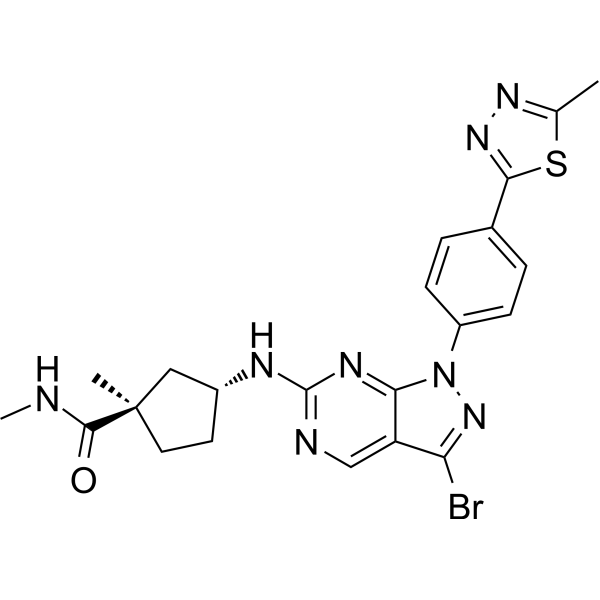
Physicochemical Properties
| Molecular Formula | C22H23BRN8OS |
| Molecular Weight | 527.440020799637 |
| Exact Mass | 526.089 |
| CAS # | 2396465-33-9 |
| PubChem CID | 147002269 |
| Appearance | White to off-white solid powder |
| LogP | 4.2 |
| Hydrogen Bond Donor Count | 2 |
| Hydrogen Bond Acceptor Count | 8 |
| Rotatable Bond Count | 5 |
| Heavy Atom Count | 33 |
| Complexity | 712 |
| Defined Atom Stereocenter Count | 2 |
| SMILES | [C@]1(C)(C(NC)=O)CC[C@@H](NC2=NC=C3C(Br)=NN(C4=CC=C(C5=NN=C(C)S5)C=C4)C3=N2)C1 |
| InChi Key | ASGMFNBUXDJWJJ-JLCFBVMHSA-N |
| InChi Code | InChI=1S/C22H23BrN8OS/c1-12-28-29-19(33-12)13-4-6-15(7-5-13)31-18-16(17(23)30-31)11-25-21(27-18)26-14-8-9-22(2,10-14)20(32)24-3/h4-7,11,14H,8-10H2,1-3H3,(H,24,32)(H,25,26,27)/t14-,22-/m1/s1 |
| Chemical Name | (1R,3R)-3-[[3-bromo-1-[4-(5-methyl-1,3,4-thiadiazol-2-yl)phenyl]pyrazolo[3,4-d]pyrimidin-6-yl]amino]-N,1-dimethylcyclopentane-1-carboxamide |
| HS Tariff Code | 2934.99.9001 |
| Storage |
Powder-20°C 3 years 4°C 2 years In solvent -80°C 6 months -20°C 1 month Note: Please store this product in a sealed and protected environment (e.g. under nitrogen), avoid exposure to moisture and light. |
| Shipping Condition | Room temperature (This product is stable at ambient temperature for a few days during ordinary shipping and time spent in Customs) |
Biological Activity
| Targets | IC50: 5 nM (GCN2)[1] |
| ln Vitro | T cell proliferation is restored and myeloid-derived suppressive cells (MDSC)-related T cell suppression is lessened by GCN2-IN-7 (600 nM; 3 d)[1]. |
| ln Vivo | At a suitable dosage, GCN2-IN-7 (oral gavage; 15 mg/kg; BID; 17 d) exhibits strong target engagement in vivo[1]. In the LL2 syngeneic mouse tumor model, GCN2-IN-7 (oral gavage; 50 mg/kg; BID; 17 d) suppresses tumor growth in vivo[1]. |
| Cell Assay |
Cell Proliferation Assay[1] Cell Types: CD8+ T cells from WT and GCN2KO cells Tested Concentrations: 600 nM Incubation Duration: 3 days Experimental Results: Relieved MDSC suppression of proliferation of the co-cultured CD8+ T cells with significant relief at 600 nM. |
| Animal Protocol |
Animal/Disease Models: balb/c (Bagg ALBino) mouse injected with RENCA cells[1] Doses: 15 mg/kg Route of Administration: Oral gavage; 15 mg/kg; BID; 17 days Experimental Results: demonstrated robust target engagement of GCN2 in both tumor (average of 84%) and spleen (average of 80%) tissues. demonstrated an average of 65% reduction of downstream marker Activation Transcription Factor 4 (ATF4) in compound-treated mice compared to the vehicle treatment group. Animal/Disease Models: LL2 syngeneic mouse model[1] Doses: 50 mg/kg Route of Administration: Oral gavage; 50 mg/kg; BID; 17 days Experimental Results: demonstrated tumor growth inhibition (56%) after 26 days of dosing compared to the vehicle group. |
| References |
[1]. Potent GCN2 Inhibitor Capable of Reversing MDSC-Driven T Cell Suppression Demonstrates In Vivo Efficacy as a Single Agent and in Combination with Anti-Angiogenesis Therapy. J Med Chem. 2022 Sep 20. |
Solubility Data
| Solubility (In Vitro) | DMSO: 50 mg/mL (94.80 mM) |
| Solubility (In Vivo) |
Solubility in Formulation 1: ≥ 2.5 mg/mL (4.74 mM) (saturation unknown) in 10% DMSO + 90% Corn Oil (add these co-solvents sequentially from left to right, and one by one), clear solution. For example, if 1 mL of working solution is to be prepared, you can add 100 μL of 25.0 mg/mL clear DMSO stock solution to 900 μL of corn oil and mix evenly. (Please use freshly prepared in vivo formulations for optimal results.) |
| Preparing Stock Solutions | 1 mg | 5 mg | 10 mg | |
| 1 mM | 1.8960 mL | 9.4798 mL | 18.9595 mL | |
| 5 mM | 0.3792 mL | 1.8960 mL | 3.7919 mL | |
| 10 mM | 0.1896 mL | 0.9480 mL | 1.8960 mL |